![The budget-friendly sampler from Casio showcased at NAMM is now up for preorder.]](https://backingtracksfullcollection.com/wp-content/uploads/2026/04/The-budget-friendly-sampler-from-Casio-showcased-at-NAMM-is-now-758x426.png "The budget-friendly sampler from Casio showcased at NAMM is now up for preorder.] 1")
One of the most unexpected products on display at this year’s NAMM Show was a brand new, playful-looking budget sampler from Casio that looked like it could become a serious rival to the popular Teenage Engineering EP-133 K.O. II.
Details were scarce on the show floor, but Casio has now officially unveiled the SXC-1 Sampler and made the instrument available for preorder in Japan. Priced at ¥39,930 (that’s around $250, but the US price will likely be higher) the SXC-1 is being pitched by Casio as an accessible and affordable sampler that “allows anyone to enjoy music production and performance”.
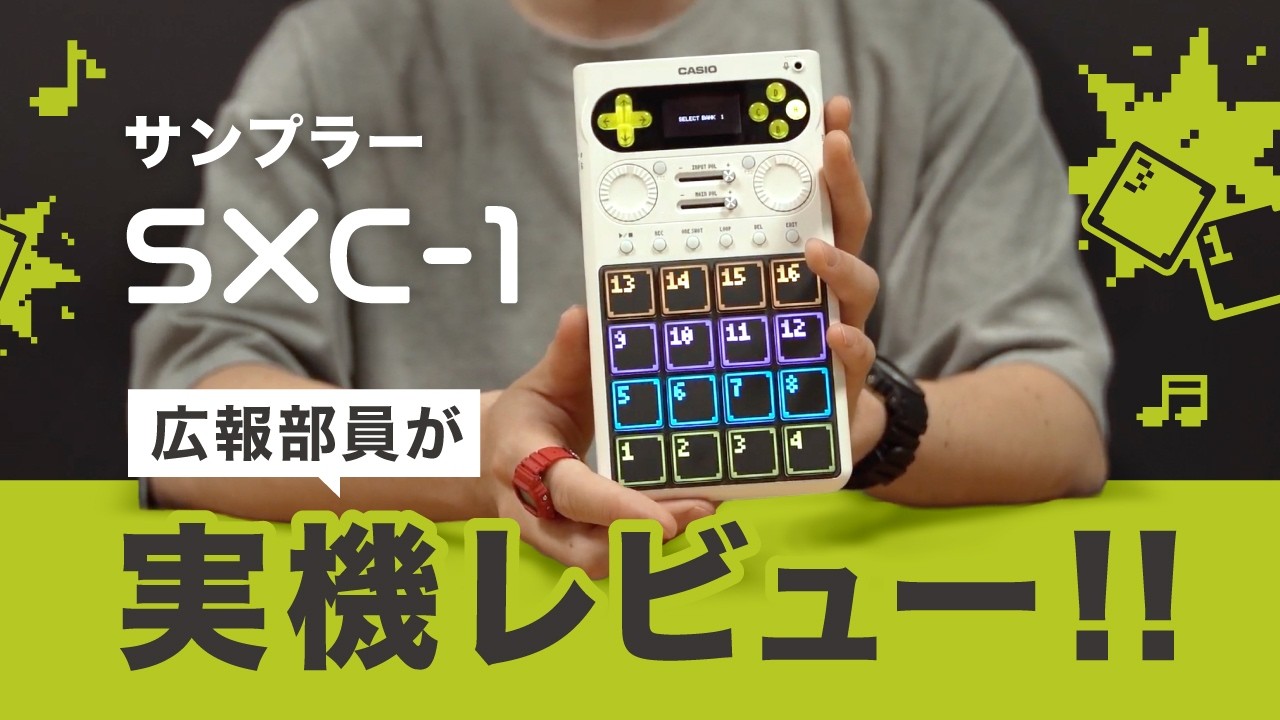
Looking like a colourful hybrid of a Game Boy, a calculator and a Roland SP-404, the SXC-1’s interface is dominated by a 4×4 grid of 16 backlit pads beneath a monochrome 1.3-inch OLED display. (We’re not yet sure if the pads are velocity- or pressure-sensitive.)
Article continues below
The most distinctive aspects of the hardware, though, are the D-pad and buttons on either side of the screen, which bring a fun and playful vibe that harks back to vintage video game consoles, and the two dials beneath. As well as scrolling through waveforms, these can be used to apply effects in real-time, with one dial accessing filter, flanger, phaser and bitcrusher and the other applying delay and four types of note roll.
SXC-1 is capable of 16-bit/48kHz sampling via its built-in microphone, USB audio or 3.5mm audio input, and it has 16 stereo voices with a maximum sample time of 15 minutes. There’s a decent amount of storage onboard (64GB) with space for 80 banks of 16 sounds, and it’s battery-powered with a built-in speaker, so it’s genuinely portable at only 315g. (Casio says you’ll get 1-2 hours of battery life on 4 AAAs).
SXC-1 can tempo-sync samples automatically thanks to its Beat Sync feature, which will time-stretch loops to match up with your project’s tempo. There’s a 16-track sequencer onboard, navigated via the D-pad, if you don’t want to record sequences live via the 16 pads. Sequences can only stretch up to 8 bars, but 50 can be stored in SXC-1’s memory, and sequencing and sound editing can also be done on your mobile device with a companion app.
I/O is a bit on the spartan side, with a headphone output, audio output and audio input on three 3.5mm jacks, and dual USB-C ports for power, MIDI and audio. Some will bemoan the lack of dedicated in/outs for MIDI and sync – especially considering the similarly-priced EP-133 has both – but the SXC-1 seems to be aimed more at beginner beatmakers than those likely to incorporate it into a broader set-up.
For many, the SXC-1 will bring to mind another budget sampler from Casio history, the SK-1 sampling keyboard, which was evidently a source of inspiration for the SXC-1. Casio has leant in to this association by stocking the SXC-1 with preset sounds from both the SK-1 and MT-40 (the vintage Casio that spawned the Sleng Teng riddim) in a 100MB library of loops and one-shots that the company says is primarily hip-hop-focused.
The budget sampler market has become hotly contested since Teenage Engineering’s $299 EP-11 K.O. II launched in 2023 and swiftly became ubiquitous, nudging other companies to follow suit – Akai has only recently thrown its hat in the ring with the $399 MPC Sample, and Casio’s SXC-1 looks set to shake things up even further.
Those devices are a little more versatile and full-featured than Casio’s offering, but the beginner-angled SXC-1 is smaller, lighter and should be cheaper than both of them, even if the US and EU prices end up getting a bump.
Casio SXC-1 is available now for preorder in Japan, but we’ve no word on when to expect an international launch. When we know more, so will you.
Find out more on Casio’s website or watch a demo video below.