![Jake Kiszka shares insights on his new Gibson SG signature guitar.]](https://backingtracksfullcollection.com/wp-content/uploads/2026/04/Jake-Kiszka-shares-insights-on-his-new-Gibson-SG-signature-758x426.jpg "Jake Kiszka shares insights on his new Gibson SG signature guitar.] 1")
For Jake Kiszka, the guitarist of the Grammy-winning Greta Van Fleet and his new project Mirador, the Gibson SG has long been his calling card. From the moment his father drove him to a guitar shop, a young Jake became obsessed with this devil-horned Gibson, and since then, he has gone on to make the model a key part of his sound and his identity.
Now, in partnership with Gibson, Kiszka has been bestowed the ultimate honor for guitarists: his very own signature model. It isn’t lost on him.
“I’ve known some of those guys, Mat Koehler and César [Gueikian], for quite some time,” he says. “It was basically them reaching out and asking if I’d like to do a signature model. Of course, I was interested, and I just became sort of obsessed with it. I’m quite elated by that. It’s quite the honor.”
Article continues below
The model also comes with a modified Sideways Vibrola, designed to give the look of the vintage trem arm, without any of the pesky tuning issues. The entire thing comes wrapped in a hardshell guitar case with a custom leather buckle strap that proudly displays Jake’s metallic coin pendant.
What is it about the SG specifically that keeps pulling you back compared to other guitars?
”You know, it’s a lot of things. The history with that guitar is something I was drawn to when I was really young. My first real guitar was an SG Standard.
”There’s always been an allure to it. A certain sensuality about the SG, as opposed to any other guitar, and specifically, Gibson.
“Outside of the history of it, it’s just sort of the sound of it. It’s always been an SG that has stood out to me, or captured my attention and inspired me in some way.”
As you say, there’s a certain mythology around the SG in rock music – especially in the style of music you play. How conscious are you of that legacy, and how do you deal with that baggage?
“Yeah, there is a lineage, if you will. But to me, in so many ways, I think doing the SG as a standard signature model with Gibson, it wasn’t necessarily going to be in the same configuration as some of these predecessors. There was going to be a sort of delineation in terms of design and approach to it.
”So, in some ways, yes, absolutely, I’m conscious of it. But at the same time, there was going to be an innovation. This is an early ’60s SG or ‘Les G,’ if you will – the SG Les Paul.
”When Gibson called and said, ‘Would you like to do a signature model?’ I was like, ‘Yeah, I would be up for it, but it really depends on what the approach is going to be.’
”What inspired me was to take my number one, The Beloved, and work with Gibson to reinvent it in modern terms. Historically inspired nuances of the original, and then the modifications – it’s the evolution of what it could be in terms of design and approach.”
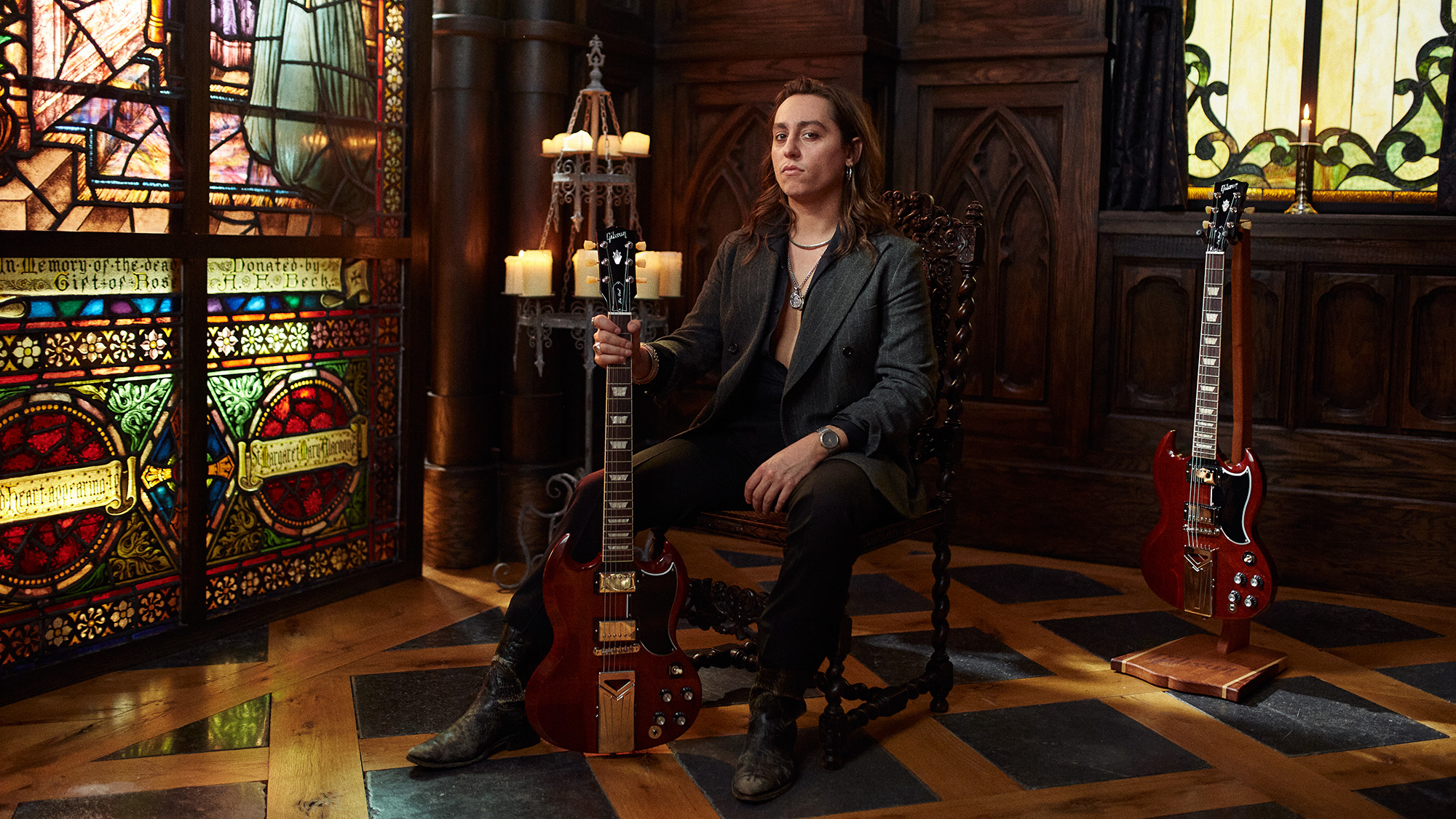
Your SG has become an extension of you. Can you remember when you got your first SG and realised this was “your” guitar?
”Yeah, absolutely. I began playing guitar quite young, but it was acoustic. My father was adamant that if I were to learn guitar, I would familiarize myself with the basics of guitar on an acoustic. Obviously, in some ways, things are more practical on an acoustic guitar.
”So I’d obviously wanted an electric for a long time, probably not too dissimilarly from other kids wanting to be Jimi Hendrix and turn the volume and the gain all the way to 15 or something, and he wouldn’t allow it. But as time went on, I guess I proved myself.
”He took me to Saginaw, Michigan, where there was a guitar shop, and I was immediately drawn to this SG. I played everything, and he wasn’t gonna let on that he was going to buy me a guitar. I think he was just taking me so I could play around with everything.
”We’d gone back a few times, and I was just continually drawn to this SG. I think it was the weight of it. The physical weight of it and the look of it. I suppose, at that period of time, I wasn’t as familiar with guitars, and the details and specifications of them, but I think it was the look and the feel and the sensuality that sort of led me down that path to begin with.”
When you started working with Gibson, what were the absolute non-negotiables – the things that had to be right or it wouldn’t have your name on it?
Those early ’60s SGs were notable for, well, just being completely unfunctional. So it’s like, how do we evolve it?
”The lacquer is very thin; it’s a thin layer so that it intentionally ages and cracks over time. They’re intended to actually distress. That was a really big part of the objective. Also, the slimness of the neck. It was like, how thin could Gibson go without the liability of it snapping and stuff – the neck is as thin as humanly possible. That was the goal, and we got it quite slim. So we worked quite closely with them to refine those details.
”Then there’s the T-Types, which I think just sounded better in terms of the pickups. Obviously, the original has PAFs, but the idea was what improvements could be made.
“I suppose, lastly, and significantly, is the sideways trem bar. Those early ’60s SGs were notable for, well, just being completely unfunctional [laughs]. So it’s like, how do we evolve it? In this sense, how do we make something that’s sort of like tactical or more practical in a sense, but it still serves a function in terms of design? We’ll just block it off. Take the functionality out of it, and it just looks quite good.
“It’s always suspended, as a suspended bridge, which changes some of the sustain, but Gibson completely re-machined that entire part, taking the arm off and taking the functionality of it away. Which is great. I think that was a major Improvement.”
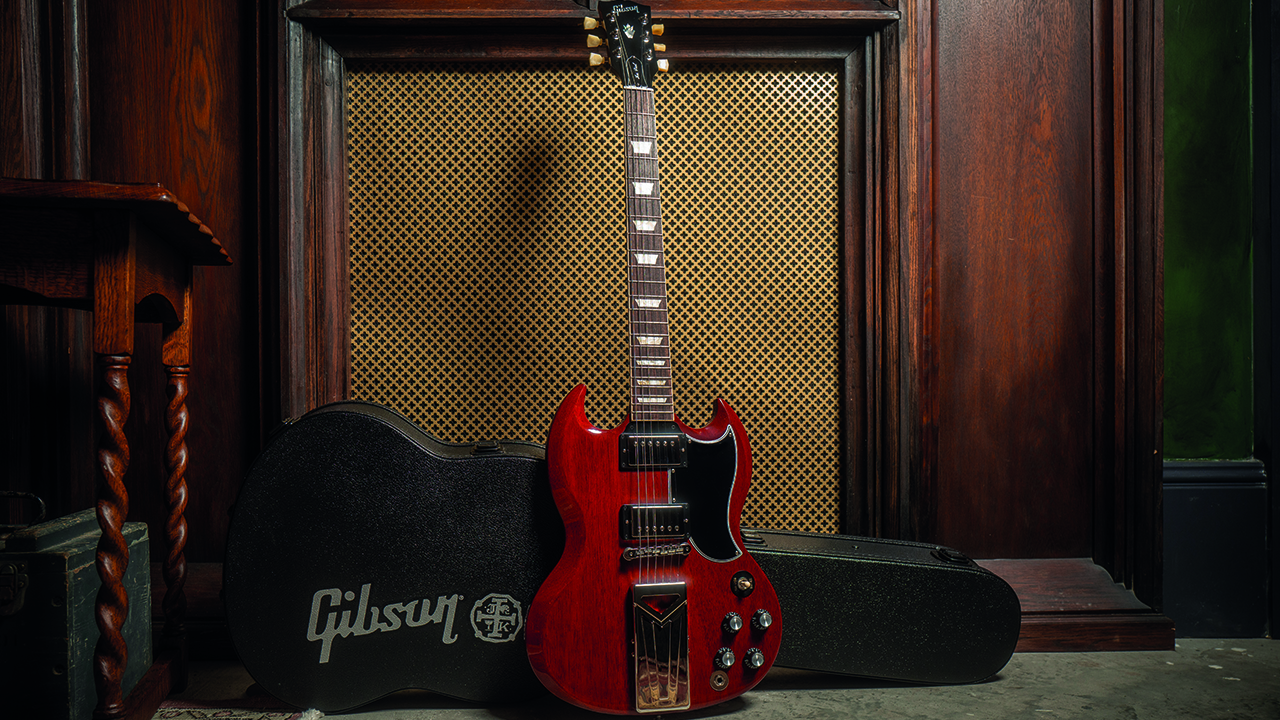
Have you been road-testing this signature guitar, and how does it compare to your number one?
”Somewhat. I mean, with my project Mirador, I was out on the road last year, and I was sort of in the process of designing the guitar, and Gibson was sending me prototypes. I was comparing them in some ways, at least in soundchecks, to my number one, which I know quite well, so it was like a control group, if you will. It was trying to get as close to the original as possible.
“It was quite triumphant because of the way the guitar sounds and feels; it has almost drawn me closer to wanting to play the original in some ways, which is interesting.”
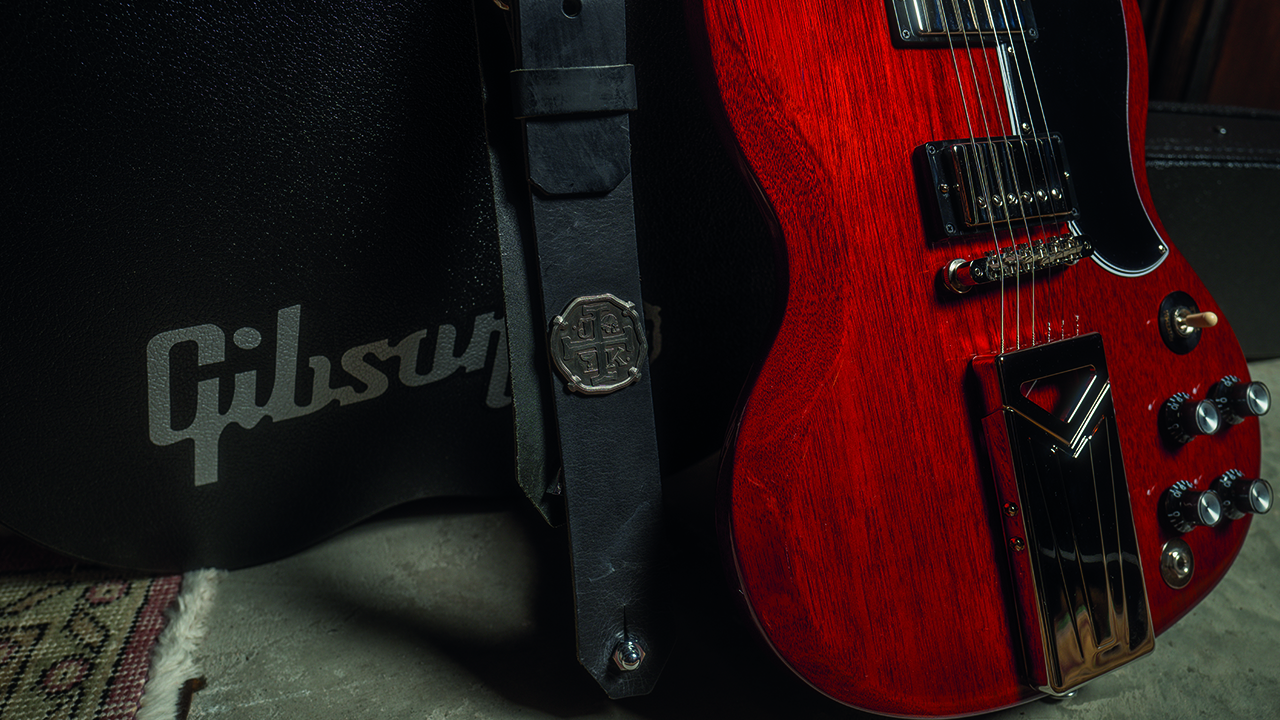
When someone plugs in your signature SG for the first time, what do you hope they feel or discover about themselves as a player?
”A wave of inspiration and influence. The modus operandi of the entire project was to try to create something that inspires people and moves them.
”Ultimately, I would like people to find their own voice in it and be able to play it. Find the inspiration that the young kid version of myself found in my first SG.”
Speaking of inspiring younger players, can we expect a more affordable Epiphone version in the future?
”As time goes on, I’d love to do an Epiphone version of it. To be able to create something that’s at a price point that’s realistic. I think down in the timeline, it would definitely make sense.
“Initially, the idea was actually to create this as an Epiphone, but I think Gibson was really keen on creating something that was from the USA factory, which shows in the quality of this guitar and its presence sonically.”
- The Gibson USA Jake Kiszka SG Standard is available now for $2,499. Head over to Gibson.com for more information.