!["Think You're Getting a Discount? You’ll Pay the Full $150 Instead: Important Considerations Before Choosing a Rent-to-Own Music Tech Purchase"]](https://backingtracksfullcollection.com/wp-content/uploads/2026/05/Think-Youre-Getting-a-Discount-Youll-Pay-the-Full-150-758x426.png "\"Think You're Getting a Discount? You’ll Pay the Full $150 Instead: Important Considerations Before Choosing a Rent-to-Own Music Tech Purchase\"] 1")
In 2023, plugin developer Minimal Audio got into hot water when it announced that its new synthesizer, Current, would only be available through a subscription. The backlash was immediate and ferocious. Minimal Audio reversed its decision, making the instrument available for outright purchase or via a rent-to-own scheme instead, a decision that was greeted with nearly unanimous praise.
Software subscriptions remain frustratingly common in the music industry. While they can offer easy access to instruments and effects, they can also come bundled with all sorts of additional problems, not least of which is that you never actually own the product you’re paying for.
Rent-to-own, on the other hand, is seen as the more logical alternative. You’re still getting the benefit of access without having to pay the entire amount upfront, but you also get to keep the plugin at the end of the rental period.
Article continues below
However, it’s not always so cut and dry. The saying ‘too good to be true’ exists for a reason, and even though rent-to-own (hereafter RTO) is generally better than a subscription, it is still not without its own pitfalls.
Before we go any further, it could be helpful to define the model.
Rather than pay for a plugin entirely upfront to receive a perpetual license, you lease it from the developer or a third-party reseller and pay it off in monthly instalments. Once you have completed the payments, the leaser then transfers the license to you and you fully own it as you would if you had bought it in one lump sum.
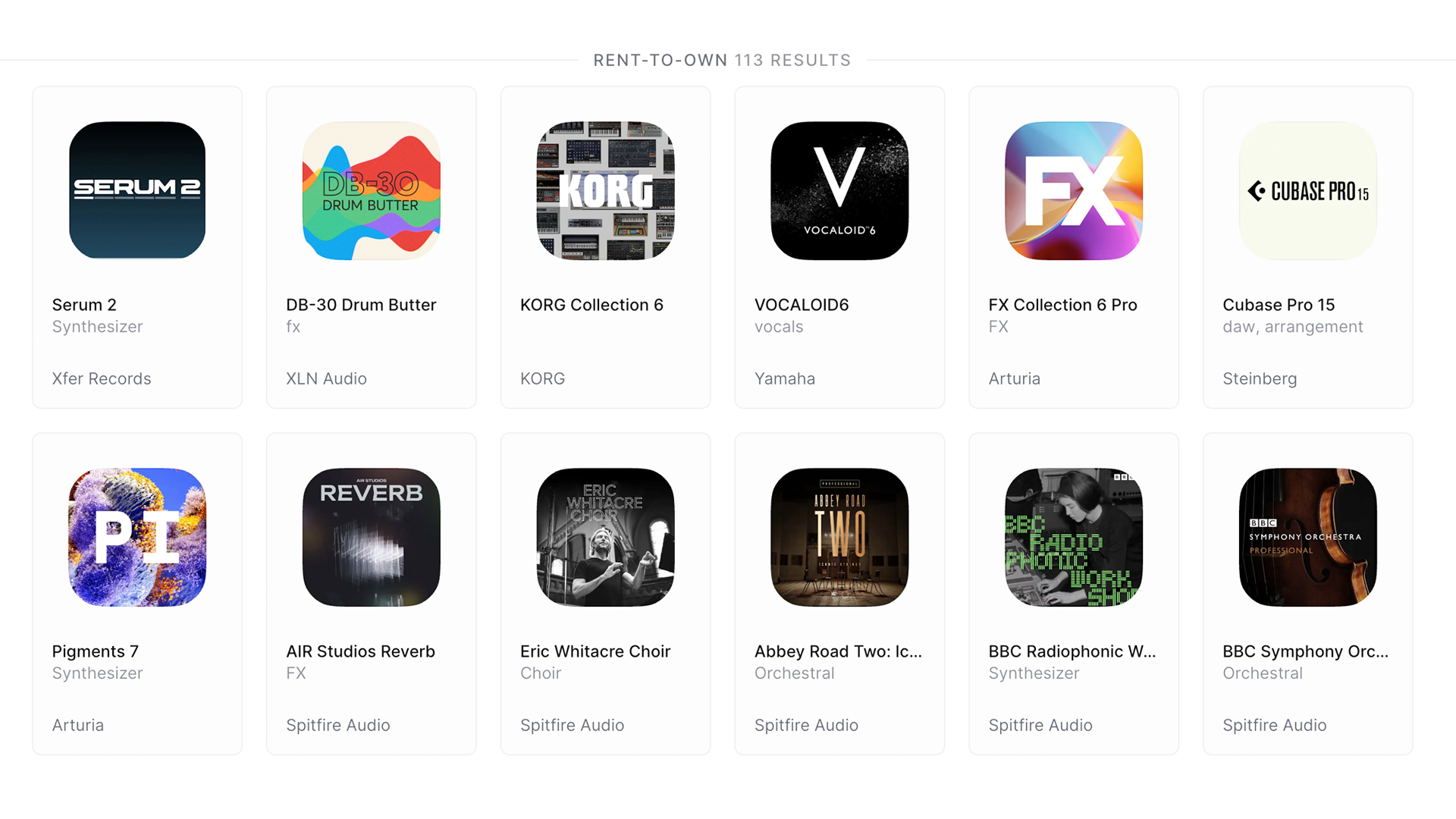
One of the first high-profile RTO agreements was between sample-provider Splice and Xfer Records, the developer of the uber-popular soft synth, Serum. Splice continues to offer RTO options for products, passing your payments on to the developer rather than acting like a bank and buying the license on your behalf.
Third-party retailer Plugin Boutique is also in the RTO business, as are more and developers, such as Ableton, who recently made not only new purchases of Live 12 available in this way but also now upgrades as well.
While RTO is certainly convenient, especially when buying expensive items like DAWs that may be impossible to afford outright, they are not without their dangers, as we shall see…
Here are seven points to keep in mind before entering into an RTO agreement. You might be surprised by some of these.
1. Say goodbye to sale discounts
When you buy a plugin via RTO, it’s true that you generally don’t pay more than the standard list price. You pay in monthly instalments at a rate that is the total price divided by the number of months.
While this is convenient, and may seem like a deal, that total amount will never be lower than list price.
What happens if the plugin goes on sale, such as during November when it’s common practice to offer deep discounts for Black Friday? Nothing happens. You still pay full price.
In other words, when buying RTO, you cannot take advantage of a sale.
“(Developers) make their money by never giving you a sale price,” notes Reddit user ‘HooksNHaunts’, “Say you pay for a plugin that is $150 but it’s on sale everywhere for $75. You don’t get the sale price. You’re still gonna pay the full $150 through the rent-to-own process.”
‘Kirk_Bananahammock’, also on Reddit, makes a similar point in a thread called Is Serum’s Rent-to-Own on Splice a Scam? “Plugins often go on sale, so you might have paid $100 towards the plugin, only to find the plugin on sale somewhere else at a discount and you could have paid less overall if you had waited.”
Upgrade pricing could also be affected when paying RTO. In general, software companies will grant you a discount on an upgraded version of a plugin when you already own an earlier revision. If you’re still paying it off via RTO, however, you don’t technically own it yet, and so may not be eligible for the upgrade.
Splice, for its part, will allow you to move up to the new version – but you’ll still have to continue paying for the original plugin on top of the latest one, adding time to your payment contract – and disqualifying you from any sales pricing in the meantime.

2. Beware impulse buying
When you only see the monthly payment price and not the total amount, impulse buying can become a real danger. “When people pay for things monthly, the first payment is what they see in their heads (in terms of) what is owed,” musician Jon Salichs tells us, who has experience leasing plugins. “So they might go crazy” buying things they don’t need”, he adds. “Why stop at Serum when you could also get Arturia’s Pigments 7, or Current, or Massive X from Native Instruments? Or indeed all of them?”
Splice also offers bundles via RTO, with multiple titles included for a discounted total price. But do you really need both of those plugins or are you pulling the trigger just because the monthly payment is tantalisingly low?
Arturia’s V Collection Pro is $699 new, an eye-wateringly large amount. But when broken down into instalments, it’s only $24.99 per month. But do you really need everything in that package?
“I got a combo so it was more expensive,” explains Jon. “You could, for example, rent-to-own only the latest Ozone instead of getting Ozone and Neutron in a pack for more money. Maybe you don’t need everything in that combo. Consider what you need.”
3. Subscription creep can happen here too
In much the same way that’s it’s easy to buy too much at a time, you could also end up with more RTO plans than you can afford to pay.
In the modern landscape of subscriptions being the norm, this is often referred to as ‘subscription creep’. In much the same way that you can end up with too many streamers like Netflix and Amazon Prime, you could find yourself with hundreds of dollars worth of payments per month to companies for RTO instruments and effects. It can all start to add up…

4. You have to be online
Much like with subscriptions, leasing outfits need a way to verify the plugin is authorised to use.
This is generally done online, and often through a third-party app that needs to be open and connected to the internet, such as the Splice app. While remembering to open the application at the beginning of a session can be cumbersome, for some having to be connected to the internet at all is a push too far.
“I personally don’t care for the ‘log-in daily’ thing, as sometimes I have my machines offline for several days,” says KVR Audio commenter Shabahbriah.
Some producers opt to work on perpetually offline computers. For them, this system would be impossible.
5. You can’t resell your license
While this danger is less common than others, it’s quite possible that even after you finish paying off your license, you’ll be forbidden from reselling it.
Every developer has their own rules about transferring licenses, with many turning into NFRs (Not For Resale) after one ownership change.
This can also be true when buying via RTO, with the license becoming an NFR after completing payment. You may technically own it – but you’re still not free to transfer it to someone else.
In response to the question, “If the developer normally allows for (a) product to be license-transferred, does that still hold?” on KVR, user ‘riddim83’ discovered that at least one company doesn’t allow resales: “It’s definitely not normal licenses across the board, as D16 (Group) licenses become NFR.”
This will not affect all producers, as many do not resell plugins anyway. Says Jon Salichs, “I’ve never sold any software. Though there might be a way, I just don’t do it.”
6. If a problem arises, who do you deal with?
Any RTO agreement will have to involve some amount of DRM and authentication, and with those additional hoops to jump through, something could go wrong. If you’re leasing directly from the developer, you would reach out to their customer service department (and hopefully they’ll get back to you in a timely manner).
But when dealing with a third-party, who do you contact? the leaser or the plugin company?
This is exactly what happened to Reddit user ‘ChildShapedMan’ when paying for Serum through Splice. “I went to use Serum today and it came up with the license expired error message,” they wrote. “I followed all of the troubleshooting I could and nothing helped. I’ve emailed the support team and they are saying they can’t see any plan on my account. I have emailed them my receipts and proof of payment for the last two transactions but (I am) currently waiting for their reply…”
Other Redditors had also had issues, and some recommended contacting Xfer Records directly, while others suggested signing in and out of the Splice app and website. While this is admittedly an older issue, with no recent similar comments appearing when performing searches, the fact remains that technology has a way of breaking, and when you’re stuck in the middle of a session with not one but two companies to deal with, it can be frustrating to say the least.
7. If you can’t make payments, you’re locked out
The biggest and most catastrophic issue is, of course, that, much like with a subscription, if you can’t make payments, you’re forbidden from using the software.
In the middle of a session? Too bad. Finally got the vocalist in the studio after months of waiting? Sucks to be you.
The good news is, however, you’ll able to pick up where you left off with no penalties when you can start making payments again.
“If you pause your membership before you’ve paid it off you’ll lose access to it,” notes Reddit user ‘Poop Fandango’ “But you don’t lose your progress towards paying it off. That will pick up from where you left off if you start paying again.”
However, lack of penalty or no, if you can’t pay, you can’t play. You could, of course, employ an alternative instrument or effect in the session.
“Probably that did happen,” Jon says when asked if he had any trouble in the studio when he paused payments. “But in that case, I (used) an alternative plugin. It wasn’t really a problem for me because I know other ways to achieve the same effect. But it might be for someone who doesn’t.”
This solution, of course, won’t work if the software that you’re leasing is not an instrument but a DAW like Bitwig or Ableton Live!

Ultimately, paying for music software through a rent-to-own scheme can admittedly, be a convenient and affordable way to get access to instruments and effects that you might normally not be able to use.
But it makes the most sense for plugins that tend to not go on sale and don’t charge for updates, like Xfer Records’ Serum.
However, you should still use your common sense when signing up and be aware of the prospective pitfalls we’ve highlighted here.
Make sure that you read the terms and conditions and understand what you’re getting into – and what will happen if you can’t continue to pay.
Nothing would be worse than opening up a session, ready to work, and finding that you can’t access an important instrument because your credit card was declined.