![Mike Stringer's Tutorial: Mastering Spiritbox's "Holy Roller"]](https://backingtracksfullcollection.com/wp-content/uploads/2026/05/Mike-Stringers-Tutorial-Mastering-Spiritboxs-Holy-Roller-758x426.jpg "Mike Stringer's Tutorial: Mastering Spiritbox's \"Holy Roller\"] 1")
A key element in many of the riffs I write is rhythmic string bending. A good example of this can be found in the main riff to Holy Roller, which I recorded with Spiritbox for our 2021 album, Eternal Blue.
Figure 1 illustrates the main riff to Holy Roller, which I play during the intro and outro. The first six bars are performed entirely on the 7th string and feature repeating pull-down bends and releases.
Article continues below
I begin in bar 1 with two unbent eighth notes at the 12th and 9th frets, followed in beats 2 and 3 by two quick ¾-step bends and releases at the 13th fret, phrased in a 16th-note rhythm. The bar ends with a return to the unbent notes.
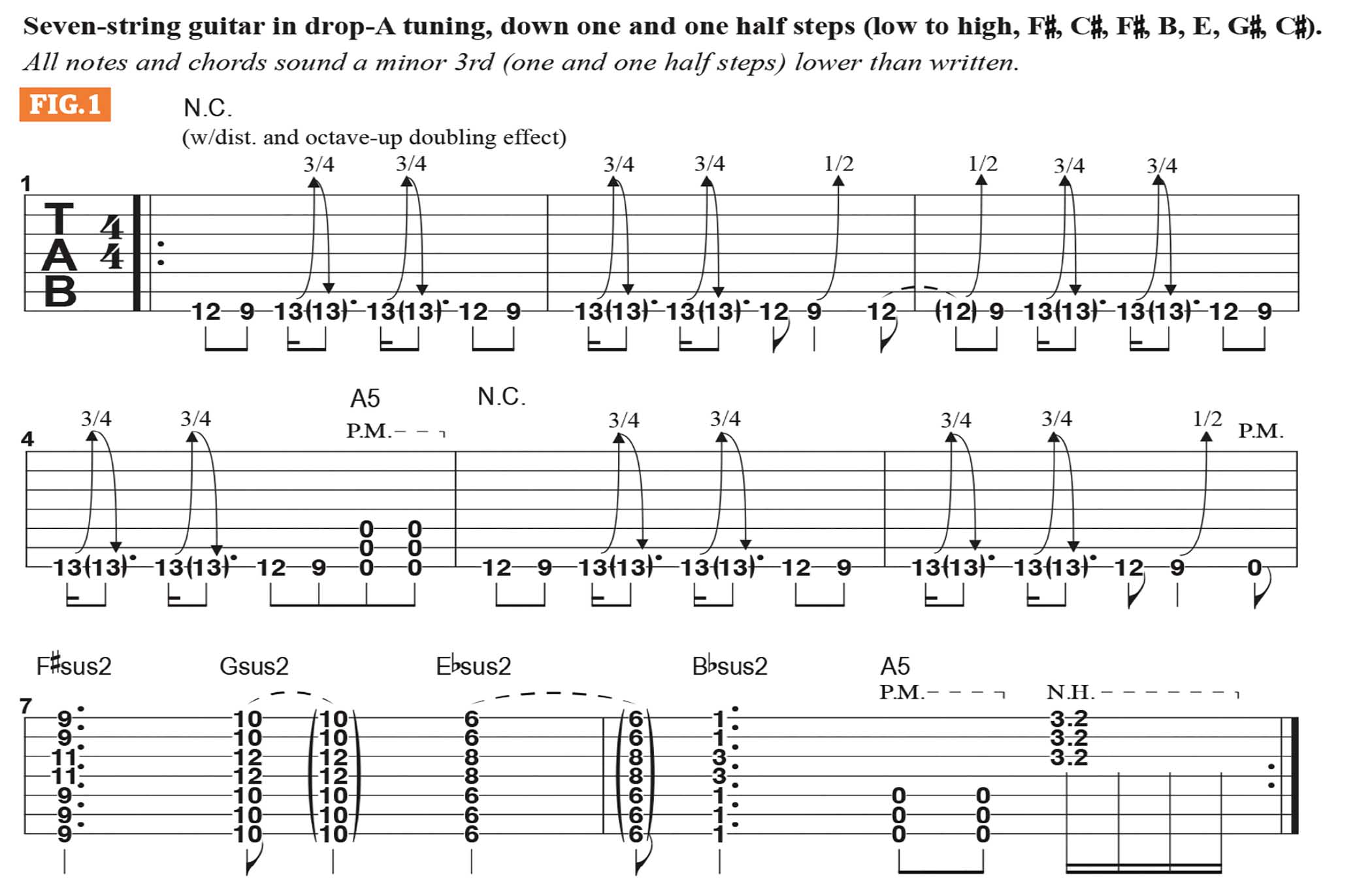
Syncopation (emphasizing the upbeats, or “weak” parts of the beat) comes into play in bar 2, where, on beat 3, I bend the 9th-fret note up a half step and hold the bend into beat 4. The final note in bar 2 is tied (held over) to the beat 1 of bar 3, which creates more syncopation, then bent up a half step. Bars 3 and 4 mostly replicate bars 1 and 2, but bar 4 ends with a pair of palm-muted eighth notes on an open A5 chord.
Bars 5 and 6 essentially restate bars 1 and 2, after which I play a big F#sus2 barre chord across all seven strings, which I shift up and down the neck in a syncopated dotted-eighth rhythm, holding each chord for one and one half beats, which, when done in succession like this, creates a jarring effect.
The riff ends with another pair of palm-muted open A5 chords, followed by high natural harmonics (N.H.) chords on the top three strings, strummed as 16th notes with alternate (down-up) strumming.
To sound the harmonics, lightly rest your fret-hand pinkie across the top three strings at the “3.2” location indicated, which is a little ways past the 3rd fret.
As is the case with many of the riffs I write, without the added bends, this riff would sound a little stale and boring. When performing the 13th-fret bends here, strive to consistently raise the pitch 3/4 of a step, which is midway between a half step (equal to one fret) and a whole step (equal to two frets).
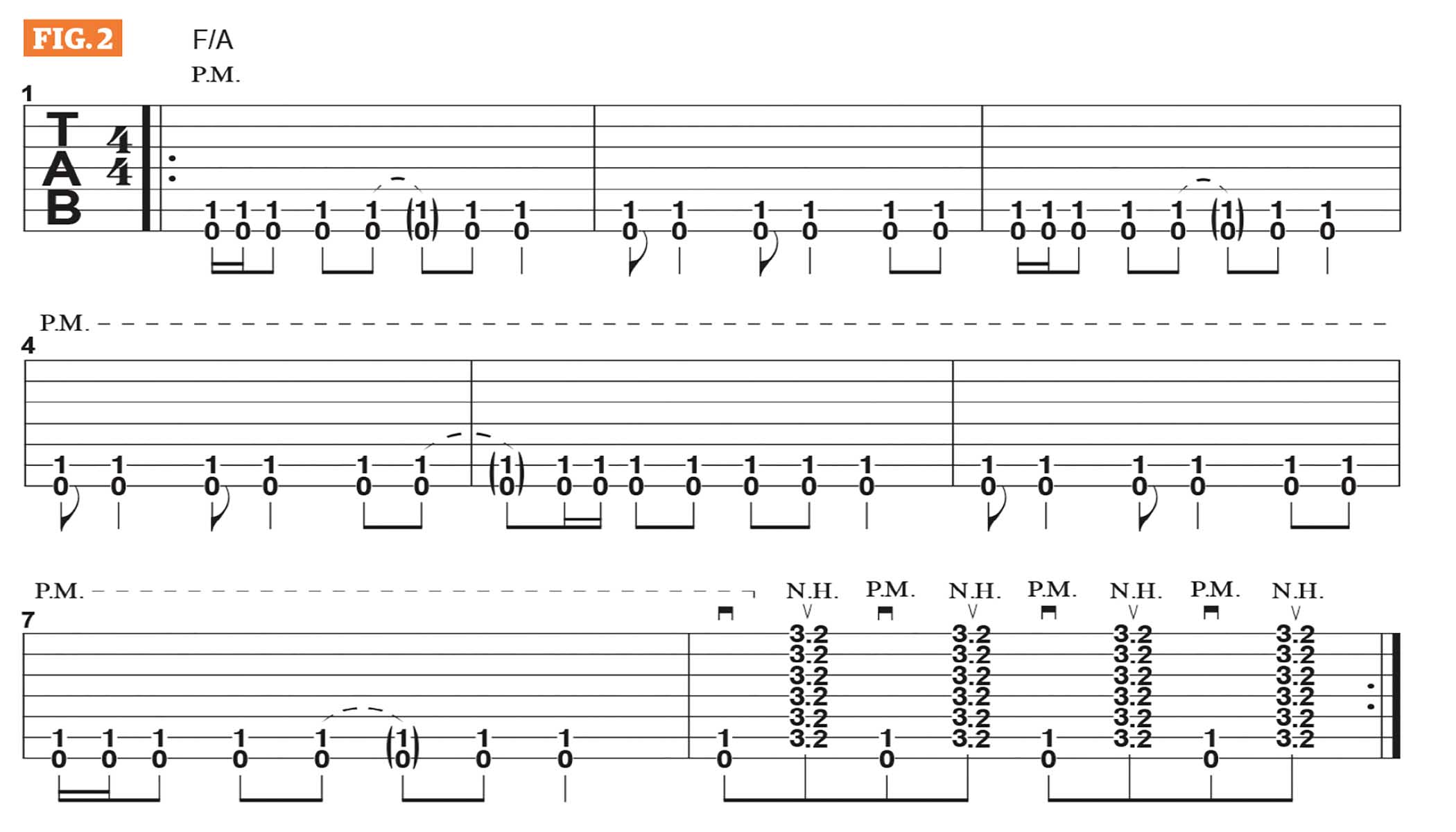
Figure 2 shows the song’s breakdown verse riff, which is built from a two-note F/A chord played on the bottom two strings and strummed in a syncopated rhythm with palm-muting (P.M.). I use all downstrokes here, except for the pairs of 16th notes, which are strummed down-up.
The syncopation is created by accentuating certain eighth-note upbeats (the “and” counts) and holding the chord into the following downbeat. To properly feel and internalize the phrasing, play through the figure while tapping your foot squarely on each beat. Start out slowly then gradually ramp up the tempo to that of the recording.
In bar 8, I play “3.2” natural harmonics again, this time across the top six strings. I strum the harmonics with upstrokes on each eighth-note upbeat. The key to getting the desired sharp pick attack here is to get a little bit of the flesh of your thumb into the strum. Doing so will also help bring out the harmonics.