
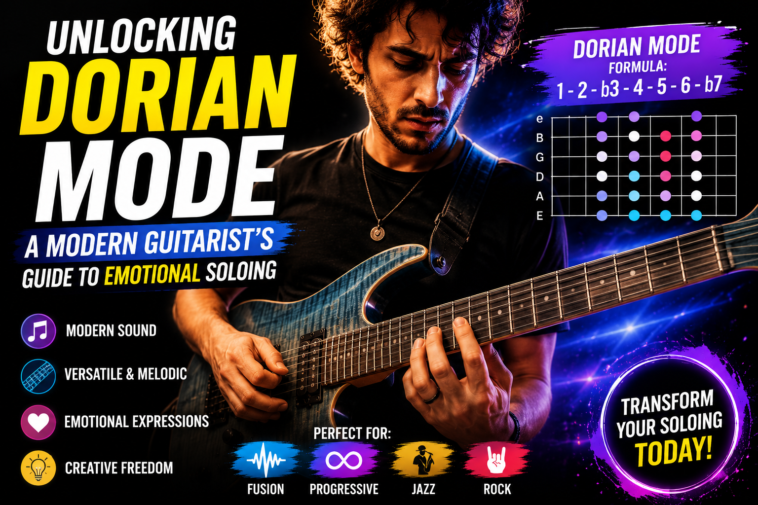
Unlocking the Dorian Mode: A Modern Guitarist’s Guide to Emotional Soloing
As a guitarist navigating the wide landscape of musical expression, the search for emotional depth in your solos can feel like an endless journey. The Dorian mode, often regarded as one of the most versatile scales, is a gem waiting to be uncovered. It’s a gateway to rich, soulful improvisation that can elevate your sound from simple licks to heart-stirring melodies. So, grab your guitar and let’s dive deep into the world of the Dorian mode and how it can enhance your creativity.
Understanding the Dorian Mode
Before we dig into practical applications, let’s break down what the Dorian mode actually is. At its core, the Dorian mode is the second mode of the major scale. It has a unique interval structure: whole, half, whole, whole, whole, half, whole. If we take a look at the D Dorian scale, we get D, E, F, G, A, B, and C.
Why Dorian?
The reason many musicians are drawn to the Dorian mode is its characteristic sound: it’s both minor and slightly brighter than a standard minor scale due to its major sixth. This gives it a perfect emotional balance—ideal for both melancholy and uplifting solos.
Practical Application: Dorian in Your Playing
1. Improvisation Tips
When improvising in Dorian, start by creating a melodic motif using the notes of the scale. Play around with rhythmic variations to give your phrases their own identity. For example, if you start with D, try emphasizing C and E before resolving back to D. This rhythmic play can help you unlock emotional nuances in your playing.
Exercise: Set a metronome to a moderate tempo (around 80 bpm). On a loop, practice improvising over a Dm7 chord, focusing on creating a simple melodic motif and varying its rhythm.
2. Scale Suggestions
While the Dorian scale itself is powerful, embellishing it can add even more texture. Try integrating the Dorian b7 (also known as the half-whole scale) which introduces a flat seventh note. This can be particularly effective in jazz or fusion contexts.
A fun exercise is to alternate between the Dorian scale and its b7 counterpart; cyclical transitions like this can spark new ideas. Practice moving between D Dorian and D Dorian b7 on the same progression, paying attention to how each note changes the mood.
3. Phrasing Concepts
One of the most challenging but rewarding aspects of guitar playing is phrasing. Dorian offers so much room for expression in this department. Think about how you can use bends, slides, and hammer-ons to emphasize key notes, particularly the major sixth.
Tip: For emotional impact, try a slow bend on the B note. Hold it until the listener feels that tension, then resolve it melodically. Create a story in your solo—bring the listener on a ride alongside you.
Fusion Guitar Techniques
4. Adding Chromaticism
The beauty of fusion guitar lies in its complexity. One way to infuse your Dorian playing with a modern edge is to incorporate chromatic approaches. By adding notes that are half steps away from those in the Dorian scale, you create tension and release, keeping your solos fresh.
Example:
From D to Eb, back to D, then leap to E, crafting a chromatic run can prepare the ears for the beauty of the Dorian sound.
5. Layering Textures
In modern fusion, layering textures can create a lush soundscape. Experiment with effects pedals like delay and reverb to expand your notes beyond just single lines. Recording multiple guitar tracks—one leading, one responding, and one providing harmonic background—can add depth to your Dorian explorations.
Practice Idea: Use looping pedals to create layers of Dorian riffs. This way, you can concentrate on your improvisation over a thick, textured backdrop.
Modern Guitar Theory Insights
6. The I-IV Progression
To craft emotional Dorian solos, try playing over a I-IV chord progression. In D Dorian, this would be Dm7 to G7. This classic progression beautifully sets up the Dorian sound, allowing those rich harmonics to shine.
Play around with extensions like 9ths and 11ths on the chords, which can create room for lush, jazzy solos.
7. Modal Interchange
To expand your tonal palette, introduce modal interchange. Switch your backing chords between Dorian and other modes like Aeolian or Mixolydian during a solo break. It creates dynamic shifts and emotional highs and lows.
8. Understanding the Emotional Palette
Dorian’s inherent emotional depth allows us to express complex feelings. Try connecting with your own emotional experiences when improvising. Use the scale not just as a technical exercise, but as a means of translating your feelings into notes.
When you find yourself playing in Dorian, think about what you want your listeners to feel: joy, nostalgia, longing. Allow yourself to improvise without a strict roadmap, and see where the emotional exploration takes you.
Tone and Recording Tips
9. Crafting the Perfect Tone
With the Dorian mode in mind, your tone plays a crucial role. A slightly overdriven sound can help you cut through the mix while retaining warmth. Consider using a clean amp setting with a touch of overdrive, coupled with a smooth delay for atmospheric depth.
10. Recording Techniques
When recording your Dorian solos, try to think outside the box. Layer multiple takes, experimenting with different dynamics and tones. You can bring out the emotional core of your solo by emphasizing various notes in different takes—perhaps one with a bright tone and another more subdued, creating contrast.
11. Experiment with Backing Tracks
To really hone your skills in Dorian improvisation, utilize backing tracks. Using backing tracks allows you to focus on your phrasing and emotional expression without worrying about chord changes.
For those passionate about creating rich textures while developing improvisational skills, check out premium guitar backing tracks available at music.backingtracksfullcollection.com/guitar-players. These tracks can provide a solid foundation upon which to practice your Dorian skills, encouraging you to explore the emotional spectrum of your playing.
Conclusion: Evoke Emotion Through Your Dorian Journeys
Unlocking the Dorian mode offers a wealth of emotional possibilities for the passionate guitarist. Through improvisation, phrasing, and a modern appreciation of fusion techniques, Dorian can transform a simple solo into an emotional journey. Remember to experiment, let go of the need for perfection, and embrace the organic nature of music. Your own experiences will flow through your solos, and that is where the magic truly happens.
So pick up that guitar, feel the music, and let the Dorian mode guide you on an adventure of emotional expression. Enjoy the ride!