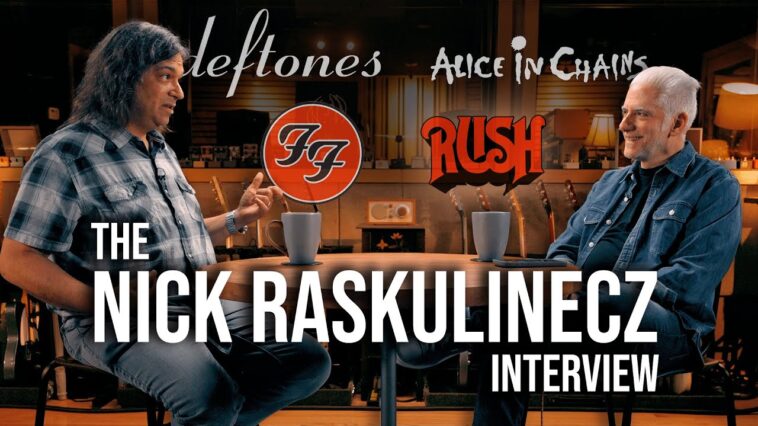
Few legacy bands can boast final albums as strong as Rush’s Snakes & Arrows and Clockwork Angels. The one-two of modern prog gems saw them bowing out of their recording career in style, but beyond their long-playing epics and extra-heavy guitar sounds, there was a surprise reunion happening behind the scenes.
The band had teamed up with producer Nick Raskulinecz after 2002’s lukewarm Vapor Trails, and for 2007’s Snakes & Arrows, they descended on Grandmaster Studios in Los Angeles.
Raskulinecz, who has also worked with Foo Fighters, Alice in Chains, and Deftones, was eager to tap into the spirit of old-school Rush on albums. Lifeson adopted an acoustic-guitar-first approach after a chat with David Gilmour on Snakes…, and then, in 2012’s Clockwork Angels, the band returned to their concept album format, as heard on their cosmic song suite “2112”.
“As a Rush fan, I know what kind of record I wanted Rush to make, and I had a pretty good idea of what the other Rush fans wanted, too,” Raskulinecz told Rick Beato last year.
Their relationship, he says, began with a cold open: an ambitious Raskulinecz emailed the group to “see if they’d be interested in working with some young American kid,” but by then they’d already started working with someone else. Weeks later, that partnership had soured, and the door was opened to him.
For Raskulinecz, tapping into the vintage Rush sound meant rekindling the flames of one of their most important pieces of gear in the 1970s and early ’80s. Then the strangest coincidence happened.
As Rush embraced a new, synth-powered era in the 1980s, bassist and vocalist Geddy Lee embraced the Moog Taurus pedals, a foot-controlled synth, as he looked to juggle playing several instruments at once.
“Taurus opened up so many possibilities for me, and it opened up this way of looking at what I do,” he told Moog in 2012. “Originally, I started to use it to fill out the bass when I played rhythm guitar on my double-neck guitar; I didn’t want to lose the sound of the bass. But they also had the ability to create other synth-y sounds, so we started playing around with that on songs like ‘Xanadu’ to add more melody in our music. It set us on a whole tangent.”
But after 1982’s Signals, they fell out of favor in Rush’s studio experiments. Fast forward 30 years, and those pedals were embedded in Raskulinecz’s mind.
“When you hear them come in, it adds a low-end bump, but [when I suggested using Taurus pedals on Clockwork Angels], they didn’t have any,” he reveals. “We had to rent Taurus pedals from a Toronto rental company. We get them shipped, and they’re their pedals.
“Geddy’s down on the floor looking at them, and he’s like, ‘That’s our modded switch,’ because he had a mute mod switch on his. So, we rented the pedals they used on the old albums and tours.

“The band were psyched,” he adds. “Those were elements that I was able to bring to the table, not to rip off or copy, but for it to feel [like Rush]. Just like on Clockwork Angels, we homage ‘Bastille Day’, ‘Anthem’, and like four or five other songs on parts because I’m like, ‘Dudes, don’t be scared to do that. Those are your riffs!”
Speaking to MusicRadar in 2012, Raskulinecz noted that, for Clockwork Angels, they swapped from “the original T-1s that they had in the ‘70s” to the newer T-3s.
“Let me tell you,” he beamed, “the new version kicks ass!”

As the band continues their highly anticipated reunion tour – which has recently hit a series of minor setbacks – Lee isn’t ruling out writing more music together. But they have to survive the tour first, though.
Elsewhere, guitarist Alex Lifeson has reflected on why he chose Gibsons over PRS during a crucial moment in his career.
![Array]](https://backingtracksfullcollection.com/wp-content/uploads/2026/05/Array.svg.svg+xml "“I’m probably gonna get 150 guitarists telling me how I’m doing this wrong, but this is just what works for me. My ’board is a hot mess”: Samantha Fish on finally meeting her fans’ demands and why the SG is the one 27")