
![Array]](https://backingtracksfullcollection.com/wp-content/uploads/2026/05/Array.svg.svg+xml "“It’s like if you found out Harry Potter’s scar wasn’t from battling Voldemort but done under anesthetic on Harley Street”: The case for and against guitar relicing 18")
The introduction of relic stickers has reignited the debate on faux-damaged instruments. But why do some players find the concept of relics so, ahem, distressing? Answering that very question – through the medium of a snarky sort-of-interview – it’s this week’s Fret Buzz.
I’m new to relicing. Give me the elevator pitch?
Box-fresh, squeaky-clean, unblemished, and virginal are fine for a Jonas Brother. But what if your guitar could imply you’ve spent the past decade gigging a Deep South dive bar, swatting Hell’s Angels during set breaks, with a wildcat stripper named Candy stubbing Lucky Strikes on your scratchplate after your nightly lovemaking?

Yes. I want people to have that impression of me.
Trouble is, that kind of lifestyle wears you down. Alcoholism. Gonorrhoea. Country ’n’ western. Hence the rise of guitar relicing: an entire art and science dedicated to making your Tele look like Keith Richards’ kneecaps.
How did relicing start, anyway?
Back in the ’80s, repair men realized that putting fresh parts on vintage guitars was like jamming Simon Cowell’s veneers into the mouth of a mummified corpse from a Mesolithic peat bog. The industry sprang up from that first soiled hardware.
All the latest guitar news, interviews, lessons, reviews, deals and more, direct to your inbox!
I’m sorry, but how is relicing different to vandalism?
Think of it more as willing sadomasochism. These days, guitarists will pay a premium for a good thrashing from a middle-aged carpenter named Kenny.
Hey, whatever your kink. Is there a relicing godfather I should know about?
Most people would cite Tom Murphy, boss and namesake of Gibson’s Murphy Lab. This man is the opposite of a plastic surgeon. An hour on his workbench would turn Harry Styles into Willie Nelson.

Is the Murphy Lab an actual laboratory?
More like a state-of-the-art torture chamber. They’ve got revolutionary lacquer formulations. Cutting-edge cooling chambers. Thermally aged soundboards. But Tom and the team get medieval too, using car keys and railroad spikes. The results are stunning – but controversial.
What’s the problem?
There’s a school of thought that players should earn their scrapes and dings. Take Rory Gallagher’s ’61 Strat…
Oh yeah. That thing looks like it spent the weekend on Miami Beach with no sunscreen.
That’s a good, honest flaying, right there. No cooling chambers in 1970s Ireland.
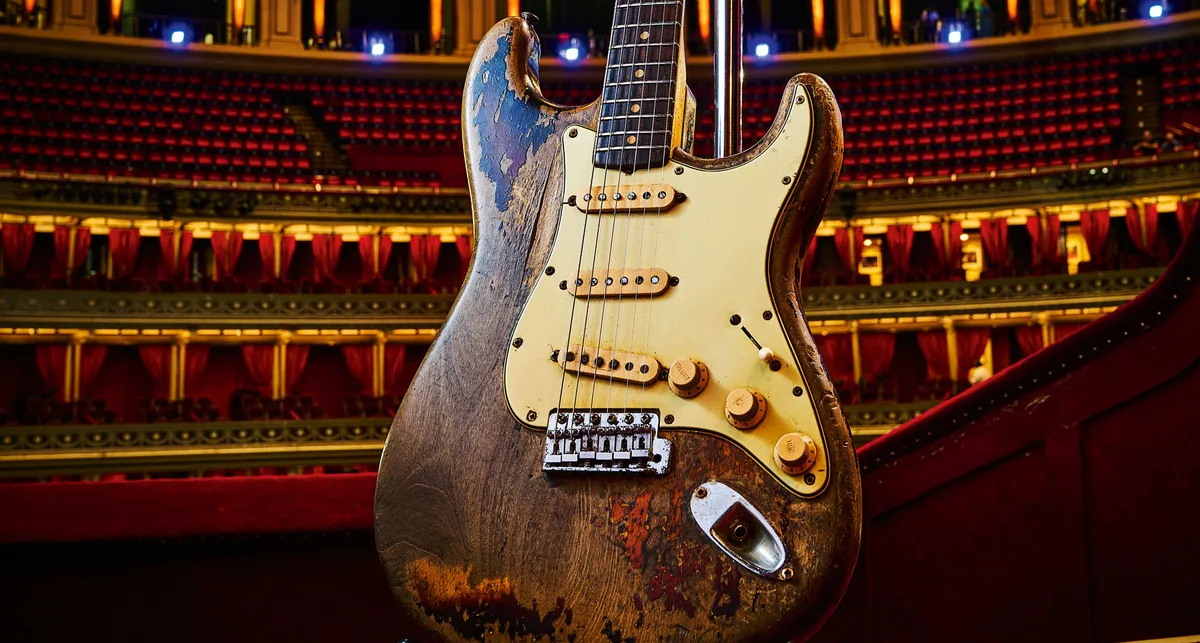
So this is about authenticity?
Yeah. It’s like if you found out Harry Potter’s scar wasn’t from battling Voldemort but done under anesthetic on Harley Street. Or that Henry Rollins’ Search & Destroy tattoo was actually one of those stick ’n’ peel jobs your mom applies with a wet sponge.
How about the defense for relicing?
As Murphy reminded Guitar World last year, relicing is more than skin-deep, with the Lab’s fretboard-rolling process giving the feel of a played-in classic. It’s also a feasible way to take a ‘vintage’ instrument out on the road. As for the looks, the only thing that’s aged better is Michelle Pfeiffer.
Maybe it’s time for an older model. How much is a Murphy Lab guitar?
Prices start around $5,600 for a 1957 Goldtop Reissue (Ultra Light Aged).
Christ! What’s next? Pay someone to scratch my car, smash my windows, and defecate on my lawn?!
Well, maybe you’d prefer those relic stickers we mentioned (yours for $6.20).
No. That’s the most pathetic thing I’ve ever heard of.
Fine. Then go at it with a cheese grater. Start holding band practice in a sauna. Or simply pop your Strat in the Stones’ dressing room – three hours should take your finish from Olympic White to Cancerous Lung.