![Array]](https://backingtracksfullcollection.com/wp-content/uploads/2026/05/Array.svg.svg+xml "Simon McBride on Deep Purple’s new golden age of heavy 18")
Simon McBride has been with Deep Purple for almost four years now, but it was hard for him to believe initially.
“During the first year, whenever I’d see my name attached to Deep Purple, I just couldn’t make the connection in my brain,” he tells Guitarist. That feeling carried into McBride’s first record with the band, 2024’s =1, but listening to Deep Purple’s latest record, Splat! (which, for those keeping score, is the band’s 24th studio album), you can tell McBride has properly settled in.
“The big thing for me is that things sound powerful,” he continues. “It’s about everybody playing in unison: like, ‘This is a freight train coming at you.’ Ritchie [Blackmore] and Jon Lord had that, and Steve Morse and Don [Airey] had it to a certain extent. Steve is a great player, but he’s a different sort of player, so that was a big thing for me – to get that big, powerful sound.

“I have a lot of amps, but for most of the Purple stuff I use my live rig, which is the [Neural DSP] Quad Cortex. I can hear a lot of Ritchie Blackmore fans crying out, going, ‘No! He’s using digital stuff!’ But it’s brilliant.”
Fans and critics alike are calling this the band’s heaviest record in decades – with echoes of Purple’s early ‘70s output.
“Everyone is in good form and we’re looking forward to doing [more of] what we love. These guys have been doing this since the ‘60s non-stop, so it does mean a lot [to play alongside them]. I just get on with it, but my name is attached to Deep Purple’s legacy now, which is a great achievement. I’m proud of that.”
Splat! is touted as Purple’s heaviest record in ages. What sent you in that direction?
All the latest guitar news, interviews, lessons, reviews, deals and more, direct to your inbox!
There wasn’t any sort of board meeting: you put the five of us in a room and that’s what came of it. A lot of people say it’s heavy like old Deep Purple, and my background is that ’80s hard-rock thing, so I guess that contributed to it. What you hear came from the first writing session.
There was no intention of making this like an early Deep Purple record, like Machine Head. If you go into it with that attitude, you’ll just come up with a load of shit [laughs]. We just went into a room and started jamming and having fun.
We’re at a stage now – especially with me being the ‘new guy’ in the band – where we’re very relaxed around each other and comfortable. There’s a clear difference between this record and my first record [with the band], = 1. With the first record, there was a lot of pressure that I put on myself to try and make it fucking brilliant [laughs]. But with this one, I didn’t really give a shit. I was like, “Just play and we’ll see what happens.”
What gear discoveries have you come across since joining Deep Purple?
I had to change my sound a bit because you’re dealing with Don Airey, who plays keys, the Hammond and Leslie, and a Marshall head and cabinet. He’s in a very similar frequency range to guitar, so I had to figure something out to make the guitar sound more powerful.
So I was talking to the guys at Engl, who made Steve Morse’s signature amp – it has too many buttons for me, but it’s a great head. Engl gave me an Artist Edition head and I asked them to tweak it and put a lot more power in the lower mids and low-end.
I knew the Leslie and Hammond didn’t have that, so that could be my little space and would cut through but also make me sound powerful when we play a riff together.
Are you still mainly relying on PRS guitars?
This guitar is like an animal. It’s hard to control because there’s so much natural sustain
Yes. I played everything on this record with a prototype from PRS. The idea is that there’s no truss rod. It goes back to the early days when guitars had no truss rods because I’m a firm believer that if you put a truss rod in a guitar, it sucks the tone and sustain out of it.
This guitar is like an animal. It’s hard to control because there’s so much natural sustain, and I don’t do high-output pickups. Acoustically, there’s such a difference without the truss rod. [The neck] must be the strongest piece of wood they could find because it doesn’t bend at all.
When we were in the studio, [producer] Bob Ezrin was recording and I changed to a different guitar. Within five seconds, he stopped the tape and said, “There’s something wrong…” I said, “I changed the guitar…” Bob said, “I don’t like it. Give me the other one back.” It’s such a versatile-sounding guitar. It’s not for public release yet; Paul [Reed Smith]’s been working on it.
Aside from that, I could get started on pedals, but we’ll be here all day…
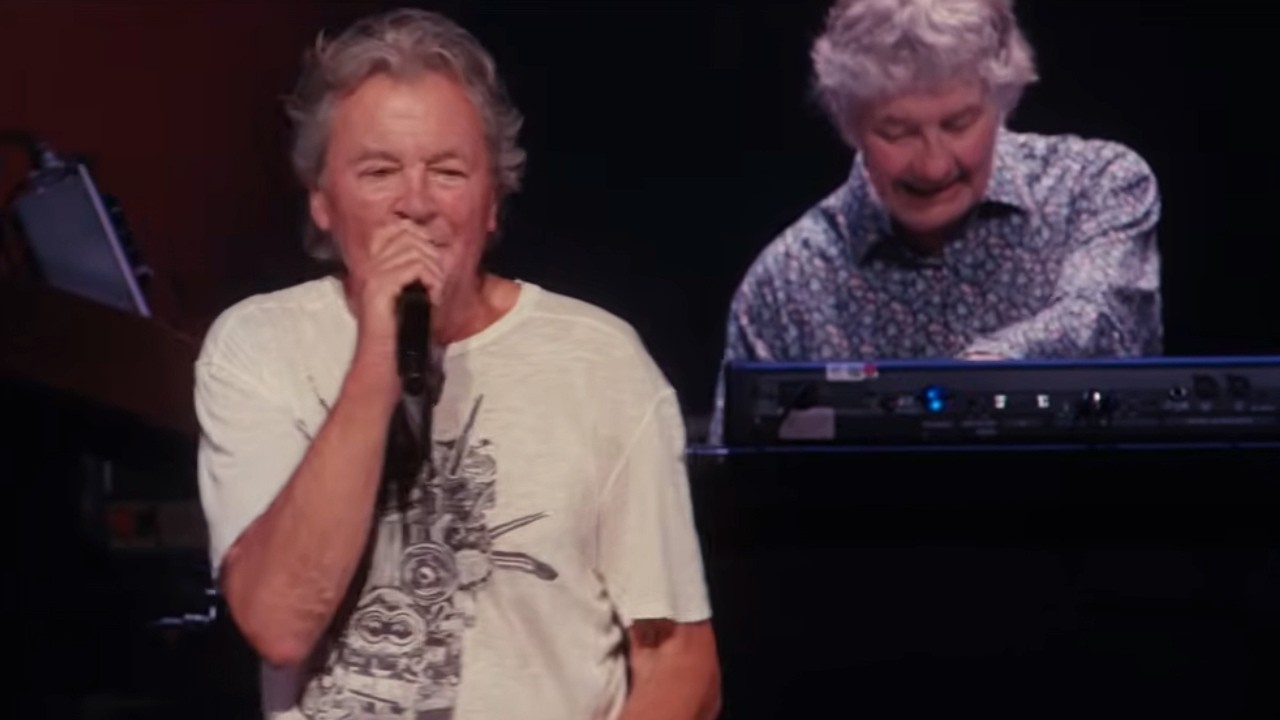
![Deep Purple [l-r]: Ian Paice, Don Airey, Roger Glover, Ian Gillan, and Simon McBride.](https://cdn.mos.cms.futurecdn.net/qnjKvpNSsNm3bMMxuGfBDm-1200-80.jpg.webp "Simon McBride on Deep Purple’s new golden age of heavy 22")
Oh, please do.
I use the same sound for rhythm and lead. The only difference is that I put a line booster on; I use a Jam Pedal called a Boomster, strictly for clean boost. I use a lot of Boss delays and reverbs, and I have an old [MXR] Phase 90.
But the most interesting thing – and this is something that not a lot of people would expect Purple to be using – is a DigiTech Ricochet. It’s like a Whammy pedal but an automatic one. I use that for crazy stuff, for little splashes of color here and there.
When I’m writing riffs, I always try to keep them simple. Once you overcomplicate stuff, you lose that drive and excitement
What’s the story behind the opening track, Arrogant Boy?
That song started when we played live, and I did my little guitar solo in the middle of the gig – I do this really fast alternate picking to get the crowd going. In the studio I started that, Don joined in and all of a sudden the main riff for Arrogant Boy appeared.
I remember Roger [Glover] telling me that Highway Star was kind of the same thing. But I love Arrogant Boy, it’s really self‑indulgent instrumental stuff from Don and me!
How about Diablo?
That started when Don and I were playing around. I think Don wrote the initial riff on keyboard and when it came to the verse section, that’s where I started playing this simple pattern. When I’m writing riffs, I always try to keep them simple. Once you overcomplicate stuff, you lose that drive and excitement.
How did Keith Urban end up on the track?
The studio we recorded in was owned by Keith [in Nashville], and we said to him, “Why don’t you play a guest solo on one of the tracks?” Keith was well up for doing it, so he worked out a solo section. I remember on one of Steve Lukather’s records, he, Steve Stevens, and Jan Hammer did this round-about of solos and I thought that was cool. I thought, ‘Let’s have that here with the two guitarists and the keyboards,’ and it worked out pretty well.
Keith has a different sound to me. He has more of an older, kind of vintage vibe. Once [Ian] Gillan put the vocal on it, it turned into a real song. Because with all these songs, they’re all instrumentals in my head until I hear the final mix.
What’s your personal favorite guitar moment on Splat!?
Probably Jessica’s Bra. Don’t ask me why it’s titled that [laugh.] I think it was supposed to be Jessica’s Bar, but it got switched around and Gillan loved that, so we kept it. I’d forgotten to do a solo while I was in Nashville with the band. I got home and Bob Ezrin had emailed me, saying, “You need to do a solo…”
I don’t know what possessed me, but I played all this different stuff that I never would have done, like tapping and sliding, and I think that’s because I listened to the whole song with words. That inspired me.
What’s next for you and Deep Purple?
With Purple, there’s talk of another record, so we won’t stop. This year, we’re on tour until December and we have another 86 shows. And next year, we have shows booked as well, so it’s pretty busy. It’s going to stop one day and that will be it. But at the moment, we’ll just keep going and doing what we love, which is writing and playing music.
As for my own thing, I’ve just finished an instrumental record that’s about to be mixed, so it’ll probably be out maybe later this year or early next year. I may do a few shows with that… if I can play it, because it’s pretty crazy [laughs].