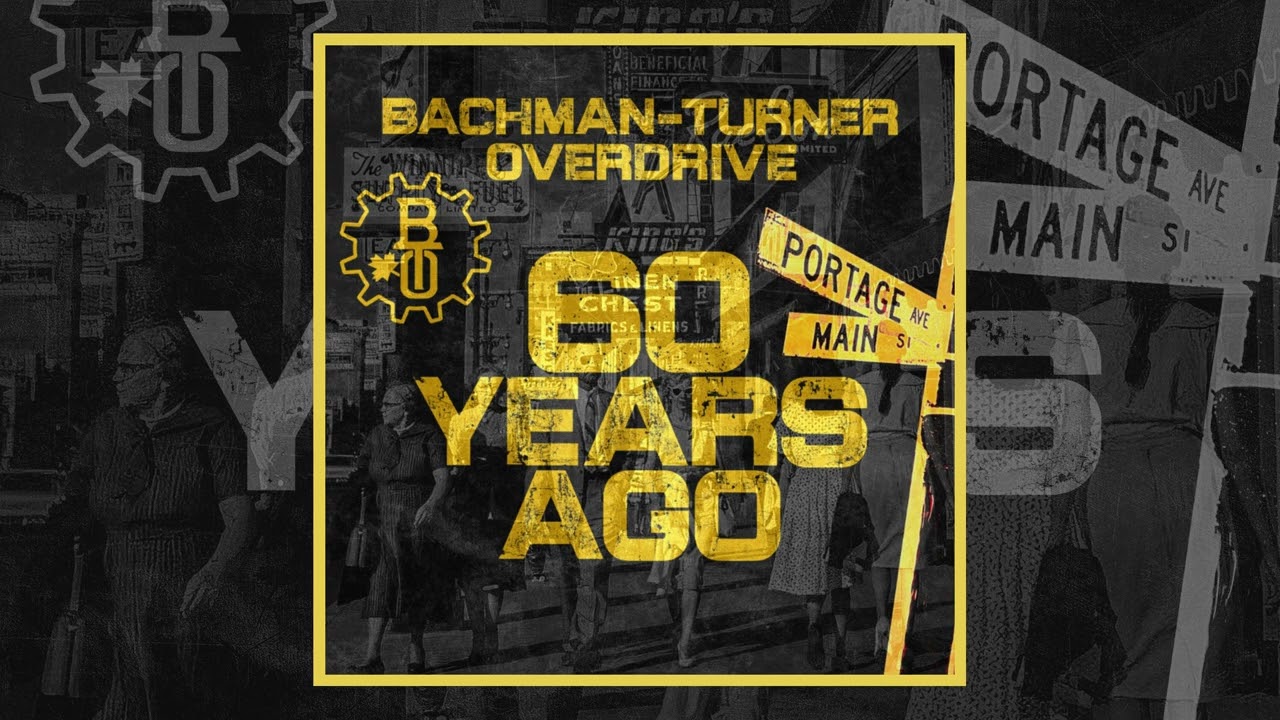
When Randy Bachman learned in early 2025 that a bridge in Winnipeg was being renamed the Bachman-Turner Overpass, he knew it was time to resurrect a song he’d written — but never recorded — dedicated to his hometown. He duly regrouped with retired Bachman-Turner Overdrive vocalist Fred Turner to cut the tune. He even invited along an old friend from his time in the Canadian city.
“I went, ‘Wow, that’s incredible! I’ve got a song all about Winnipeg,’” Bachman tells Guitar Player. “I’ll rock it up with BTO. I’ll get Fred to sing on it, and I’ll get Neil to play on it.”
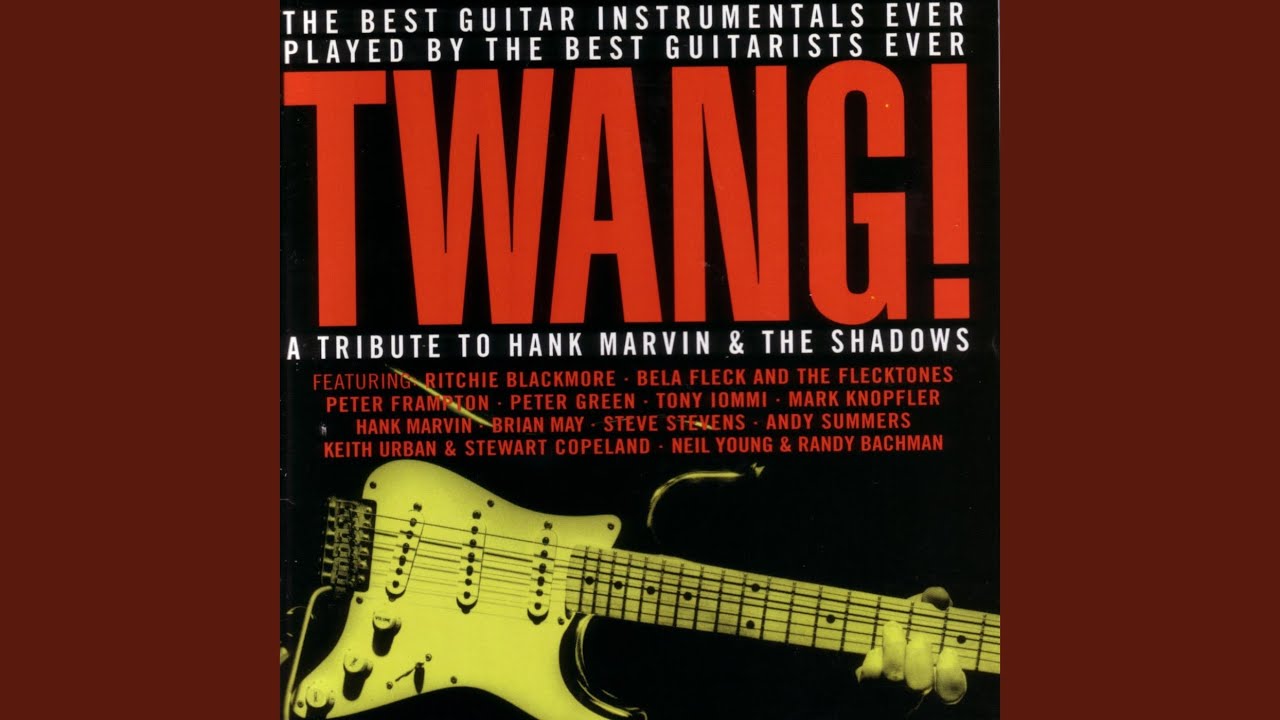
“Neil” would be Bachman’s Winnipeg pal from the 1960s, Neil Young, who uncorks a ragged glory end solo on the track. This isn’t the first time the two pals have appeared on record together — Young guested on Bachman’s 1997 song “Prairie Town,” and a year earlier they both collaborated on a cover of the Shadows’ “Spring Is Nearly Here” for a Hank Marvin and the Shadows tribute album.
Strangely, the two guitarists — who bonded as young players over their love of Gretsch electric guitars, a Fender combo and Hank Marvin — never started a band together in their early years. Bachman played in the Silvertones, who morphed into Chad Allan and the Expressions and scored a hit with “Shakin’ All Over,” before settling on the name the Guess Who. Young, meanwhile, performed with the Squires.
Neil has always been very generous with his time. He played Toronto last year with the Horse. He did every song that I or the audience ever wanted him to play.”
— Randy Bachman
The two went their separate ways, but Bachman is happy whenever their musical paths cross, including whether in the studio, onstage, solo or with groups, including Young’s band Crazy Horse.
“Neil has always been very generous with his time,” Bachman says. “He’s invited me down to his studio. He played Toronto last year with the Horse. I went to see them, and they were phenomenal. He did every song that I or the audience ever wanted him to play — incredible songs.
“He was there with Daryl,” he says, referring to Young’s wife, actress Daryl Hannah. “I gave him an acoustic version of ‘60 Years Ago,’ and he emailed me back the next day and said, ‘I love this song. It’s so historical. Daryl loves it. We’re playing it on the bus all the time.’”
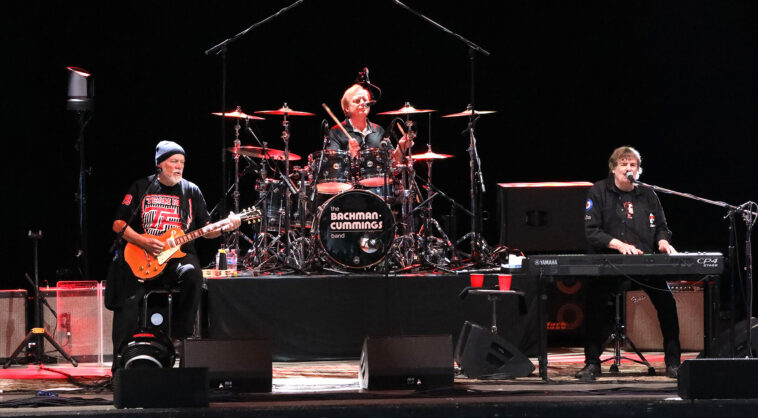
Bachman is currently on the road with Burton Cummings in a revamped lineup of his other famous group, the Guess Who. Their Takin’ It Back tour runs through August 25.
When you send a track to Neil for him to play on, do you give him any kind of direction.
[laughs] Let me just say this: Nobody tells Neil what to do.
That sort of figures. Still, one might assume you might given your long-standing relationship with him.
The relationship is pure respect of his artistic vision. When we did the Shadows song, there’s a part in the bridge where there’s a C7 — I’m playing rhythm and Neil’s playing lead. In that C7 there’s a B note, a C note and a C sharp note. It was like “Chopsticks.” I called Neil’s manager, Elliot Roberts, and asked, “Can I correct this mistake? There’s this weird thing in the middle.”
What was the response?
“Neil would prefer you to leave it alone and don’t touch it. It was captured in the moment.” I said, “Okay.”
So that’s kind of like the Godfather wants you to eat this plate of spaghetti and one meatball. You don’t ask for another meatball.
Neil has said that your old band, the Silvertones, was the best group in Winnipeg in the early ‘60s. He cited you as being a big influence on him.
I played lead guitar because I played violin when I was a kid. The Silvertones were a cover band — we did the hit parade and songs from England. We knew all the Shadows songs, Cliff Richards, Shane Fenton and the Fentones, Johnny Kidd & the Pirates — that’s where we got “Shakin’ All Over” from. Neil’s band would copy that, but they wanted to be different from the Ventures because every band was doing “Walk, Don’t Run.”
So Neil’s band, the Squires, was doing what the Silvertones did.
Same thing. We would play a dance and not say a word. You’d play Ventures or “Sleepwalk” so the kids could waltz. You’d play instrumentals for an hour and a half.
When I joined the Silvertones, the band had a rare thing — an amplifier. Jim Kale had a Fender Concert amp. It had two channels, and each channel had two inputs, so we could put a microphone in one for the singer to sing. We had no P.A. system, so we put rhythm guitar, bass and my guitar into that amp. That was our P.A.
Whenever we weren’t playing, Neil would call up and say, “Are you guys playing a gig next weekend? Can we borrow the amplifier?”
Oh, so he liked your equipment.
Well, he wanted to be Hank Marvin. My piano player had a tape recorder, and if you moved the recording head a little bit you’d get an echo like Hank Marvin. We had no pedals, but suddenly I had an echo. Play with the tape a little and there was the sound of Hank Marvin and the Shadows. Neil loved that sound. That’s why we played together on the Hank Marvin and the Shadows tribute album.
What do you remember about Neil’s playing style back then?
We were both very good players. He was like me — you’re clumsy, and you do it night and day, and you get smoother and smoother. Everybody’s clumsy at first. Just try to play an F chord. I mean, it’s the hardest chord on guitar, whether they’re using a barre with your finger or your thumb. It’s really tough to play.
Did you guys hang out and play together?
No. He lived on one side of town, I lived on the other. We would meet on the bus. We were friends, and we both had the same dream. We wanted to be on the radio. We wanted to be like Hank Marvin or Elvis. There’s something about the brotherhood of guitar, especially if you both have a Gretsch and you both like Hank Marvin. You’d kind of help each other. I’d say, “I’d learned this lick.” He’d say, “Oh, but I play it down here.” And I’d say, “It’s easier up here.”
Did you do this kind of thing at gigs?
Yeah, at gigs. We didn’t have that much time. I would show up with Jim Kale at Neil’s gigs. We would take the Concert amp, put it onstage. Neil would plug it in and test it. We would watch him play. Or I would be playing, and he’d be watching us. He’d say, “How do you play that?” “Oh, here’s how you play that. You can play your A on the second fret, or the fifth fret, or the 10th fret or whatever.” “Oh, okay.”
It’s surprising you never played in the same band. Did you both buy Gretsches around the same time?
A Gretsch [6120 Chet Atkins] finally came in to Winnipeg Music Supply, and it was pumpkin orange. We had no idea, because you’d only see a Gretsch guitar on American Bandstand, and it was black and white. So I bought the Gretsch, but it didn’t sound right because it had the Filter’Trons. The guy called me back and said, “I’ve got the twangy one. It’s got DeArmond pickups. Gimme a hundred bucks, and I’ll give you the twangy one.”
I took mine back, and Neil bought it. That became his Gretsch that he played on “Mr. Soul” and “For What It’s Worth” on American Bandstand. I’ve got the other Gretsch that I played on “Takin’ Care of Business,” “Laughing,” all that stuff. Those two guitars became famous for both of us. They’re what we learned to play on and what we wrote and recorded with.
I took mine back, and Neil bought it. That became his Gretsch that he played on ‘Mr. Soul’ and ‘For What It’s Worth’ on American Bandstand.”
— Randy Bachman
One could ask him the same question about you, but back then did you have any sort of inkling that he was special and going to make it?
I did, yeah. Other guys came and went in his band. Other guys came and went in my band. What was consistent was us, the look in our eyes of “We don’t care what happens or who quits the band. We were going forward. If you’re coming with me, enjoy the ride. If you’re not coming with me, get off the bus. You’re too heavy.”
When he went to Los Angeles, did you think of going there too?
Well, we had left first in ‘65 to go and do the Kingsman “Louie Louie” tour after we had a hit with “Shakin’ All Over.” When we left town, I sent him a postcard: “Opened in New York. Met Burt Bacharach, Ashford and Simpson, Dionne Warwick. You gotta get out of Winnipeg.” So he went to Thunder Bay, met Stephen Stills and started Buffalo Springfield.
Later on, did he ever float the idea of you joining CSNY?
No. He had his own world, and I was stuck in Winnipeg. By then, My son Tal was born. When nobody offers you a job and you’ve got a wife and a kid, you don’t go somewhere with no work. You stay where the work is.
Still, it’s surprising that the two of you never played together in a band. It seems like it would have been the most natural thing.
Well, let me say this: I envy his relationship with Stephen Stills. I would love to be Stephen Stills, the other guitar player who answers him on “Down by the River.” When you’re doing an eight-minute solo, I would love to do that. It’s never happened.
He’s played many times in Vancouver. I would go see him and he’d say, “Get a guitar. Come on for the encore” I’d go, “Phenomenal!” I’d walk onstage and he would yell out, “’On Broadway!’” I’d go, “What?! Can’t we do ‘Down by the River?’” “Nah.”
So we would do “On Broadway” or “Up on the Roof” — some weird Drifters song. I’d say, “Neil, I want to play ‘Down by the River.’ I want to do ‘Southern Man.’ I want to show you that I can rip on these solos.” [laughs] You would just do whatever he wants.