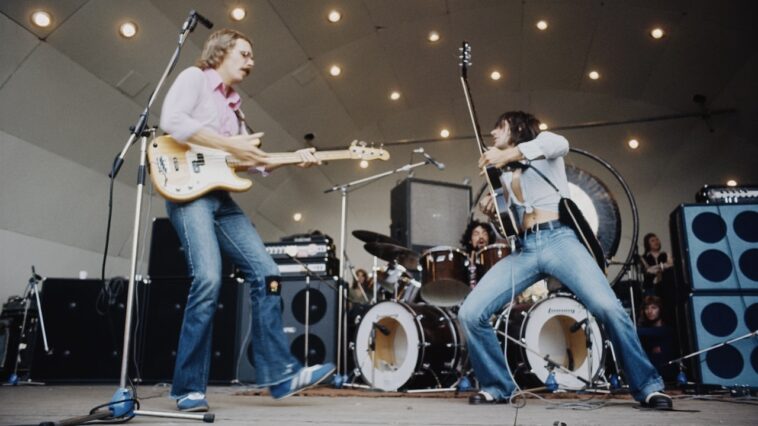
Bassist Tim Bogert first came to prominence via Vanilla Fudge’s eponymous debut in 1967. His virtuosic style helped define that band’s sound during a prolific five-album stint that lasted up until 1969.
“Vanilla Fudge were an amazing band,” said Billy Sheehan. “Tim was all over the place on bass – but everything he did worked. He was a huge influence on me.”
Bogert and Fudge drummer Carmine Appice went on to create Cactus, which churned out four studio albums before dissolving in 1972, when the duo teamed up with guitarist Jeff Beck to form the power trio Beck, Bogert & Appice.
Latest Videos FromGuitar World
But despite boasting the kind of explosive musicianship not heard since Cream, the trio never found the chemistry to match its collective talent.
“The nights that BBA were on, we were frightening,” said Bogert in the March 2011 issue of Bass Player. “But we were only on maybe one of three nights.
“That group was like a dragster when it does a burnout: you get a lot of smoke and a lot of noise, but it doesn’t go anywhere. But when it hooks up, my God, it’s amazing. That’s what that band was like. I lived for those moments when it all hooked up; they’re some of the best musical memories I have.”
Lady, the second song on the group’s only studio album, exemplified Bogert’s freewheeling inventiveness on the bass guitar.
“For Lady, I played whatever flopped out of my head at the time, trying to be appropriate, flashy, or both. We did the basics in one take, and then everything else was over-dubbed.
“No-one taught me to play the bass; I just picked it up and did my thing. So it was out of ignorance of the rules that my style developed.”
To record the track, Bogert played a Fender Precision Bass with a Telecaster neck and La Bella flatwound strings through a Sunn Coliseum head and custom cabinet made by Tony Frank of Univox.
“I’d mic the cabinet, which had two 15-inch speakers, and play the bass hard – you had to with the flatwound strings, so it would distort and break up.”
The guitar and drums set the mood in the first three bars with a gritty stop-start riff, joined by the bass in the second half of bar 4, as Bogert enters with an echo of the track’s defining E minor pentatonic figure.
At 00:07, Bogert – who employs a two-finger plucking technique and occasional rakes – settles into a simmering groove that makes full use of the open E string.
Note how he matches the rising intensity of the drums with a high staccato root-note figure at 00:22, which he contrasts with flowing, chromatic 16ths through beats three and four.
Bogert opts for a simpler riff under the first 12 bars of the 16-bar verse, sticking to root notes while the vocals sketch out harmonies atop his basic foundation. Appice and Bogert both sing on the track: Bogert is the higher of the two voices.

As the promise of a guitar solo unfolds at 02:05, Bogert navigates Beck’s dense, multi-layered guitar work with fearless creativity, injecting the music with fluid chromatic runs and rich, Jamerson-influenced syncopation.
The low-end excitement continues as Bogert soars up to a high B on the G string under the B major chord at 02:47 before working his way down to the open E, leading to a period of quiet E7-based reflection.
This is followed by two more verses, during which Bogert’s on-the-fly development continues: Highlights include a cool descending D Mixolydian run at 04:08, and some wide-ranging skips at 04:14.
After a semi-false ending, followed by a drum solo, the final section pivots around bass-heavy reiterations of the track’s E-minor pentatonic theme.