
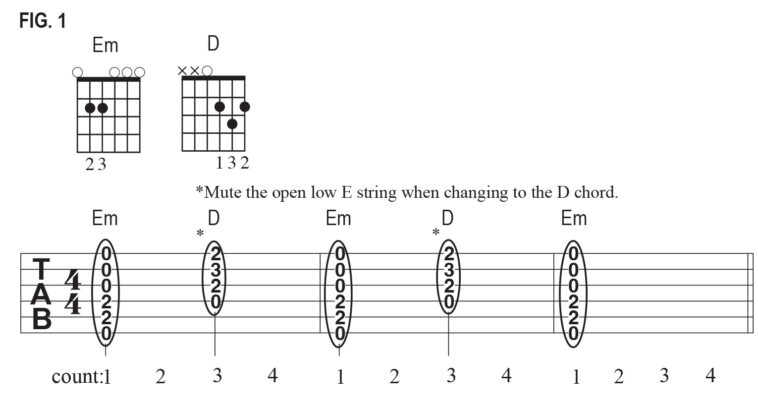
An often overlooked aspect of playing guitar that many beginners aren’t aware of is the importance of silencing the open low E string when moving from an open Em chord to an open D chord, or from E to D.
In most cases, you do not want to have that ringing open low E note “lingering” into the D chord because it will sound dissonant, muddy and sloppy, as the note does not musically “agree” with those that make up the D chord (D, F#, A), especially in that low register.
Check out FIGURE 1, which has us changing from Em to D a couple of times. If you look at the fretboard frame for the D chord above the tablature, you’ll see that the low E and A strings each have an “X” above them. That signifies that those two strings are not to be included in that chord voicing.
A hollow circle, on the other hand, indicates that the string is to be played open, and a black circle indicates where a string is to be fretted, such as at the 2nd or 3rd fret, with the fret-hand finger indicated below.
So, the open D chord is officially only on the top four strings, with the open D string being its low root note. However, inadvertently sounding the open A string, or allowing it to linger from a previous chord, such as Am, doesn’t sound bad at all, as A happens to be a chord tone of D major – its 5th – and the open low A note can add warmth and “fatness” to the chord voicing, which is sometimes desirable. But not the low E note. That just sounds like doo-doo under a D chord, with all six strings ringing.
When you pick an open string, it will continue to ring for a while unless you actively stop it from vibrating. This can easily be accomplished by lightly touching it, a technique known as muting, or dampening. One way to do this is to lightly touch the low E string with the tip of your fret-hand thumb, briefly hooking it around the top side of the neck at the 2nd fret as you form the D chord shape with your fingers.
Alternatively, you could mute the low E string with the palm of your pick hand, a technique known as palm muting (indicated in guitar music by the abbreviation P.M.)
While palm muting “after the fact” like this achieves the objective of muting the string, it could in some cases disrupt the flow of your strumming. So I recommend using the fret-hand-thumb muting method first and foremost, to help ensure a smooth, flowing change from Em to D, or E to D.

Another commonly committed error beginners typically make is they inadvertently strum their open low E string when playing an open C chord, which in the vast majority of cases should only include the top five strings, as opposed to the rarely used C/E (“C over E”) chord illustrated in FIGURE 2. Again, note the “X” over the chord frame for C and the “O” over the frame for C/E.
An effective way to prevent your low E string from sounding or vibrating sympathetically when playing an open C chord is to lightly touch it with the “paw” of your fret-hand ring finger (3) as it frets the C root note on the A string’s 3rd fret.
Doing this will ensure that the chord sounds pleasing and proper and allow you to strum a little more loosely, casually or aggressively, without having to worry about accidentally grazing the low E string with the pick because, even if you do, the string will remain silent.