
An essential rhythm playing technique every guitarist should learn is what I call eighth-note “pendulum” strumming. It involves keeping your pick hand constantly moving down and up across the strings in a steady, unbroken eighth-note rhythm – “1 and, 2 and, 3 and, 4 and” – with downstrokes on the downbeats and upstrokes on the upbeats (the “and” counts).
The movement is comparable to that of a pendulum on a grandfather clock that swings back and forth, the only difference being the horizontal orientation of your arm, as opposed to the vertical hang of a pendulum.
The technique takes a bit of practice to master, but once you get the hang of it, it makes your strumming feel natural, flowing and automatic, to the point where you don’t even need to think about it and can just feel the eighth-note groove. As always, it helps to tap your foot on each downbeat as you play.
Note, however, that this down-up-down-up eighth-note strumming technique isn’t universally applicable to every style of music and at every tempo.
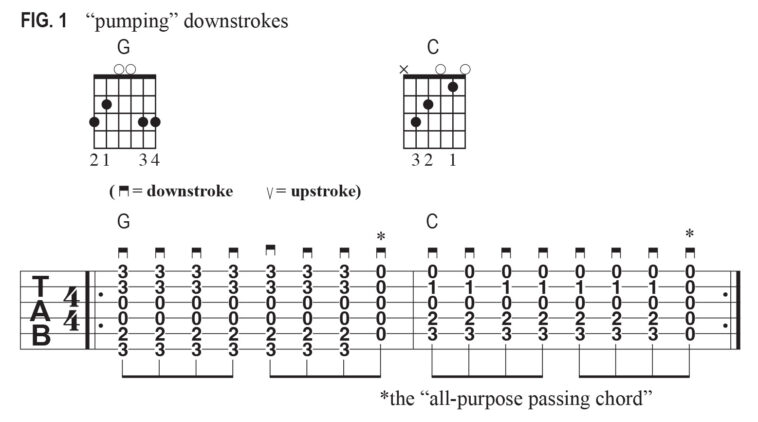
In some styles, such as punk rock and metal, most songs call for the eighth-note rhythms to be strummed with consecutive downstrokes, oftentimes in conjunction with palm muting (P.M.), to create an urgent, “pumping” effect, which is totally cool.
But in many other genres, such as pop, rock, folk, country and R&B, you want to create a more laid-back strum feel, and that’s where eighth-note pendulum strumming works best.
To demonstrate the differences between all-downstrokes strumming (aka “downpicking”) versus down-up strumming, FIGURES 1 & 2 show the same repeating G-to-C chord change strummed two different ways but with the same eighth-note rhythms. (Note the use of the “all-purpose passing chord”.) Notice the difference in the sound and feel of the rhythms.

Sometimes you don’t want to just play a continuous stream of eighth notes and prefer to mix up the rhythms with various combinations of quarter notes and eighth notes, or decide to strum a chord on an eighth-note upbeat and hold it into the next beat, what’s known as a tie. This is where eighth-note pendulum strumming is especially useful and effective.
The key is to keep the pick hand in perpetual motion, without stopping, even while you’re letting a chord ring for longer than an eighth note.

FIGURE 3 shows our G-to-C chord change again, this time with some quarter notes and tied eighth notes used, to break up the “busy-ness” of the continuous eighth-note rhythms.
Notice that, for the quarter notes, you have two consecutive downstrokes and, for the ties, two consecutive upstrokes. Unless you’re performing Pete Townshend-style “windmills,” you’re going to automatically do a silent, “phantom” upstroke between two downstrokes and, likewise, a phantom downstroke between two upstrokes.
The key is to allow your pick hand to silently pass over the strings during these moments where you’re letting the previous strum ring and to not freeze up and “stop, start, stop, start.”

To the observer, it looks like you’re strumming continuous eighth notes, even though you’re playing various combinations of eighth and quarter-note rhythms and using ties.
Again, as always, I recommend counting “1 and, 2 and, 3 and, 4 and” as you play and tapping your foot only on the downbeats, like a human metronome. This will help ingrain the coordination of your technique.
Also keep in mind that, in some songs, there may be parts where you’ll want to momentarily switch from pendulum strumming to all downstrokes, say, for a buildup leading into a chorus.
A good example that comes to mind is the Foo Fighters song Big Me, where guitarist Dave Grohl uses eighth-note pendulum strumming for most of the song but briefly switches to pumping downstrokes in a few spots.