
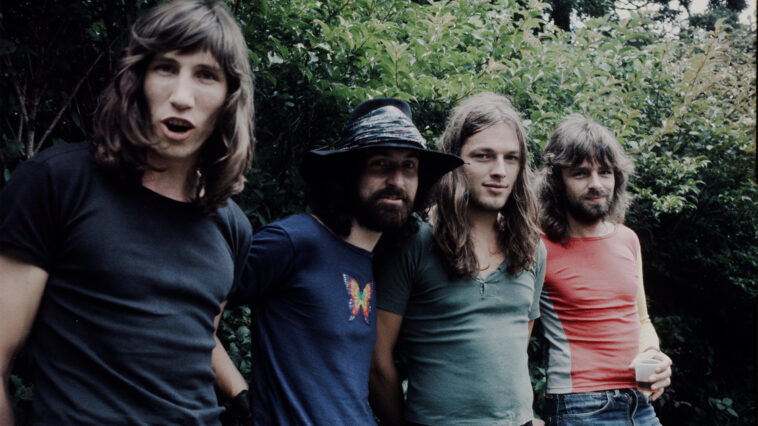
Pink Floyd roadie and production manager Chris Adamson saw much of what went on behind the scenes during the group’s halcyon days in the 1970s, becoming firmly entrenched within the band’s inner circle.
“I was with them for a good 10 years, having begun working for them from around the time of Meddle,” Adamson recalls today. “I was with them through Obscured by Clouds, The Dark Side of the Moon and right up to them starting The Wall album. I was just a roadie but, in those days, I worked for the band full-time. They didn’t tour like you do now, where you have a set period, and you build up to it and go. In those days, you’d even go out and do a couple of gigs on a weekend, or whatever else came in.
“And then when you weren’t doing that, you did other things. I would take their wives out shopping. I even dug a pond for David Gilmour at his house in Epping Forest once. You just did all that sort of stuff. You became like a domestic helper, a butler of sorts. A jack of all trades, which was enjoyable.”
During the group’s recording sessions for The Dark Side of the Moon at Abbey Road Studios, Adamson was there front and center. He provided the title to “Any Colour You Like,” which he explains was one of his catchphrases: “Any color you like; they’re all blue.” He also contributed several spoken-word fragments to two of the album’s tracks.
“The first voice you hear on that album is me,” Adamson reveals. He appears soon after the ticking clock on the opening track, “Speak to Me.” “I say, ‘I’ve been mad for fucking years, absolutely years…’ I also do the bit at the end of ‘Money.’”
He explains that the statements he and the other participants provided were answers to questions posed by the band.
“We were in the studio one day and Roger just gave us these cards with questions on them. We went and sat in the studio and you had to just read the questions to yourself. One was, ‘Do you think you’re going mad?’ Another was, ‘What do you think of the dark side of the moon?’ and ‘When was the last time you had a fight?’”
Adamson recalls some of the other participants.
“There is the Irish-sounding guy who was the doorman at Abbey Road, a guy called Roger ‘the Hat’ Manifold, who was a roadie and used to work for a band called Love Affair. There’s also a woman on it too, Puddie, who at the time was going out with Pink Floyd road manager Peter Watts. She’s the one who says, ‘Cruisin’ for a bruisin’.’
“And the other two people on there are Henry McCullough, the guitarist out of Wings, and his wife. Ironically, the question they were answering was, ‘When was the last time you had a fight?’”
McCullough’s answer — “I don’t know. I was really drunk at the time” — can be heard at the end of “Money.”

Part of Adamson’s job involved working closely with David Gilmour, particularly when setting up his electric guitars, amps and effects in the recording studio. It was a responsibility he took on from the moment he came onboard. In this role, he inadvertently became responsible for one of the most unusual sounds on “Echoes,” recorded during the Meddle sessions.
“Where you hear what sounds like a seagull screeching was due to me being in a rush one day wiring all of David’s pedalboard,” Adamson explains. “That caused me to wire the wah-wah pedal the wrong way around. So when he went to switch it on, that was the sound he got, but David loved it.
“So then I had to have that incorporated into his pedalboard so that he could play it. I had a switch made that would switch it back to a regular wah-wah pedal or switch it so he could get that screeching sound whenever he wanted. So that all came about from just an accident of me rushing and plugging it in the wrong way.”
In keeping with Floyd’s experimental spirit, the success of The Dark Side of the Moon encouraged the group to begin hatching plans for an album built entirely around non-musical sounds. Tentatively titled Household Objects, the project would eventually be shelved, but not before the band created material from everything from cans and bottles to a vacuum cleaner. Adamson was assigned to seek out the objects.
“They were going to use objects, such as airplane elastic that could be stretched over a table with a matchbox under it to get a bass sound,” he explains. “And a stiff brush on a wooden floor for a snare sound.
“I spent ages with Rick going around department stores buying bits of things that you could make any kind of noise from. And eventually we’d got three basic tracks down. When we came to put some footsteps on one track, though, we could never get them in sync. And that’s where we found out that the metronome we were using at Abbey Road Studios was always going out of tempo on the sixth beat. So all the tracks became useless. They did end up using a lot of bits and pieces from the tracks on other albums.”

Adamson considers Gilmour “one of those magical guitar players with such an identifiable sound.” To him, the three principals of Pink Floyd — Gilmour, Waters and Wright — were all masters of sonic exploration.
“It was the age when synthesizers of all sorts started to appear with loads of sounds,” he says. “And they all used to use Binson Echorecs too, which were delay units made out of a metal disc in Italy. They had these heads around it where you could set the delay or could change it. On a lot of the tracks, when you hear Roger playing bass, it’s being played through a Binson and then through an Echoplex.”
Adamson says tape echo was a commonly used effect, with the band employing various tricks to extend the loop.
“They’d have a two-inch tape machine, and then positioned right across the room we’d have a drumstick and use it to hold the length of tape while it spun so we could get a really long loop to create a delay. They were real explorers of music.”
The critical and commercial success of The Dark Side of the Moon transformed Pink Floyd from a cult band into one of the biggest groups on the planet. For Adamson, who had been there through the experiments, the breakthrough was as dramatic as it was unexpected.
“The Floyd were a sort of cult band before then, but that album just launched them into the stratosphere,” says Adamson. “I don’t know why it did, but it did, and it just happened at the right time. It was monstrous.”
For someone who had spent years wiring pedalboards, hunting down odd noises and doing whatever jobs the band needed, Adamson had witnessed the transformation from unusually close range. Pink Floyd had gone from an experimental cult act to a global phenomenon — and he had been there for the strange, messy and often accidental moments that helped make it happen.