
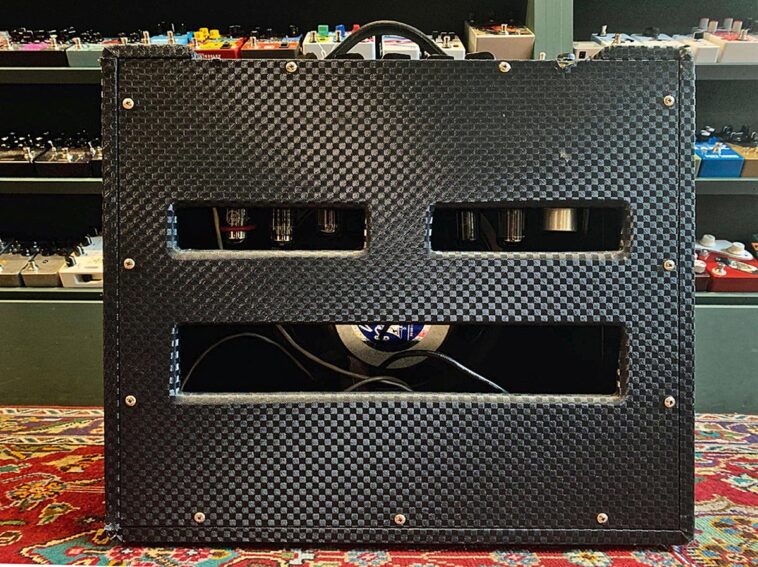
Although Hammond invented spring reverb way back in the late ’30s, reverb did not become a standard feature on guitar amps until the early ’60s.
That’s because reverb tanks were too large to fit into an amp chassis until Hammond developed the compact Type 4 dual-spring tank in 1960, which they immediately licensed to numerous amp manufacturers.
Google’s AI search engine claims that the 1963 Fender Vibroverb was the first guitar amp with reverb, but this is woefully incorrect as a wide variety of amp models with reverb from other companies like Ampeg, Danelectro, Magnatone, Premier and more emerged much earlier in 1961.
Latest Videos FromGuitar World
Fender only offered its standalone 6G15 Reverb Unit at the time and didn’t introduce its famous reverb combos until 1963, starting with the Vibroverb.
Because the Hammond Type 4 reverb tank was made available to so many different amp companies at the same time, it’s impossible to determine which amp model was actually the first. However, the Ampeg Reverberocket, which prominently announced the new reverb feature front and center in the product’s name, undoubtedly was the first popular, commercially successful guitar amp with reverb.
Ampeg Reverberocket amps went through frequent circuit modifications during the product’s initial lifespan. The first version had a circuit similar to Fender’s Princeton and Deluxe amps that delivered an estimated 12 watts of output, featuring a pair of 6V6 power tubes, octal preamp tubes and a 5Y3 tube rectifier.
This circuit distorts pretty quickly as the volume level is turned up, and because Ampeg’s main clientele was primarily jazz players they quickly modified the circuit to provide higher clean headroom and never really stopped making changes.
The 6V6s were abandoned in favor of 7591 or 7868 tubes, the octal tubes were replaced by 12AX7, 7199 and 6C10/6BK11/6U10 compactron tubes and the tube rectifier was ditched in favor of a solid-state version. If you compare three random Reverberocket/Reverberocket II amps, you likely won’t find any with matching tube configurations.
The first Reverberocket iteration has a top-facing control panel with knobs for volume, tone, dimension (reverb depth), speed and intensity (tremolo), while the Reverberocket II switched to a front-mounted control panel with six knobs where individual bass and treble controls replaced the solitary tone knob and “dimension” was shortened to “echo” but functioned the same.

Both versions retained an input labeled “accordion” – a concession to more conservative times when musicians wore suits and bowties.
Ampeg Reverberocket amps still remain desirable today for their lush, deep reverb effects with smooth tails. Ampeg really got it right from the start.
Early Reverberockets with 6V6 tubes are preferred by blues players and raunchy rockers for their gnarly distortion, while the later versions are better for pedal-based rigs thanks to their clean headroom, although they also deliver delicious gritty overdrive when cranked up.
One caveat: the original CTS and ceramic Jensen speakers supplied with the amps are underpowered, so the output level is low and the speaker can easily be blown out.
A modern replacement speaker is highly recommended if you want to kick out the jams or simply want a louder amp.
Reverberocket amps rarely appeared on stage with pro bands due to their relatively low volume output, so the list of famous Reverberocket players is essentially non‑existent.
However, these amps were a common recording-studio fixture, especially in Manhattan where session players used them to record many classic pop, rock and jazz songs during the ’60s.