You can trust Guitar World
Our expert reviewers spend hours testing and comparing guitar products so you can choose the best for you. Find out more about how we test.
What is it?
The Chug Capo can’t be deemed the new gold standard without winning a fight or two first
With the PR for its new drop-tuning pedal, the Chug Capo, Ola Englund’s Solar is coming out of the traps with confidence and at least two potential aces up its sleeve.
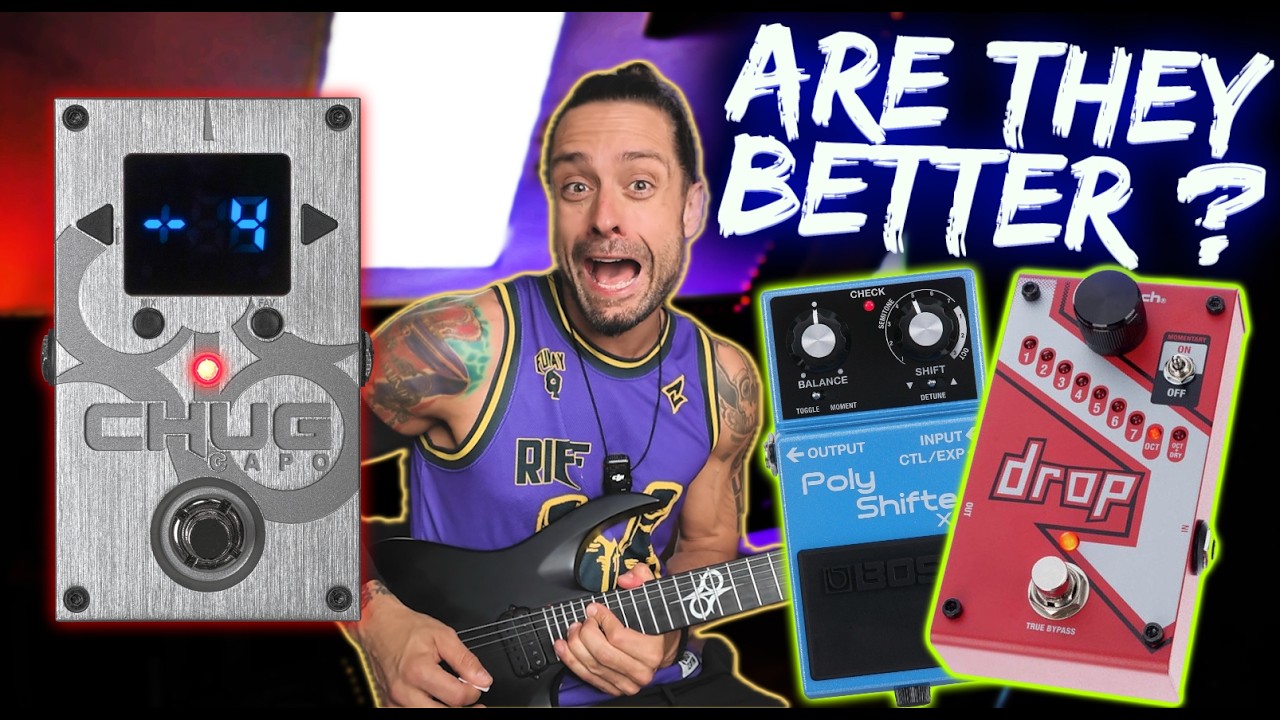
The pedal’s shtick is simple: It pitches the entire guitar signal by a set number of semitones – stretching up and down one octave each – and does so, the firm reckons, with a greater clarity than ever before. Yet many other pedals, like the long-adored DigiTech Drop, the new and impressive challenger, the Boss XS series, aren’t going to take such hype lightly. The Chug Capo can’t be deemed the new gold standard without winning a fight or two first.
Chiefly, Solar points to two standout factors that go in its favor. Firstly, the “digital bi-directional capo” pedal promises the lowest-latency performance, roughly half that of the other big players. That means players can chug to their heart’s content without it feeling like it’s dragging; it might make them forget the signal has been pitched altogether.
Latest Videos FromGuitar World
Secondly, there’s talk of retaining “sonic integrity” even with the shifting at its most extreme. That means full, detailed note clarity with single notes and chords. The Boss XS-100 proved remarkable at this; with its artifact-free shifting, it made it one of 2025’s most impressive pedals. The bar is high.
The overarching idea from Solar here is that this pedal could feasibly replace the need to gig with multiple guitars, as it can handle tuning changes in a flash and it also benefits from a preset slot. At the same time, a Mix dial also lets it double as an octaver. It could become a real cuckoo piece of gear.
Lastly, there’s also the option of plugging in a non-latching switch, which is not included, and would need to be purchased from a third party. The Boss FS-5U and the Harley Benton Tap Tempo Switch have both been confirmed as compatible.
So then, the Solar Chug Capo is a pretty straightforward design, and its makers are talking a big game. But how does it fare against the pedals it claims to be ready to slay?
Specs

- Price: $249 (approx £186/€217)
- Type: Pitch shifter and octaver pedal
- Controls: Pitch +/-, mix, Fav, on/off footswitch
- Connectivity: 1/4″ inputs, outputs, 3.5mm non-latching switch input, 9V DC, USB-C
- Power: DC 9V, 180mA
- Dimensions: 120mm x 70mm (4.72 x 2.75 Inches)
- Contact: Solar Guitars
Build quality ★★★★½

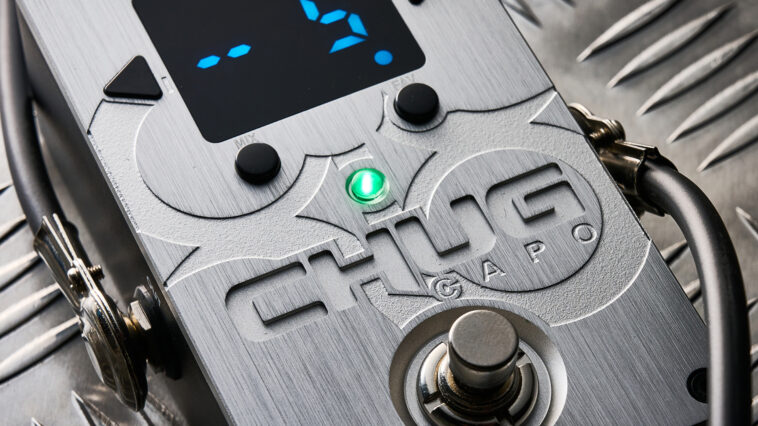
The pedal is an absolute tank. Coming in a little boxier than your average Boss pedal, it should sit on most pedalboards with little fuss, and honestly feels like it could survive a nuclear holocaust and still be able to down-tune the world’s last-ever electric guitar. Its metal face makes it clear what kind of guitar playing it’s aimed at – even if I’ve never been a fan of how on-the-nose Solar is with the cliché metal aesthetic – and its four interface buttons and sole footswitch are equally rock-solid.
Curiously, it boots up at -2 by default. I find it a shame that it doesn’t recall the last setting used, but it’s an easy fix nevertheless.
Meanwhile, the on light glows red when the pedal is engaged. There are no color discrepancies between up and down shifts, but it glows blue when the Mix mode is on.
Still, its lack of MIDI connectivity harms its compatibility in modern rigs. It’s built to either be on or off throughout a song, but it feels like an oversight all the same.
Usability and features ★★★★☆

The Chug Capo’s interface is as simple as it gets, and that works in its favor. The screen is bright and clear, with arrows on either side for pitching the signal up and down. A dot appears above the Mix and Fav mini switches to indicate when they’re engaged, and on the darkest stages, visibility should be no issue.
Pressing the Mix button turns it into octaver mode, blending the dry and pitched signals. Holding the switch down for around four seconds displays a number between 1 and 99, which is the percentage of the pitched signal that’s audible. The higher the number, the drier the signal I get. Conveniently, it defaults to a 50/50 split, unless I’m recalling a preset.
Speaking of which, the Fav button instantly brings up a saved setting, and a new favorite can be saved by holding the button down for 4 seconds again. It’s a doddle to do. However, given that Englund and Solar see this as a trusty gigging companion, I think this feature should have been taken further. There is only one preset slot, so for sets where more than one shift is needed, I’d need to squat down and dial everything in manually. Nevertheless, having presets at all is still a feature the compact competition of the Boss XS-1 and DigiTech Drop don’t offer.
I feel the Mix and/or Fav buttons could have benefited from being footswitches
Granted, hitting the Fav button a second time restores the pedal to its last setting, including whether Mix is on or off and its percentage. That means there are, in essence, two settings you have access to, which does give its practicality a shot in the arm – even if the non-preset mode will need to be freshly dialed in every time I boot up the pedal. But there’s another issue, too.
I feel the Mix and/or Fav buttons could have benefited from being footswitches. There are feasibility issues here, of course, with Solar wanting to keep the pedal as small as possible. But even the smallest of feet are going to have issues trying to hit any of those buttons on the fly, while not simultaneously hitting one of the arrows. Of course, this is where the extra non-latching switch comes in, connecting via a ¼” to 3.5mm cable handily provided in the box. I can confirm the Boss FS-5U works a treat, but it also increases the pedal’s surface area and, in fixing one operational problem, causes clunky problems of its own.
Another feature Englund is very happy about is how fast the pedal turns on/off, and does so without any weird glitches. Bashing the footswitch repeatedly confirmed that, which is great for peace of mind when making changes mid-song.
Sounds ★★★★☆
In Englund’s own words, the pedal has been created to satisfy his need for “something fast, something tight, and something specifically made for metal rhythm playing,” and so it only seems fair that that’s the benchmark the pedal is put up against.
When tracking fast, aggressively picked riffs, the pedal does its duties with aplomb, and it’s easy to forget that the guitar is actually pitched at times, given the speed of its response and how smooth it handles riffs. Even pinch harmonics squeal with clarity and aren’t smeared with weird glitches.
It’s a similar deal for chords; they don’t get too mushy; they don’t sound warped, and only when making more extreme shifts – +/-7 is where imperfections start to arise – are chords marred by a sense of artificiality. It’s all very impressive, and honestly, even in 2026, expecting an extreme pitch jump to be executed flawlessly feels unrealistic.
Expecting an extreme pitch jump to be executed flawlessly feels unrealistic
Solar forewarns players that “for Solos, some digital artifact is unavoidable and audible as in all pitch manipulators, but the tone remains faithful to the source.” This is very much the case, and, in a shootout with the Boss XS-100 and DigiTech Drop, playing the same Gojira-inspired aggressive metal riff through -2, -4, -8, and -12 shifts, the Solar wins out in terms of tone preservation. There is a minor signal loss and a little of the life sucked out of the Boss, while the DigiTech falls just behind that. The differences, I must add, aren’t night and day, but it’s clear that in moments like this, I am finding that Solar can walk as well as it talks.
However, the tone-sapping is avoided by compressing the pitched signal; it’s essentially trying to pep the signal back up after applying the effect. While that means it really does excel when playing heavy riffs, the compression is far more noticeable with clean tones. Here, the Boss is the outright winner, perhaps alluding to the fact that the Boss is meant to be a catch-all in terms of genres and styles, while this is an area that isn’t the Chug Capo’s strong suit. It adds a little too much grit to the clean tone for my liking, as it endeavors to prevent the signal from losing too much character.
As for solos, I’d go one step further than Solar’s advice. Where possible, disengage the effect and shift the pitch manually, perhaps only relying on it if there are open-string passages that are vital. It keeps things pure; the Chug Capo is meant to be a rhythm machine above all else.

Again, the differences between the three pedals are negligible, but if you’re reading this with very specific uses of the pedal in mind, they are really important aspects to consider. If, like I imagine I would, you need a pedal to go between D and C standard at the press of a button during a metal show, the Solar edges the Boss. And that surprised me, because the Boss is exceptional.
But for more universal applications, I fear Solar’s quest to make it the ultimate chugger means Boss takes the crown for its versatility. If metal rhythms aren’t your only usage, the Boss suddenly becomes way more viable.
It’s only around +/- 7, and beyond that I start to feel the pedal show its weaknesses, but that’s common across its competitors, too – it’s a big jump; there are always going to be side effects. For anything less, I’d happily use this over bringing an extra guitar to a gig, and the pitched tones are virtually indistinguishable from the non-pitched tones with regard to the cleanliness and purity of the effect in that first quartet of semitone shifts. To that end, the Solar can hold its head high. For one-track metal rhythm usage, this pedal will absolutely be a godsend for so many gigging riffers.
Verdict
Verdict: ★★★★☆

The Chug Capo does exactly what it says on the tin when it comes to standing as a potential replacement for a second guitar for gigging metal bands. When shifting the signal by up to seven semitones, my tone doesn’t suffer; chords ring out fully, fast runs are tracked with ease. Even pinch harmonics remain clear and artifact-free.
But, ultimately, it’s a pedal designed for metal guitarists. For more universal uses, especially in lower-gain and clean settings, the Boss XS-100 beats it, but not by much.
The fact it only has one preset slot, and that the Mix dial – which turns it into an octaver – isn’t overly accessible on the fly, lets it down a little, but for metal guitar pitch shifts on the fly, I feel Solar’s big talk isn’t hyperbole.
Guitar World’s verdict: Designed to be the ultimate pitch-shifting pedal for metal rhythm guitar playing, the Chug Capo aces the test with its shifts up to +/-7 semitones artifact-free, while also retaining the original tone and handling fast passages and chords comfortably. But it has also painted itself into a corner, away from high-gain settings; its inherent compression becomes apparent, and I feel that a few quality-of-life features have been overlooked. It isn’t the undisputed king, but it certainly deserves a place in the castle’s keep.
|
Test |
Results |
Score |
|
Build quality |
Built like a tank and suitably metal, it’s hard to fault it here. |
★★★★½ |
|
Usability and features |
It gets the ease of use just right, but one preset slot and lack of footswitch for Fav/Mix disappoints. |
★★★★☆ |
|
Sounds |
Great for metal rhythms, but overly compressed for cleans. Shifts are less convincing past +/- 8. |
★★★★☆ |
|
Overall |
For metal guitarists wanting to avoid mid-gig guitar swaps, it’s a solid option. But falls short of being the best in its field for all-round use. |
★★★★☆ |
Also try
Hands-on videos
Solar
Attila Voros