Innovation Week: Ask a child to draw a guitar, and chances are they’ll draw a Stratocaster. Shop for guitars online, and S-types dominate your options. It is, by and large, the quintessential electric guitar silhouette.
But it’s not the only one, and Fender’s ongoing cease-and-desist campaign, as it bids to reaffirm its ownership of the Stratocaster body shape, will only force other manufacturers to think outside the box.
Changes had already started before Fender swung into action. In recent years, new body shapes have flooded the market. They offer fresh contours, curves, or angularity to sit alongside the classics.
Latest Videos FromGuitar World
Kiesel has introduced two new shapes – the Kyber and the offset Antares – over the last 14 months. Eastman has gone bold with the FullerTone Offset ’62. Taylor, Ibanez, Baum, Collings and Gavilan guitars (spearheaded by former Fender Custom Shop ace Levi Perry) have also stepped away from existing templates. Some designs are more familiar. Others, like the Valiant Mercury, hybridize the norms for something bold.
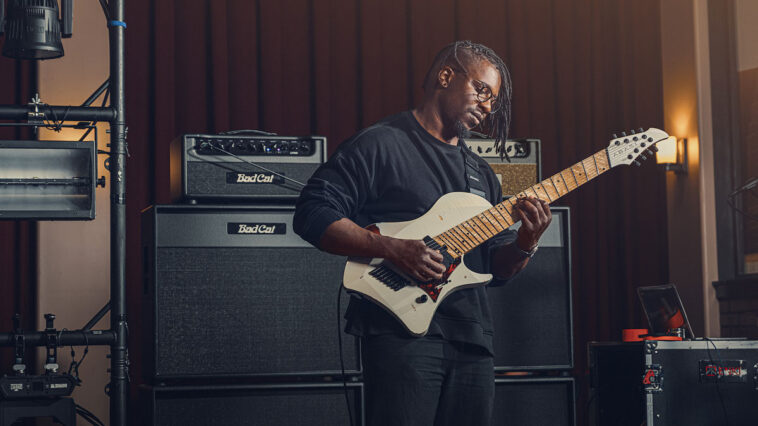
Indie builders are largely driving innovation. Tosin Abasi, the virtuoso behind Abasi Concepts and the bold Larada body shape, has a theory about why.
Risk and reward
“There’s been a lot of experimentation in the past,” he says. “But the percentage of what’s accepted is actually pretty low. The risk-reward analysis for large multinational corporations is different – it can limit how much experimentation they can validate. A lot of the artisan stuff is occurring on a small scale.”
He severed ties with Ibanez to launch his own brand in 2017, aiming to create an ergonomic eight-string guitar from the ground up. Before then, most were elongated versions of pre-existing concepts. Building on Strandberg’s game-changing ergonomics – now a buzzword in all guitar PR – he sees the tide is turning.
“Ergonomic-driven guitars are now feature sets that are pretty established, but they weren’t 10 years ago,” Abasi says. “Larger companies are leaving us to take the risk. Once something is validated, they can essentially copy and address a market that was created for them.”
When the Ibanez Alpha launched, swathes of people compared it to pre-existing designs; accusations of homework copying were flung around with abandon. Abasi himself has another take: he says there “isn’t a ton of permission to introduce new designs,” in a largely conservative market.
Nostalgia is easier to sell because of the legacies of those instruments. But extended-range guitar communities showed him that a sliver of the market had an appetite for purpose-built guitars. That market has grown to be one that Ibanez – and Kiesel – can no longer ignore.
Artist innovations

Music Man, however, has long been using its signature collaborations as a chance to break from the mould. Work with St. Vincent, Albert Lee, and Omar Rodríguez-López, as well as its tradition-skewing Kaizen for Abasi, proves the company doesn’t want to play safe.
“We’re the odd to everyone’s even,” says Drew Montell, Director of Engineering and Product Development. “We have a lot of brand equity in our artist roster, and we really pride ourselves on providing them with the tools they need. Sometimes they’re incredibly outlandish.”
Montell says those projects “are exactly what I live for” and he feels a big part of the market appreciates Music Man’s push to innovate. But it’s still a tough ask.
“When you’re making something, you don’t know if it’s just a weird blob or something that can become an aesthetic of its own,” he says. “The biggest challenge is, ‘What’s too outlandish versus what will people be willing to get behind?’”

Releasing a design in collaboration with a player who often colors outside the lines makes it easier. Still: “Most people hate our best-selling guitars right out of the gate,” Montell laughs. “I don’t want to say we don’t care what people think; we’re just confident that once someone puts it in their hands, they’ll recognize it’s not just a weird shape. It’s actually for a reason.”
He does concede, however, that the company’s reputation for quirky designs is both “a blessing and a curse,” as they’re now expected to push the envelope again and again.
That’s interesting, because Abasi compares the Kaizen to a Porsche 911, and says the core design will remain, with small adjustments expected in future generations. Now he has a design that nails its extended-range, ergonomic-focused brief, it’s evolution over revolution.
Augmenting acoustics
If electric guitar manufacturers feel that the shackles are always on them, acoustic builders are far more constricted when it comes to innovation.
With its Super Auditorium design, introduced with the Gold Label Collection last January, Taylor has found a way to get creative within the confines of acoustic guitar design. It builds on its Grand Auditorium concept, but boasts a slightly longer body and wider lower bout.

“I enjoy working with curves and proportions and studying how profile shapes are used to shape an instrument’s tone,” says Andy Powers, CEO and Chief Guitar Designer at Taylor Guitars. “Mechanically and structurally, the builder needs to work out the physics of the shape, its voicing, how the woods will be bent into form, and how the silhouette affects the design’s prospective voicing.
“With an existing shape, you have the known variables in mind. With a new shape, all the variables are on the bench for development. The shapes of acoustic flattop guitars are not arbitrary aesthetic decisions. Each curve and dimension brings a sonic impact.” Even the slightest deviation from the norm can have massive sonic side effects.

Additionally, Powers suggests that “many guitar shapes are popular because manufacturers prefer to build designs that fit an existing case.” It’s a point which can add outlay of buying into a new concept – another risk for the player.
Pleasingly, Powers says the playing community has “largely welcomed” his design, as it offers “a good blend of classic proportions” and has proved well-suited to a variety of genres. But there’s a long way to go. “Beyond this initial response, it will require years for the shape to become firmly established into the library of guitar designs.”
Our bodies in mind
All three manufacturers are forward-thinking, but form must always follow function. Powers says “the physical comfort and weight balance were paramount in the design” of his Powers Electric A-Type.
Music Man go through up to 10 iterations before electronics and hardware are even considered. Abasi notes: “You have to design within the confines of the human interfacing with the instrument.”

He adds: “Stratocasters were the first double cutaway I know of, and there’s an ergonomic benefit to the upper register, so I think ergonomics have always been the core of guitar design – within reason.”
More and more manufacturers are finding ways to let their creativity fly. Montell, for one, believes makers have a duty to accommodate players of all persuasions. It’s likely that recent events – from Fender’s lawsuits to the increasing space for adventurous guitar designs – will see many more makers follow suit.
“I would hate it if the industry just said, ‘All distortion pedals have been done before; don’t make a new one,’” Montell says. “It’s fantastic that so many manufacturers, designers and players are willing to try new things. Our job is to create tools that people can actually use, and a guitar that someone always wants to go back to.”