Lonnie Mack’s beloved 1958 Gibson Flying V is heading to auction, along with the 1962 Magnatone Custom 440 combo and strap he used throughout his career. The Flying V — number 7 off Gibson’s production line — has a starting bid of $300,000 and is expected to rise when it goes under the hammer at Heritage Auctions.
For guitar players, though, the significance of the instrument goes well beyond its rarity. Mack never quite became a household name, but serious players knew his power and influence. Through his mix of blues, country and soul, he left an indelible impression on a young Stevie Ray Vaughan — who would eventually help bring his hero’s career back from the brink.
When Vaughan discovered Jimi Hendrix’s music via a lucky dumpster find, his life was irrevocably changed. He never had the chance to meet Hendrix, but when another pillar of his musical inspiration needed a helping hand, Vaughan was able to be his hero.
“Lonnie was a big influence on me,” the bluesman said in Guitar Player’s April 1985 issue, speaking during a break in a recording session at Austin’s Cedar Creek Studio. Mack’s career, playing and comeback via Strike Like Lightning, which he co-produced with Vaughan, were key topics of conversation.
“A lot of people don’t realize how big an influence he is on today’s guitar players in general, especially when it comes to phrasing,” Vaughan said. “That first album of his, The Wham! Of That Memphis Man, is the first record I ever bought. Actually, my brother Jimmie first turned me on to Lonnie, but I beat him to the punch getting the album to the house.”
After the success of his debut album, Mack struggled to properly follow it up, with subsequent records suffering from poor promotion. Compounding matters, as the British Invasion took hold in the States — the Beatles’ Ed Sullivan debut came the year after Wham! was released — his opportunities and prominence began to wane.
During his bleakest spell on the fringes of the music business, Mack was reportedly selling Bibles out of the back of his car. He was later hired to play bass on the Doors’ 1970 album Morrison Hotel, where he can be heard on “Roadhouse Blues” and “Maggie M’Gill.”
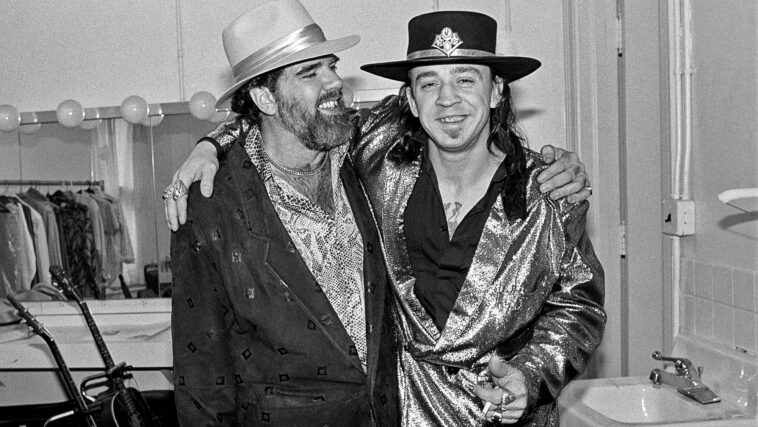
It was the better part of a decade later that Mack and SRV crossed paths. The meeting proved fortuitous for both men.

“Stevie impressed the hell out of me,” Mack said in that same interview. “He wasn’t right for the South band [Mack’s group], which was country-rock, but he was definitely a great player.”
“I was playin’ the Rome Inn in Austin, and we had just hit the opening chords of ‘Wham!’ when this big guy walked in,” Vaughan recalled. Little did he know he was playing Mack’s biggest hit in front of the man himself.
“He looked just like a great big bear,” Vaughan added. “As soon as I looked close at his face, I realized who he was, and naturally he was blown away to hear us doing his song. We talked for a long time that night, and he wanted to produce us. So it’s kind of ironic the way things turned out.”
Indeed, plans were made, and in 1985, Vaughan and Mack wound up working together on Strike Like Lightning, Mack’s comeback record. Vaughan co-produced the album, helping bring the guitarist back into the spotlight.
Mack had essentially one guitar throughout his career, and he didn’t need anything else. It was a red 1958 Gibson Flying V, number 7 off Gibson’s production line. A quick look at it reveals that he was more than happy to modify the guitar, with a metal bar running across the split in the V to accommodate a Bigsby vibrato. The guitar was also sent to Gibson for its distinctive refinish in 1963, the same year his debut LP was released.
Notably, the guitar has more than Mack’s own history attached to it. On Strike Like Lightning, it was plugged into some of SRV’s most distinctive tonal weapons.
First, it ran through the guitarist’s fabled Ibanez Tube Screamer, with the signal then feeding into a mic’d Fender Vibroverb, another piece of Vaughan’s arsenal.

Their album together had plenty of poetry to it. The Wham of That Memphis Man was the first record SRV ever bought, and together, they reworked its instrumental title track, renaming it “Double Whammy” for obvious reasons.
A year after its release, Mack was asked by Guitar World how he arranged the song with his biggest fan. His response typified the informal chemistry between the two.
“I’d just say, ‘go!’” he laughed. “I’d say, ‘Okay, you play rhythm, take the second solo,’ like that; we never worked anything out in detail.”
For more SRV, check out our recently republished 1984 Guitar Player interview, taking in everything from Dumbles to strippers and crazy gigs.