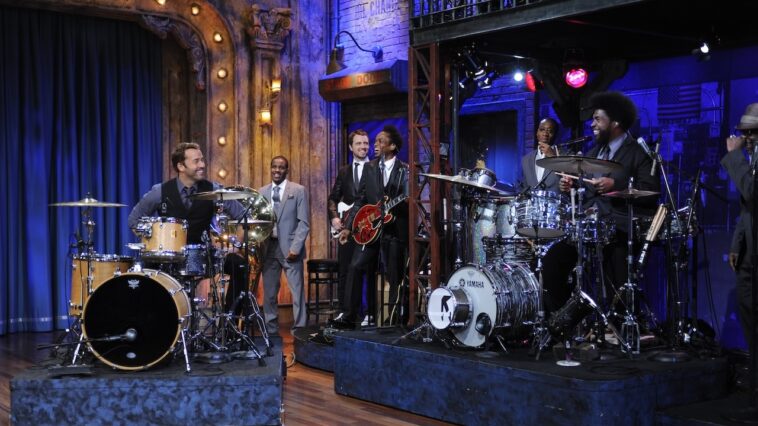
For Owen Biddle, playing bass guitar with The Roots on Late Night with Jimmy Fallon was about as far removed from a typical gig as it gets.
Presiding over the nightly comedy show, the band had to be ready for anything, all while delivering the kind of bulletproof groove that made The Roots one of the most formidable backing bands around.
“We’ve gotten to do some really cool gigs,” said Biddle in the July 2011 issue of Bass Player. “It’s definitely been a whirlwind. I’m trying not to take for granted that my résumé now has this huge spike in it!”
Latest Videos FromGuitar World
It was August 2007 when bassist Leonard “Hub” Hubbard announced he was leaving the Roots after 15 years, opening the door for Biddle to take over.
Before long, the Roots had become the backing band de jour for everything from NBC’s Haiti Relief Telethon and Jon Stewart’s Rally to Restore Sanity in Washington, D.C., to Carnegie Hall’s Tibet House benefit and Comedy Central’s inaugural Comedy Awards.
“I remember Bootsy Collins sat in on bass and vocals with the Roots all night on a Fallon show; we did Tear the Roof Off the Sucker at the end.
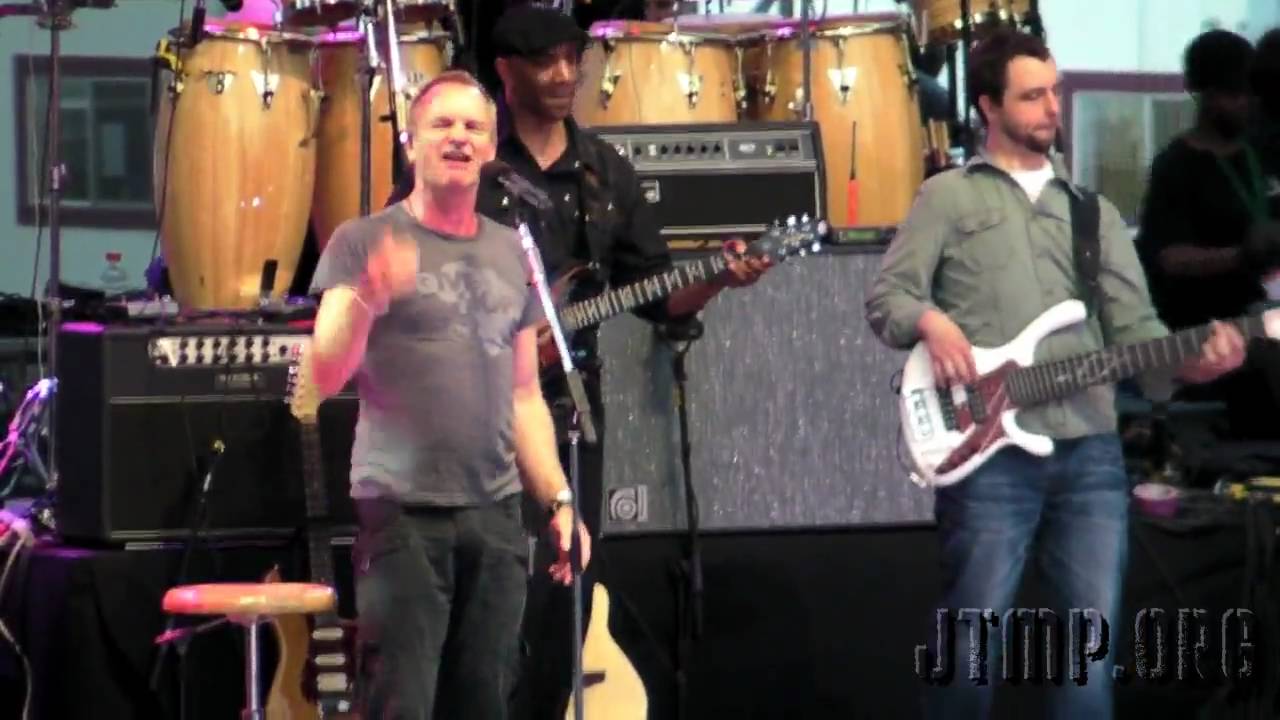
“Backing Sting was definitely one of the highpoints; he got to rehearsal while we were jamming and said, ‘Keep it going!’ and he jumped right in.”
“Probably my standout memory was the night we did two songs with Bruce Springsteen. When I first encountered Bruce and Steven Van Zandt, and they saw my bass, they lit up like two kids in a guitar store: ‘You have a six-string bass!’
“Then Bruce told me this story about when he was young and trying to get his tone together on guitar. He wanted to get more of the lush sound he was hearing from players like Jeff Beck, so he ended up buying this Gibson that had a real smoothness to it – but people kept saying, ‘Hey, that’s a cool-sounding bass you have there.’
“It turns out he had bought an EB-6! So we bonded over six-string basses.”
Biddle was handed his first G&L bass at 14, which had been left behind when his cousin’s ska band broke up. He later worked his way through a succession of basses before turning to Philadelphia luthiers CallowHill Basses to build his dream instrument: a six-string bass with a compact 30-inch scale.
“I went into CallowHill basses with a laundry list of features that I wanted, and they catered for all of my quirky requests. I wanted the mahogany fretboard for the tone, and an overdrive circuit before the preamp so that the signal runs directly from the pickups to the overdrive, which I keep it on at all times.
“What I wanted was the sound of a short-scale bass, like a Höfner, but with more rigorous construction and modernised amenities.”

“The preamp, the pickups and the extended range of the B and C strings all give it a uniqueness that I sort of conceptualised when I knew that I was going to create this custom bass.
“The B string holds the tension of the notes beautifully because it is short scale at 30 inches, so the notes don’t die out and they get this punchy feel if I need it.”
Despite the instrument’s six-string range aiding his upper-register excursions, Biddle finds the low B string far more relevant to his playing than the high C.
“The 6 hasn’t changed the way I play; I still think like a 4-string player, but there are more opportunities for notes, especially down low. I don’t use the C much except for the occasional chord, or to show a keyboard player a specific voicing.”
“What I do like is having something visually provocative, which sorts people out for me – from the open-minded to the purists.
“I use flatwounds, which are also have that sort of built-in muted tone. The two pickups are Fat Stacks by Nordstrand, which I keep full on, in single-coil mode. Add in the warmth of the mahogany body and it has a classic, understated, all-purpose tone that I use for almost everything.”