
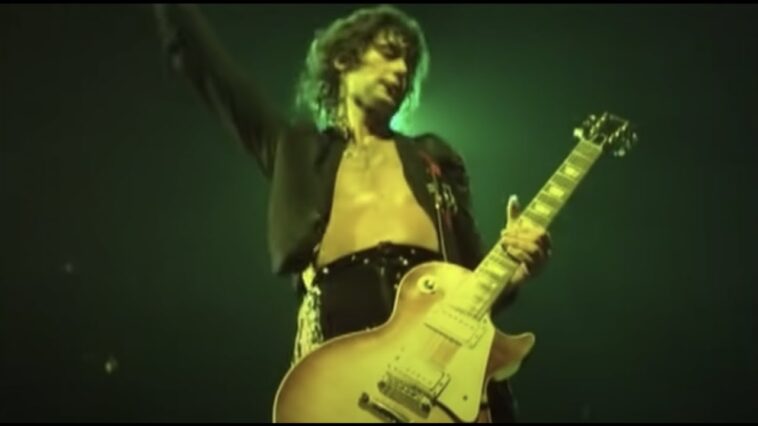
A violin bow may be better associated with Vivaldi’s Four Seasons, or Rosalía’s Lux, than rock music. However, a handful of guitar players dared to challenge the confines of guitar playing and brought the lofty violin bow into the rock circus.
Jimmy Page is undoubtedly the most famous of them all – he stunned audiences at Madison Square Garden in 1973 with his bowed-guitar shenanigans. Eddie Phillips is widely cited as the player who inspired Page plus Adrian Belew, Lee Ranaldo and Sigur Rós’ Jónsi.
The violin was my first instrument before I took “a walk on the wild side” and picked up the electric guitar. Fast-forward to when, teenage angst and all, I decided it would be a good – no, an excellent – idea to use the bow of my first-ever violin on my first-ever Strat. I didn’t even know that Page had done that decades prior on Dazed and Confused.
Latest Videos FromGuitar World
The shtick stuck. Over the past five years or so, I’ve been experimenting with perfecting the technique in the studio and, more importantly, live with my band ĠENN – making sure that the result is more “ethereal” than “screeching cat.”
Here are a few tips you might find helpful if you’re thinking about trying the technique, but don’t want to get tied up with a bow…
Getting started with a bow

Welcome to the world of rosin: for the uninitiated, it’s essentially a block of hardened tree sap, mixed with other ingredients, that, when applied to a bow, creates the friction needed to produce sound. Naturally, guitar strings are not made for a bow, so they need a lot more friction to respond. You need to apply more rosin to the bow than you would when playing a violin, viola or cello.
But beware! Rosin leaves a lot of dust behind that can gradually ruin your electric guitar strings. So if you want to avoid racking up hundreds of dollars in guitar-string costs, a low-dust rosin like Pickaso’s is the way to go.
Size it up

Another consideration is bow size, which range from 15 inches – known as 1/32 – to 29.5 inches – 4/4 or full size. A 4/4 bow gives you more space for sustained chords, while shorter bows are easier to start with as they give you more control over what you’re doing. I spent the first couple of years using the trusty bow 6-year-old me had used on my beginner 1/4 violin.
Violinists are very picky when it comes to bow weight – some won’t even dare try one that doesn’t weigh approximately 60 grams. Paying a visit to your local music store and try bows out in person. See which one you jive with, and swipe right when you find your perfect match.
Find your angle

Nailing the bow’s angle matters more than pressure. Guitar players tend to instinctively apply more pressure when trying out the technique, but tilting it slightly up or down – depending on the guitar’s design and pickup position – and gliding it across the strings tends to do the trick, and helps avoid the “screeching cat” effect.
Chords not strings
And speaking of screeching cats, since guitar strings and the fretboard aren’t made for bows, it’s way harder to bow individual strings. Chords tend to sound better, so don’t shy away from experimenting with capos, chord shapes, and altered and open tunings – find which ones work and, more importantly, sound best.
If I’m adding a bowed guitar layer to a track, I tend to go for open tunings that work with the song’s key or chord progression. And, for a touch of pure, chaotic noise, go for standard tuning – or your altered tuning of choice – and bow that guitar like there’s no tomorrow.
Not all guitars are equal

Different guitars respond differently to the technique. I’ve tried it on quite a few – my Pawn Shop Mustang, a couple of Les Pauls, Strats, Teles, even a Gibson Marauder.
Each guitar requires some trial and error in terms of which pickup produces the best sound. I’ve found that those equipped with humbuckers tend to produce the clearest sound. That said, with some tweaks, single coils can produce quite an airy and eerie tone, which I’m quite partial to.
Reverb is your friend

Considering its inherent airy, avant-garde quality, a bowed guitar sounds best when it’s drenched in reverb and delay. Then you can throw in a healthy dose of overdrive and distortion and a volume pedal for an added cinematic effect.
My secret (now not-so-secret) ingredient, however, is the DigiTech Whammy, or any other octaver/harmonizer pedal – it really brings out the expansive orchestral potential of the technique. Who needs a string quartet when you’ve Whammy-d up your bowed guitar?
Keep an open mind
As Page explains in the book Light and Shade: Conversations with Jimmy Page, “Whatever squeaks I made sort of intrigued me.” This is the point. Follow your ear, experiment with your gear – grab all your long-forgotten delays, reverbs, and the wackiest of pedals and try things out.
- ĠENN’s latest single, Jaguar Sun, features the bowed guitar technique and is out now.