Alice Cooper was getting high in his pool house when news broke on TV that John Lennon had been murdered. The shock, he says, turned his world upside down.
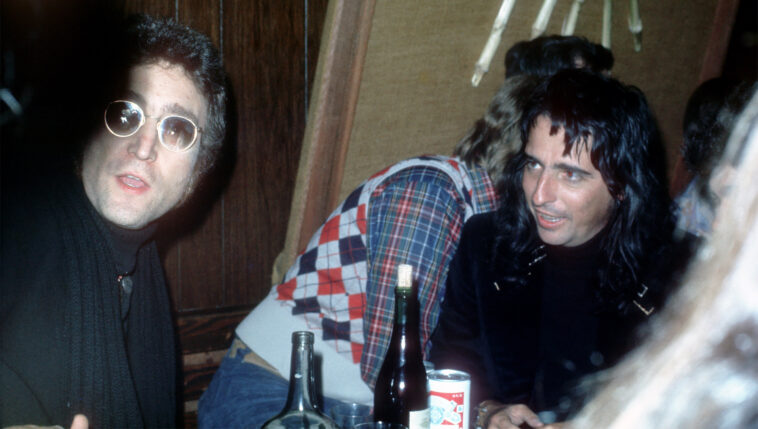
The shock rock icon has never hidden his love for the Beatles. He once said hearing the Fab Four’s “She Loves You” for the first time “literally changed something in my brain.” He went on to befriend Lennon during the former Beatle’s “Lost Weekend,” from 1973 to 1975, when he was separated from his wife, Yoko Ono, and spending time in New York City and Los Angeles. The two also moved in the same rock ’n’ roll circles, including the Hollywood Vampires, the famous drinking club Cooper helped establish in Los Angeles.
But Lennon’s death, on December 8, 1980, was more than the loss of a musical hero — one who had even been impressed by one of Cooper’s own songs. His murder also exposed a frightening reality for musicians.
Lennon was shot four times outside his New York apartment. Despite the best efforts of a Beatles-loving surgeon, he died at Roosevelt Hospital. Cooper understood the wider implications of the killing and the fear it would inspire throughout the music community.
“We were working… in my pool house, so we’re getting high, of course,” he tells Rolling Stone. “All of a sudden it comes on TV. And I’m telling you, it was like a vacuum.
“It was just like, ‘That can’t be right. Why him? Why not somebody political?’”
Cooper acknowledges that Lennon’s murder was not politically motivated. His killer, Mark David Chapman, had become fixated on Lennon, including his infamous remarks that the Beatles were more popular than Jesus. Whatever the motive, the killing left the “School’s Out” hitmaker fearful for his own safety.
“To this day,” he says, “it seems unreal. I could understand somebody having a grievance over a politician, but John, ‘Give Peace a Chance’? And then after it all unfolded, you realize it only had to do with an insane fan. It’s still just hard to digest that.”

Lennon’s murder also prompted other musicians to reflect on their own encounters with dangerous fans. Mark Knopfler, for instance, revisited his own brush with a crazed fan and wrote a song inspired by the experience that took him 16 years to complete.
For Cooper, the immediate effect was more personal: he began to worry that he, too, could be a target. He says other musicians felt the same way.
“I know that all of my friends started carrying [guns],” he continues. “I started carrying back then because all of a sudden it was a threat to all of us, even though we don’t put ourselves on the level of John Lennon.
“It scared a lot of musicians because it was a reality now. David Bowie used to talk about that all the time, and I kept going, ‘Dave, don’t talk about that.’”

Cooper has been promoting his new memoir, Devil on My Shoulder, discussing, among other things, his struggles with drug addiction during the 1970s.
After a short book tour, Cooper is set to return to the road for a new U.S. tour. Guitarist Nita Strauss will rejoin the band after taking much of the year off to welcome her first child. During her absence, she personally selected an unknown British shredder to fill in for her.
Meanwhile, another of Cooper’s bandmates, Tommy Henriksen, has shared the life advice that helped him land the gig — and explained how a guitar he found in a dumpster became one of his most cherished possessions.