
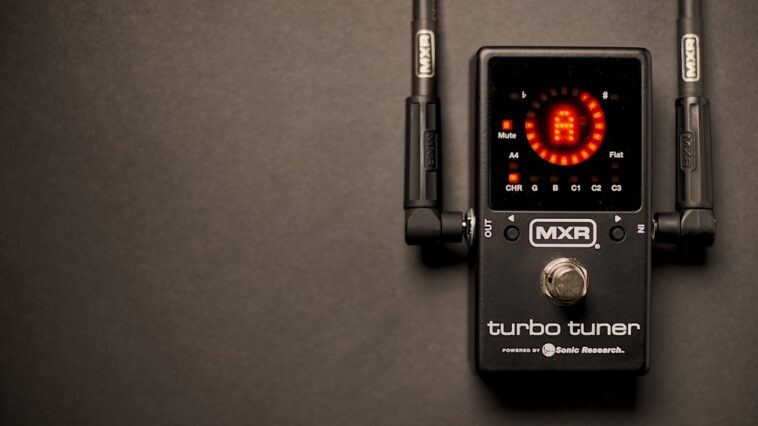
MXR has made all kinds of pedals. It has built overdrive pedals, delay pedals, reverb and modulation, compression – all of the main food groups. But it has never made a guitar tuner until now, teaming up with Sonic Research for the Turbo Tuner.
Is the Turbo Tuner the only tuner you will ever need? It’s a bold claim but MXR is making it.
This compact strobe tuner is a serious piece of kit, based around the original Sonic Research Turbo Tuner, and comes with a laundry list of pro features.
Latest Videos FromMusicRadar
It has five custom presets, accommodating 12-string and six-strings alike, and all in between, and comes with the promise that its hi-viz LED strobe display “tracks pitch with fraction-of-a-cent precision” (it can also be viewed in direct sunlight).
“There’s no lag, and no bouncing needles,” says MXR. “You play a note, turn the tuning peg, and watch the pattern rotate instantly to reflect the actual motion of your string against a steady reference pitch. It’s physics in action: the display is driven by the analogUE signal straight from your instrument, so it tracks with zero latency and no simulated guesswork.”
In Chromatic mode, the tuner tracks all 12 notes of the octave. The preset modes offer Guitar and Bass modes, with each displaying the string number rather than the note, then there are three more programmable modes that come out of the box with settings for six-string electric guitar in standard tuning, drop D, and six-string bass guitar settings.

All of these presets can then be reprogrammed for alternate tunings – and, good news for Angine de Poitrine fans, experiments in microtonal guitar, as you can create custom tunings 50 cents (half-a-semitone) in either direction at 0.1-cent increments. But anyone who plays a Telecaster with a three-saddle bridge might find this useful for compensated tunings, especially when recording.

There is a high-quality buffer under the hood. You can run it in true bypass or with the transparent buffer, and there are three sub modes that let you mute the signal when tuning up, run the tuner always on with footswitch muting, or let your signal pass through and the footswitch toggles the tuner.
And there is a USB-C connection for firmware updates and editing via the software. Lastly, there is a 9V DC output for passthrough power to another device.
That’s a lot for one compact pedal that’s priced at £126/$149 street. For more details head over to Jim Dunlop.