

You could easily make the argument that Elton John and Bernie Taupin’s songwriting partnership is the greatest in rock and pop history. The other obvious contenders would be Lennon and McCartney, but they only worked together for a dozen years, while Elton and Bernie have been in each other’s creative pockets for more than half a century.
Taupin has now been reflecting on his work with Elton in an interview with Rick Beato. Famously, the two men were brought together in 1967 when they both responded to an ad placed by A&R manager Ray Williams, who was looking for songwriters, in the New Musical Express (NME). The story goes that Taupin’s envelope of lyrics was almost randomly chosen from a stack of them and given to John, so they could easily never have met.
Taupin, though, suspects slightly less serendipity: “Ray Williams says and Elton says that he had a stack of lyrics that people had sent in, and that [Williams] just pulled these out and he said, ‘Well, take a look at some of these,’ and Elton said, ‘Well, these look really interesting.’
Latest Videos FromMusicRadar
“I don’t actually go along with that – I mean, they’ll deny it, but do you really think that a lot of people sent lyrics in? I don’t think so. Maybe a couple, but there wasn’t a stack of them. You know, he wasn’t like fanning through them and going, ‘Well, try these,’ you know, and ‘Oh, these are interesting – I’m going to take these.’ But if public opinion wants to go along with that, I’m not going to argue with it.”
One thing that Taupin definitely agrees with John on is that Skyline Pigeon, which they wrote in 1968, was one of their first great songs, and the one that started to get them noticed. “It kind of went underground for a while, but the interesting thing was that when we wrote it, we got three covers on it within a week,” he says.
Elton’s first version of Skyline Pigeon appeared on 1969’s Empty Sky, and is played on a harpsichord. The song deserved more, though, and a fleshed-out arrangement was recorded and first released as the B-side to 1973 single, Daniel.
Written from the perspective of a younger brother, Daniel is believed to tell the story of a Vietnam war veteran leaving for Spain after coming home injured, but this is never explicitly mentioned. It’s long been known that a verse was cut from the song, leading to speculation that this fully explained its meaning, but Taupin says that this is nonsense.
Asked if Elton ever used to change his lyrics – or ask him to change them – he replied: “No – he would make everything work. He might take an ‘and’ or ‘but’ out, but that’s about it. I mean, the only only thing he would do is if I overwrote something, if he felt it would be too long, we’d take out a verse or something or a few lines – or maybe he’d say ‘there isn’t enough’ and I’d put something in. Hence the urban myth about the song Daniel – that he took a verse out that really explained the song – which is absolute rubbish. You know, it didn’t make it any different. It was just more of the same. It’s a good story, but it’s not true.”
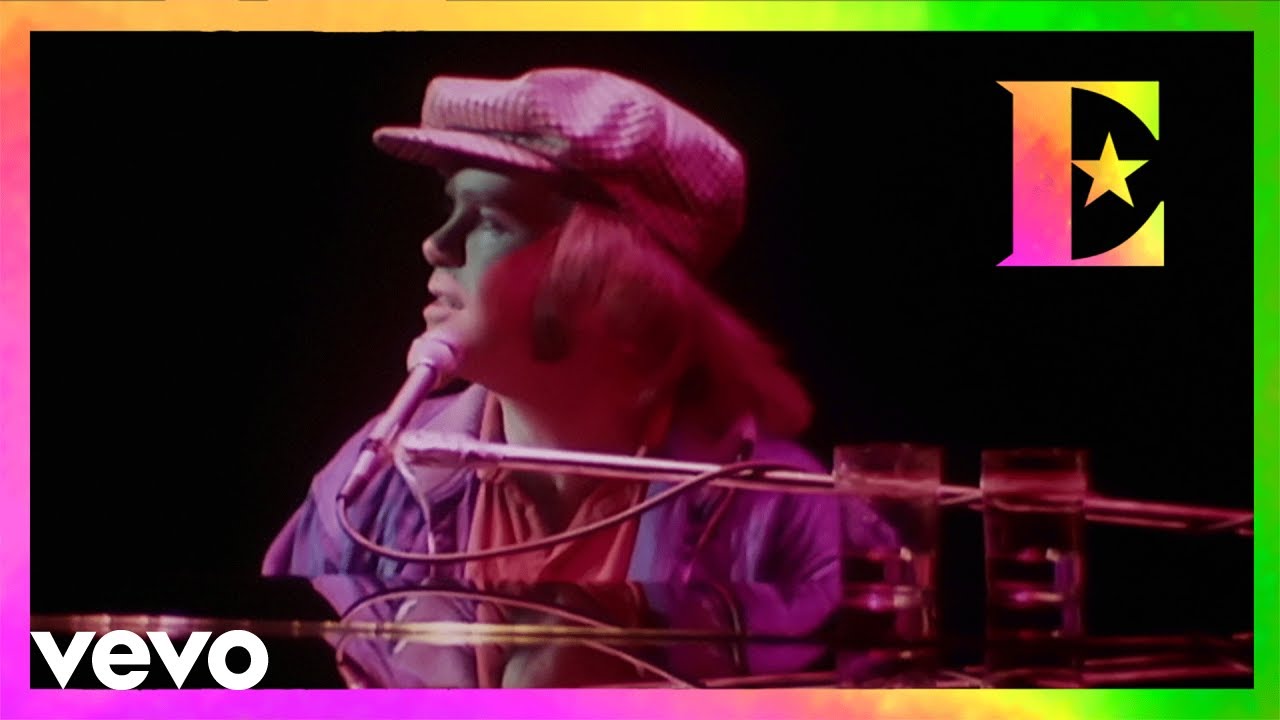
This slightly contradicts what Taupin told Billboard in 1997 – “I don’t remember what the last verse was, so I don’t know whether it [changed what the song was about] or not” – but even then he was saying that “I seriously doubt” if it did much to change Daniel’s meaning.
Elsewhere in the interview, Taupin discussed another great lyric he wrote in that period – 1972’s Rocket Man. He explained that, while he used to write some songs “top to bottom” in less than an hour, this one took a lot longer. Its opening lines, though, arrived fully formed – and at an inopportune moment.
“The initial three lines of that song came to me when I was back visiting my parents in the north of England before I moved them to the States,” he recalls. “I was driving to their house, and I didn’t have any paper or pencil or anything. And the first three lines, you know – “She packed my bags last night, pre-flight, Zero hour, nine am, and I’m gonna be high as a kite by then” – came straight into my head. So I’m driving like at 70 miles an hour along these little back roads, because my parents lived out in the middle of nowhere, and I’m repeating this to myself over and over and over again, and I kind of screech into their driveway, run into the house – ‘Give me a pen,’ you know – and write it down.”