
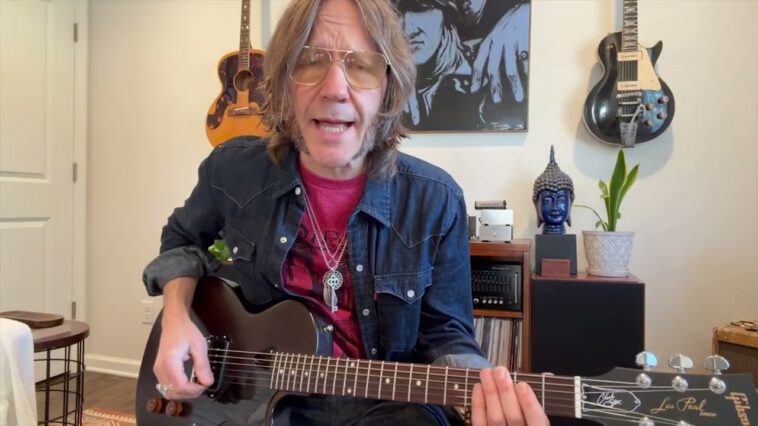
In putting the music together for my band Blackberry Smoke, I’ll often come up with a primary guitar part – the one that plays the principle riff of the song – along with a complimentary part that sits under it and offers musical and rhythmic support.
A good example of this can be found in Morningside, which we recorded for our 2021 album, You Hear Georgia. I wrote this song with my good friend Nick Perri, who’s a fabulous guitar player you may have heard of from his work with Perry Ferrell, Matt Sorum and many others.
Morningside opens with a heavy single-note riff that’s played in the key of B and with a triplet, or swing, 16ths feel, illustrated in Figure 1. The riff is based on the B minor pentatonic scale (B, D, E, F#, A) and alternately references the I (one) and IV (four) chords, B, and E, bar to bar. The triplet feel gives the riff a nice swing-type groove, especially as it’s played against a slow, half-time feel.
Latest Videos FromGuitar World
At the verse section, the guitars settle into ringing chords that serve to lay down a solid foundation for the vocals. Figure 2 shows the B root note octaves played as whole notes by the main guitar part, which I slide into.
Figure 3 depicts the complimentary ringing 1st-position chords played by the second guitar part, which is treated with a tremolo-type modulation effect and alternates bars of Bm7add4 and E7/B.

This is followed by a return of the intro riff, which leads into the second verse and a reprise of the ringing parts shown in Figures 2 and 3.
We then go to the chorus, the complimentary guitar parts for which are illustrated in Figures 4 and 5. The primary part (Figure 4) simply rides on major and dominant 7 chords with the progression E – F#7 – G7 – A7. At the end of the phrase, it reverts back to the single-note B minor pentatonic riff.

While the main guitar lays down the foundation of the progression of full chords, I felt that the complimentary guitar part, shown in Figure 5, needed to “dance” with the vocal melody.
This part adds syncopated, hybrid-picked dyads over each chord in the progression. While downpicking the low 6th-string root notes in a steady eighth-note rhythm, I fingerpick moving two-note figures on the D and G strings over each chord.

Notice that the pattern always begins with the B note on the G string’s 4th fret as the highest note, which then descends, offering its own countermelody behind the vocals.
I wanted the solo section that follows to move to an entirely different feel. As shown in Figure 6, a D5 power chord moves down to D5/C#, followed by C#7 then F#m and E. Underneath this part, the complimentary guitar arpeggiates the related but slightly altered progression Dsus2 – A/C# – C#7 – F#m7 – Esus4 with somewhat different voicings.

The modus operandi throughout this song has been for the primary guitar to “sit” in a very clear place while the complimentary guitar moves around it in various ways.
Keith Richards of the Rolling Stones, a master of layering multiple guitar parts, refers to the process as the “ancient art of weaving,” which is a perfect way to describe how two guitar parts can compliment one another.