“Most people who own our bridges aren’t beating the door down to get them on their vintage guitars,” says Matt Blackett, EverTune’s director of market development. “That’s like putting a moustache on the Mona Lisa.”
Blackett, who was Guitar Player editor for 15 years, has always championed industry innovations. So when he discovered Cosmos Lyles’ bridge design that promised to never go out of tune, he jumped aboard. He knows the bridges aren’t for everyone – but the firm’s reach is growing beyond the prog metal realm, gaining prominence in Nashville and in studios.
Lyles dreamed up the idea on July 4 weekend 2005. “I was high,” the designer admits, “and thinking outside the box.” It would be another six years before the EverTune as we know it was considered complete, but the big turning point came in 2007: “My engineering partner, Paul Dowd, successfully tested the first prototype with the current mechanics, which he devised,” Lyles says.
Latest Videos FromGuitar World
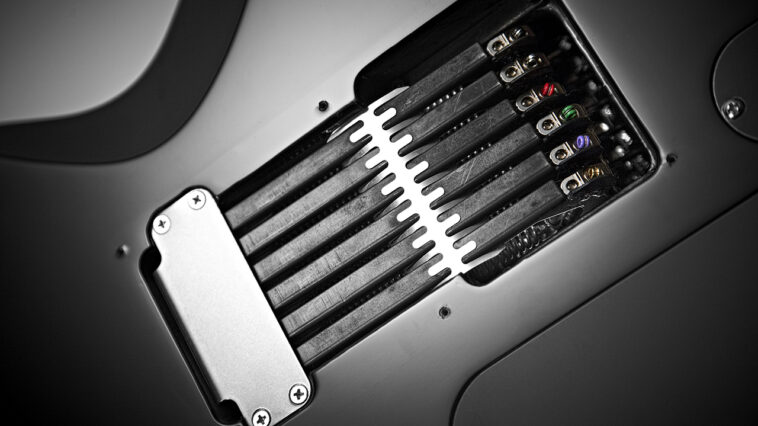
“It had a swinging arm as a cam to balance the change in spring tension, and it worked surprisingly well. That’s when I knew we had something; it went from abstract idea to physical model.” In essence, EverTune bridges are alive. Each string gets a dedicated system of springs and levers that react to everything from pick attack to environmental factors, maintaining consistent string tension.
The initial setup is finicky, but restrings after that – so long as you stay in the same tuning – are business as usual. There’s comparable preparation with Floyd Roses and Bigsbys too.
Six-string bridges for Gibsons, Strats and Teles cost $350, and installation potentially doubles that once you’ve found a certified installer – there are 53 approved worldwide. Blackett admits making the jump “is a commitment,” but insists it’ll “intonate flawlessly.”
“You can do a monster bend and it won’t come back flat,” he states. “I just played a gig in more than 90-degree heat and never went out of tune.
“Keeping string tension constant means the pitch of a note’s attack is identical to the pitch of its sustain, so producers love us. They’re on us every day asking, ‘Where’s the bass bridge?’
He points out the system is more flexible than some people realize: “Some producers like it so bends don’t affect the pitch; they don’t want someone squeezing a chord out of tune in the middle of a really good take. But this idea that you can’t bend is completely false; you just need to understand how it works.
“Typically, bends and vibrato are 99% normal. For the system to do its job, there needs to be a slight lag between when you bend a note and when the bend kicks – but it can be very subtle.”
He adds that players can turn off the system on any string and choose the sensitivity of their bends. Still, there are caveats. Installing one requires a fairly extensive route made in the guitar (similar to those for Floyd Roses and Strat trems).

Players who want to drop the low string mid-gig can do it at the headstock, but note that it won’t get the EverTune benefits. Another sensitive point is how, at roughly 1.28 pounds, they’re heavy – given the modifications to the body, an average bridge adds around 0.5 pounds to a guitar’s weight. The changes are more noticeable on lighter instruments. Whether it impacts tone has left players split.
“Some people think it adds highs; some people think it’s darker sounding,” Blackett notes. “But it absolutely changes the way the guitar resonates and responds. In the upper registers there’s a difference in terms of how it sustains. They don’t resonate like a PRS McCarty with a one-piece wraparound bridge.”
Cosmos goes, ‘I haven’t played it in a while. It’s going to need a setup.’ He pulls it out of the case, hits a chord – and it’s perfectly in tune
He continues: “They play a little bit stiffer too. So 9s feel like 10s, 10s feel like 11s. I typically go with 9-46 strings, but I’m experimenting now with 8s on my ESP, and it’s a freaking hot rod!”
He calls these “tradeoffs” and says all bridges have them. That’s why many are embracing his company’s technology. “Ron Nevison was doing a session in LA and needed an EverTune Telecaster,” Blackett says.
“I knew Cosmos was a huge fan, so I said, ‘Do you mind loaning him your guitar for a session?’ He goes, ‘Sure, but I haven’t played it in a while. It’s going to need a setup.’ While we’re on the phone, he pulls it out of the case, hits a chord – and it’s perfectly in tune.

“We installed an EverTune for Steve Vai on an eight-string, and he loved what it did on the low strings; it threw him on the high strings. We told him, ‘You can have the bridge only working on the low strings. Keep those as tight as you want, and take the others out of the equation.”
Then there’s Spiritbox’s Mike Stringer, who craved an EverTune on his multi-scale Aristides. With little resources to spend on the project, the Dutch firm asked to take the reins to make multi-scale EverTune bridges a reality. “They’re a very agile company,” Blackett says. “They can turn on a dime. We thought about it for a split second and said, ‘Why not?’”
This technology works for anything that requires tension. We could come up with systems for acoustic guitar, piano and drums
He wasn’t convinced there’d be demand for them – but he was proven wrong. Now aftermarket options are available, and they’re also options with Kiesel’s new made-to-order Antares guitars.
What about EverTune’s future? Blackett says smaller, lighter bridges with less invasive routes will represent “a natural evolution.” The resonance factor is also under the microscope and headless guitars are also on its radar. The possibilities are endless – sort of.
“What’s really exciting is this technology works for anything that requires tension,” he says. “We could come up with systems for acoustic guitar, piano and drums. We just can’t devote any resources to that right now.”