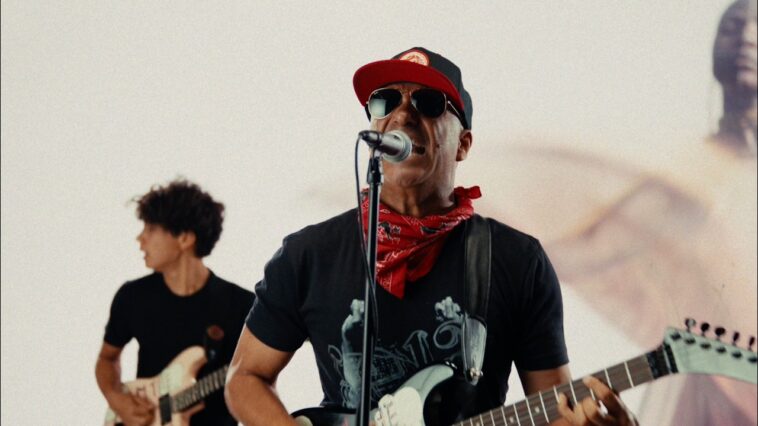
Between arranging the Back to the Beginning show in 2025, touring with his solo band and voicing his opinion on various socio-political issues, it’s hard to believe Morello has had time to make a new record.
Yet Everyone Gets Everything They Want, which features five tracks co-written by his guitar-wielding teenage son, Roman, delivers what the ’90s hero is known for. With big riffs, off-kilter solos and fury to spare, the record, as Morello puts it, is his “heaviest since Rage’s debut.”
“I’ve been playing solo shows since 2001,” Morello says. “I’m very comfortable. But many of those shows were acoustic folk shows, and it’s only recently that I’ve fully embraced an electric band.”
Latest Videos FromGuitar World
This led Morello to make what he deems his “first solo rock record,” and he couldn’t be more excited.
“The dissolution of Rage Against the Machine or Audioslave opened a path for me to embrace the totality of what I can do,” Morello says. “I love playing huge monster riffs, I love playing solos that sound like R2D2 or barnyard animals, and I love jamming with my shredding son, Roman. All roads have led to a record that I’m super-proud of and that’s super-heavy.”
They have also led him to Guitar World’s Goes to 11 format, where we ask heroes our most probing questions. Starting with…
1. What are the quirks or habits of your playing – like them or not – that have become a part of your style?
One thing that’s constant in my playing history is embracing mistakes. When it’s time to do a solo, there’s zero preparation. I’ll just step on a random pedal, hit go and see what happens. In songwriting, there’s inspiration and there’s craft.
You write a riff, and you say, “Okay, I can see a field bouncing up and down in Germany.” And then there’s craft, which is, “Let’s make sure we get a good take.”
But I remember doing records with [producer] Brendan O’Brien, with Audioslave and Rage Against the Machine, where it would be time to do the solo, and he’d be laughing his ass off at whatever came out of my guitar. He’d be like, “That’s the solo?” And I’d be like, “Yes, bro, that’s the solo.” [Laughs]
2. Which guitar do you have the closest relationship to?
For the longest time, I tried to deny any personal relationships with my instruments. I used to just say, “They’re tools or colleagues that you see at work.” But through the years, the Arm the Homeless guitar is the one I’ve been on a journey with. It’s a deep love affair.
I have to admit that after all these decades. I’ve had hedge-fund guys offer me insane amounts of money for it, and I’m like, “This thing ain’t going nowhere, buddy.” I stopped modifying it in 1988, but from late ’86 to ’88, a tremendous amount of modifications happened. After that, I literally gave up. [Laughs]
3. What’s been the hardest/toughest time you’ve had as a musician, and how’d you get through it?
There have been four pillars of my career, which are four great failures. The first was when I was 13 and wanted to learn Led Zeppelin’s Black Dog and Kiss’s Detroit Rock City. I failed, and I quit guitar. I told my mom, “Music is not for me,” and the guitar sat in my closet for four years before I touched it again.
After getting a Sex Pistols cassette, which is when I picked up the guitar again, there was a determination to forge my own path without lessons and to find my voice without someone telling me what to do.
Failure number two was when I had this overpriced guitar that I got at a custom shop in L.A., and it was the worst guitar I ever played. It felt and looked the worst, and I’d blown a bunch of money. I spent the next year changing the neck, pickups, electronics and whammy bar, and I also had an amp I thought sucked.
Then one day, I spent a couple of hours in rehearsal and realized there was a sound in my head that I failed to get. I gave up. I was spending too much time worrying about tone and not creating. So, I marked the setting on my amp and said, “This is the guitar I’ve got, and this is the gear I’ve got.” That was the Arm the Homeless guitar, my 50-watt Marshall half-stack and the Peavey cabinet I’ve used on 22 records.

The third failure was when my band Lock Up got dropped. I moved to Hollywood to be a rock star and make records. I got a record deal, and it was spectacular. Our record came out, and 15 minutes later, we got dropped. I failed my quest.
The producer for that record had me tone it down and be smoother. After that, I vowed to never play another note of music that I didn’t believe in, and that’s when I started writing riffs for Rage Against the Machine.
That leads to the fourth failure, and the last pillar of my career: not being able to keep Rage Against the Machine and Audioslave together. I had these two massive bands with billions of streams, and they dissipated.
But that opened a door to some of the greatest musical experiences of my life. A million windows opened for me because those two doors closed, leading to what I’m doing to this day. So, those four massive failures led to a career I’ve absolutely loved and am proud of.

4. What was your first guitar, and how did you get it?
It was the guitar that sat in my closet for four years, the Kay “SG” I got when I was 13 and took lessons on. My mom would say, “Whatever happened to that guitar that we blew 50 bucks on?” And then, when I started playing with my punk band in high school, I got another guitar, and that Kay sat in my closet in Libertyville, Illinois, for decades.
Then, one day, I thought to myself, “I wonder if that Kay SG is still there.” So, the next time I was in Chicago, I went to the house, and sure enough, it was there. I brought it to L.A. and put new frets on it, and I’ve used it on a bunch of records. It couldn’t – and still doesn’t – stay in tune to save its life, but I’ve used it a bunch anyway.

5. How many guitars do you own, and what gear do you own that might surprise people?
I was looking at my guitars yesterday, and there are a lot more than I thought. [Laughs] I’m not a collector, and I’m not buying vintage guitars. My guitars are either for a specific purpose or ones that I’ve been gifted.
But including the ones in storage, there are probably 50. But none of them are fancy! I do have a couple of [Gibson] Les Pauls in a special place, but the rest are all from the Island of Misfit Toys.
As for surprising – and I don’t know if it’s all that surprising – I’ve leaned heavily on two pedals: the small [EHX Nano] POG [octave pedal] and the DigiTech Space Station [XP300] that they made in, I think, 1994. It’s got some freaky sounds that lead to solos where we’re on an unknown journey together. [Laughs]
6. Tell us about a moment of genuine inspiration.
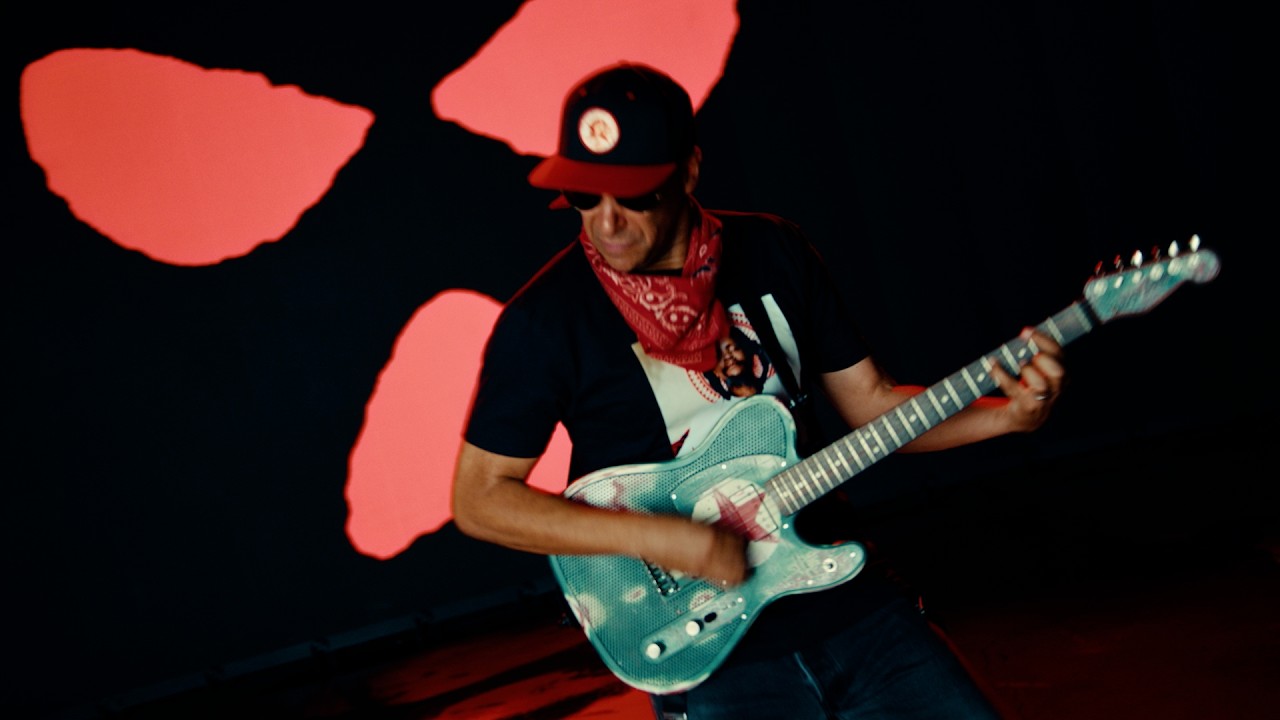
For my new album, I was determined to make my first rock solo album. I’ve made plenty of band rock albums and some collaborative rock albums, but over the last five years, in live settings, I’ve played some of the best shows of my life. I’m having more fun than ever fronting the Freedom Fighter Orchestra.
I’ve been playing heavy music and loving it. I wanted to make a record that reflected that. I’d say that this record, Everyone Gets Everything They Want, is probably the heaviest record I’ve made since Rage Against the Machine’s [self-titled] debut. I wanted to meld and bring the Morellian riffs from Rage Against the Machine, Audiosalve and Prophets of Rage, but also bring them into the present and future.

7. What was it like being in the room with Chris Cornell, Zack de la Rocha and Bruce Springsteen?
What a great blessing to have been in bands with Zack de la Rocha and Chris Cornell, and to have worked with Bruce Springsteen
What a great blessing to have been in bands with Zack de la Rocha and Chris Cornell, and to have worked with Bruce Springsteen. They’re some of the greatest to ever do it. To be able to witness the way they rock a crowd, their mannerisms and preparation has been hugely influential.
With Bruce, there’s that commitment each night that every time you go on stage, there’s determination that this is going to be the best show you’ve ever played. You’re going to give these people something that’s better than what they’ve seen before.
It’s like, “Just wait until they fucking see me tonight.” That’s something I very much ingrained in myself. The intensity of Rage Against the Machine, the melodic ability of Chris Cornell, along with their kindness, and the way they treat people… all of that has been inspirational as well.
8. Who is the most exciting up-and-coming guitarist?
Here’s the thing: it’s not nepotism when your kid’s that fucking good. [Laughs] There’s a lot of great players out there, but I’ll put my kid up against anybody.
He has something that I didn’t have, which is an ear. I had to fight forever because I had zero natural ability, so it took me maybe 10 years to find my voice. But Roman Morello has got an ear and has a natural [internal] jukebox.

9. Which of your songs do you find most challenging to play, and why?
Well, from my new record, that’s easy. My son Roman was a co-writer of five songs from this record. I always have an ear to his door and poach his best riffs, so there’s a kinship there.
He has the Morello DNA and writes riffs that are familiar to me. But his fingers move in ways I’d never think of. So, the riff from Everyone Gets Everything They Want is really counterintuitive to me.
And then there’s another from Soldier in the Army of Love, where there are these big pentatonic riffs. You might go, “That’s a Tom Morello riff,” but it’s not. That’s a Roman riff that Tom had some difficulty learning. [Laughs]

10. What’s the best piece of advice you’ve ever received as a guitarist?
That’s easy! I was a beginner guitarist, and there was a high schooler who was more advanced than I was. He’d come to my house to jam, and he said in an offhand way – though I took it as gospel – that if I wanted to get better on guitar, I needed to practice one hour a day without fail.
I said to myself, “I’m going to try that.” I practiced one hour a day, every day, without fail. I immediately noticed – because I started late at 17 – that I was getting better. Then I thought, “What if it’s two hours? What if it’s four? Shit! What if it’s eight?” That’s when I hit this crazy, euphoric stride where I felt the tide rising almost daily.
I locked into it, and there were times when I was pursuing honors at an Ivy League university, and I was practicing until four in the morning obsessively for 365 days a year. I don’t necessarily recommend it, and it hurts your social life, but that bit of advice is what allowed me to unlock the guitar and my creativity.
11. What’s the biggest misconception about you?
People are often surprised that I have a folk music career. People are surprised by Saturday-night disco nights at my house. [Laughs] But one time, I went to see my friend Warren DeMartini, and he said, “A friend of mine is in a metal band, and he’s a big fan. He wants to meet you.” I was like, “Totally cool.” So, I was hanging out, just sitting there, and there’s metal dudes all over.
People are often surprised that I have a folk music career. People are surprised by Saturday-night disco nights at my house
I saw Warren standing with the dude, and he was pointing over at me. The guy came over and was very excited, and he walked right past me to a dude that looked exactly like Zakk Wylde. [Laughs] He assumed that must have been the guy Warren was pointing to! It couldn’t have been the half-Black dude in a Cubs cap wearing a Charlie Brown shirt! [Laughs] Then that guy behind me that looked like Zakk Wylde goes, “No, no, no, that’s Tom!”
The other guy had this look of utter bewilderment. [Laughs] I mean, this other guy was like a cross between Zakk Wylde and Rob Zombie, so he must have thought, “That’s gotta be the guy.” I guess the greatest misconception about me leads to: don’t judge a book by its cover.