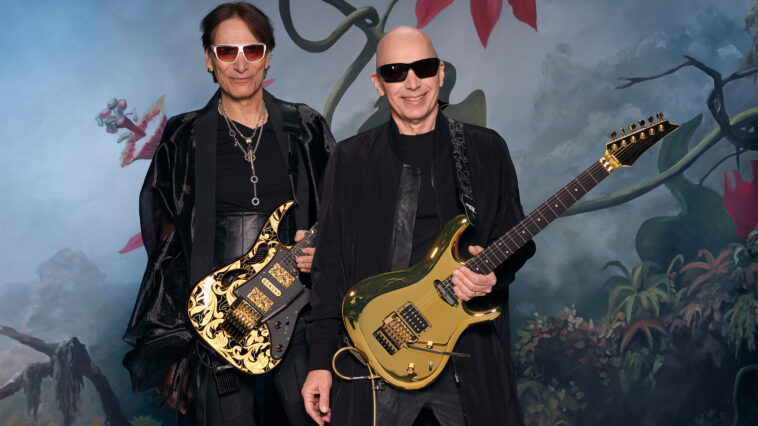
For Joe Satriani and Steve Vai, making a record together was inevitable.
It was just a question of when. Now, 52 years after Satriani began giving Vai guitar lessons while they were teenagers growing up on Long Island, it’s happened.
The Sea of Emotion, which comes out November 6, is a labor of love the two guitar heroes have spent much of the last two years making between other projects. Those include Satriani’s membership in Sammy Hagar’s Van Halen-saluting Best of All Worlds Band and Vai’s assignment to the Robert Fripp seat in the King Crimson spin-off Beat.
For guitar fans, it’s the arrival of a sonic summit meeting that’s been on many a wish list. For Satriani, 70, and Vai, 66, it’s the culmination of a lifetime of work and mutual admiration.
Vai remembers those lessons with Satriani as “glorified jam sessions,” sitting back-to-back in Satriani’s backyard, playing unamplified and learning to intuit what each other were doing.
“That was an incredible training,” Vai tells us during a joint Zoom with Satriani. “When you do something like that, you develop a listening atmosphere, so to speak. For me that’s one of the highlights of being a musician, sharing that space with somebody else.”
Their ambitions led each to California for long careers spent mostly in parallel as they released their own albums and worked in bands: Satriani with Deep Purple, Mick Jagger, the Greg Kihn Band and the all-star Chickenfoot; three-time Grammy Award winner Vai with Frank Zappa, Alcatrazz, David Lee Roth and Whitesnake. They intersected on many occasions, primarily during the Satriani-organized G3 tours that started in 1996.
During 2024, meanwhile, Satriani and Vai toured together with their own bands and teamed up on the encores. When management suggested having something original to play together, they recorded “The Sea of Emotion, Pt. 1,” which set the idea of a full-fledged band of their own, and an album, in motion.
This year SatchVai released two more songs — “I Wanna Play My Guitar,” featuring Glenn Hughes on vocals, and “Dancing” — while completing The Sea of Emotion remotely, with producer/keyboardist Eric Caudieux assembling contributions from a rotating cast of musicians. Drummer Kenny Aronoff and bass guitarist Marco Mendoza joined SatchVai on tour during the summer, along with guitarist Pete Thorn.
The album runs a wide stylistic gamut, from the hard-charging “Mayhem” and “Bronco Freight Train” to the lively “Dancing,” an interpretation of a song by Italian singer Paolo Conte. “The Feeling I Know” builds majestically from a quiet start, while “Old Sins Have Long Shadows” leans toward fusion. The centerpiece, of course, is the three-part “The Sea of Emotion,” more than 17 minutes of collaborative combustion that pushes the pair to new peaks of prowess.
Neither Satriani, who resides in the San Francisco Bay Area, nor Vai, who is based in San Diego, was in need of a career statement at this point, but The Sea of Emotion is certainly one. Call it a summit or a master class; it’s how two generational talents finally found a moment to join forces and do something they, and the rest of the world, have been waiting for.

So… what took so long?
SATRIANI [laughs] We certainly thought that when the time was right, it would happen. We couldn’t figure out ahead of time, with our schedules, like, “This year we’re gonna do it” or something like that. We knew a project like this was gonna take us away from all those other things we wanted to do. So without talking about it, we figured it would happen when it happened. And it did, quite organically.
VAI It’s something we always considered in the back of our minds, but we were forging our careers and we had a lot of ideas for our solo music. This album had a little bit of an odd chronology, because Joe and I had all these other gigs going on, and the evolution of making the record was kind of organic. We never actually sat there and thought, “Hey, do you want to make a record together?” It just happened. We knew.
All good things come to those who wait, then.
SATRIANI I’m glad we waited for it, in a way. Now we’re remarkably older, and we’ve had this benefit of a crazy roller coaster of success. So there was such a relaxed attitude toward, “What are we gonna write?” and “What kind of album are we gonna do?” We simply never talked about it.
If we’d tried it before, when we were really trying to prove ourselves and take advantage of our sudden successes, we would’ve brought that anxiety into the studio and would’ve had a lot of pressure from outside sources, labels and things like that. Doing it now, we were able to let it just happen.
VAI When people who know Joe and I listen to it, they’ll obviously know if something was Joe’s or mine. And there are songs here like that.
But there are others that were just an idea, a couple of chords or a riff or something, and we built them up going back and forth with each other. I don’t collaborate like that very often; I’m usually the master and commander of every note, so it was really great to be in an environment where it was so creative.
SATRIANI What keeps coming to my mind is coming to terms with the fact that we’ve made this record that has this compositional weight to it that’s really something. It’s not a record that I would’ve made on my own, and I don’t think Steve would’ve made on his own.
Somehow when we get together we make this third thing we weren’t expecting that’s really greater than the sum of its parts. That’s how it feels now that I’ve forgotten all the fader moves and the edits and everything; I can just listen as a normal human being, and these songs are intense. They’re beautiful and unexpected and have all these cool little Easter eggs everywhere. It’s just really nice.

Easter eggs? Explain…
SATRIANI The biggest one, really, is the fact there’s a recording of us playing when we were teenagers that I had made during a guitar lesson we were doing in my childhood bedroom. Steve kept that tape and transferred it to digital and decided to write a song based on those few minutes of us trying to work out a lesson built around something I was writing at the time.
If people didn’t know this story they’d probably think it’s the weirdest introduction to a song they’ve ever heard, but what a perfect way for “The Sea of Emotion, Part 3” to start — going back to an actual recording of us playing as teenagers. I think that’s pretty amazing.
Making the album, what did you learn about each other and each other’s playing that you didn’t know — or could not have known from the ways you’ve worked together before?
VAI I think for me, many things were reinforced based on my perspective of what I was expecting — things like quality of melody, quality of rhythm, instincts for ideas and sections and things like that. One of the things that didn’t surprise me was Joe’s instantaneous inventiveness, just sitting there and playing. The riffs come organically, frequently, and they just sound so inspired. I’m in the next room going, “What is he doing?! We’ve got to record that and make a song out of it!” It’s constant, and it’s cool. It was constant inspiration and education.
SATRIANI I had this sort of revelation the other day, when I was listening to the album. I was surprised because I thought I knew how crazy Steve was, but as we progressed writing and recording this album remotely, you’d be waiting a day or a week or a month for the other part to arrive. And then you’d get it and you’d think, “What the hell is that?! That’s insane!” And that happens over and over again.
So I thought I knew how crazy Steve was until we got to the very end of the record, and I thought, “I did not know he was that crazy!”
VAI [laughs] I can’t help it. Sorry.
SATRIANI I even went back to his other records, like, “How did I miss that?” And, no, he’s been more conservative in the past. He got even crazier on this album, where I thought maybe he would have done the opposite.
VAI I blame you for that.

So how reactive were you to each other during this process? Did the interaction really make Steve crazier, and then what did that bring out of Joe?
VAI The nice thing is I don’t think we felt limitations from the outside world…from what the industry is doing, from what technology is doing. I would receive something from Joe, and to reflect on what he was just saying, I was feeling the same way. It’s rare to hear something innovative and new in just a little riff or something, but there were so many of those.
Like, I remember when I received the “Zoot Suit Riot” solo. I was stunned. In the back of your mind, you’re not competing but you’re trying to up your game based on how the other guy is upping his game. For me that means you’ve got to go a little more crazy. You’ve got to think a little bit more out of the box.
So after I heard that “Zoot Suit Riot” solo and especially the little, tickling riff on the end of it [sings], I’m like, “What the fuck is he doing?!” Then it’s like, “Okay, I’m taking the straitjacket off. What can I do? Where’s the weird Steve Vai?” — within reason.
SATRIANI [laughs] No. No reason.
VAI So the riffs turn more into a guilty pleasure as opposed to being appropriate for the songs, and that was fun. It was so fun. I think we both went to places we may never have gone on our own. It needed that chemistry, that chemical soup of both of our DNAs. It was really fantastic.
SATRIANI The first time I heard “Zoot Suit Riot” I thought, This is a Steve Vai show. In my mind, I could see how Steve would set the stage up, what he would wear, how the song would go down based on the entire presentation beyond just the cool guitar parts and the interesting melody and all the cool rhythms. I just never write music like that.
So all of a sudden I’m in this position where I’m hearing it and I’ve got to grow into this, somehow. Steve has offered this amazing piece of music up, and I don’t know what the hell I’m gonna play, because I’ve never inhabited it before. So it doesn’t surprise me that I would play something that would surprise Steve, because he’s surprised me.
And that whole process played out over and over again on this record. There are spots in each song where one of us offered something and the other one would respond like, “Wow, that’s crazy. What am I gonna do now? I’ve got to somehow up my game in this fun process.”
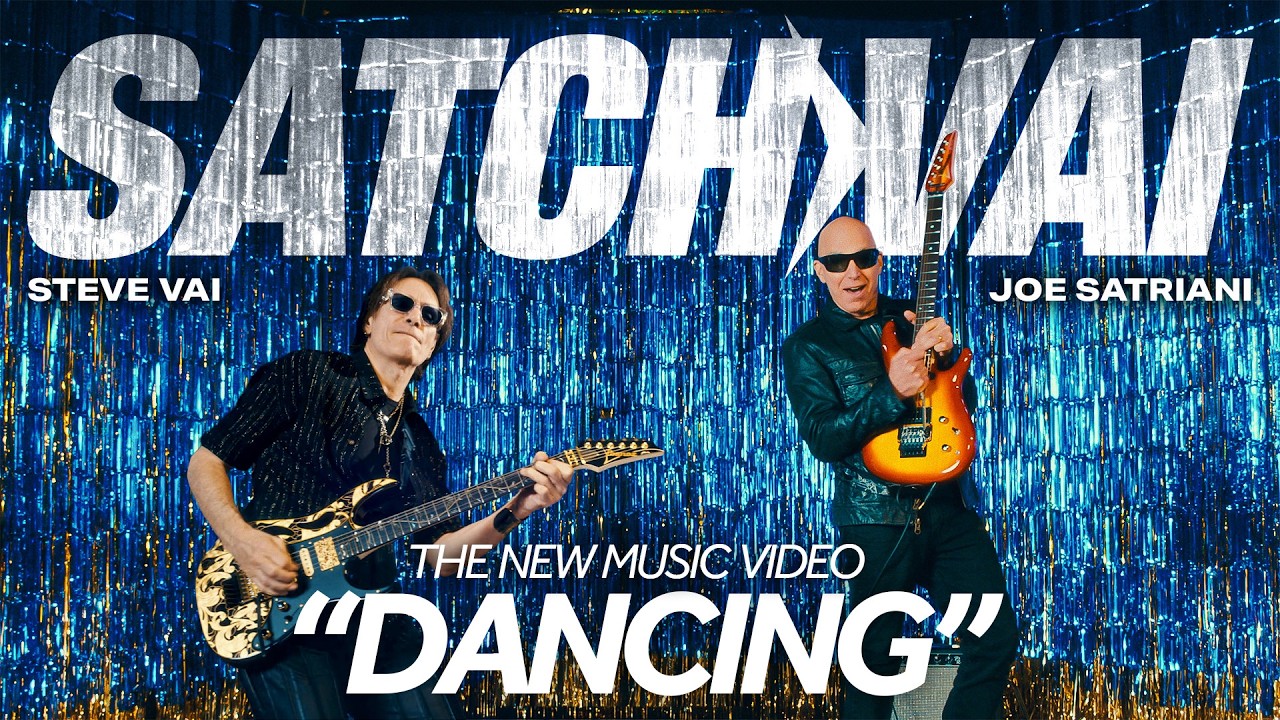
“Dancing” is emblematic of that. What’s the story there?
VAI Many years ago, in the early ’80s, I found this Paolo Conte track; he’s an Italian, kind of pop singer, very famous. I just fell in love with it and kept listening to it through the years, and I would keep imagining it as a guitar track. So I kept it in the back of my mind and just thought, “Well, one day…,” ’cause I wanted to do it with another guitar player.
When we started doing this album, I sent it to Joe and said, “I got a crazy idea here. I love this track. I want to make all the horns that are on it the guitar tracks and beef up the arrangement.” I thought he’d say, “What, are you crazy? This is not rock and roll!” or whatever, but he came back and said, “I don’t know what I’m gonna play on this, but I trust your insanity,” so we did it.
SATRIANI I like the idea that it showcases some of Steve’s bizarre ideas about what you can do with the guitar and the guitar arrangement of a song. It was really a product of just pure fun, me putting on my guitar and going, “What the hell am I gonna play on this track that’s got, like, 18 Steve Vai guitar tracks on it?”
Glenn Hughes recently announced a retirement from touring and live performances due to health reasons. That must make it mean more to have him singing on “I Wanna Play My Guitar.”
SATRIANI I have great memories of that session. That was the only time Steve and I were together at a session for this record. We were at the Harmony Hut, Steve’s studio, and Eric was there with us, along with Glenn. That was pretty magical, just watching Glenn sing.
And, y’know, the odd part about it is I’m the only one who ever hired Glenn Hughes to not sing on an entire album. This was What Happens Next [Satriani’s 2018 album featuring Hughes on bass guitar], and it was the funniest thing just to watch him not be able to sing, ’cause in-between takes he’d be singing things that would’ve been appropriate for the songs. He just couldn’t help it. I thought, “Oh, damn, I should’ve written a vocal album for him.”
So it was really great to watch him sing on this, just hour after hour getting better and better with every vocal take he’d do, and just trying different things. He’s a magical singer.

Was there any particular piece of gear or some kind of technique that was part of the album what you felt was brand new or, just out of the ordinary?
SATRIANI Well, the main weird thing is that Steve and I recorded this album not using any amplifiers and microphones on our guitars, I don’t think, other than the recording from years back.
VAI I used my [signature Carvin] Legacy [amp] for the rhythm on “Part 3,” but that was it. There were a couple of really nice moments that were a little left of center for what we normally do, such as “The Sea of Emotion, Part 2” and the nylon-string Joe plays. That’s a really beautiful part, and very different from the past.
SATRIANI Today, if you’re 18 years old making an album, the thought of going into a studio with microphones and engineers is, like, so old-school. Everyone goes direct. They’re all using plug-ins and some way of just recording directly.
Steve and I love the art of recording with microphones and speakers and outboard gear and tape and everything. We have so much experience with the traditional way of recording guitar.
I’ve done a lot of DI recording over the years, but I still really love being in a studio, the whole chaotic circus element of it, and watching an engineer with a great set of ears find the right tone.

How about guitars?
SATRIANI I used my ’58 Esquire again. It’s been on every record since ’92, when I picked it up. I used it for a slide solo on “Bronco Freight Train.” Everything else was pretty normal — just my most recent [Ibanez] JS guitars that happened to be hanging out in the room for those few days where I’d be home. And I always use this crazy choral sitar Sterling Ball made for me that’s a seven-string, sitar-style neck and harp strings. That was one of the more bizarre instruments I used.
VAI All my guitars were pretty conventional, but one of the things I like to do is try to experiment with the existing gear that’s available and do things with it maybe I haven’t done before. The DigiTech Whammy Pedal has so much potential in creating sounds and riffs that are not just the conventional thing. The solo I did on “Part 2” of “The Sea of Emotion” — at the end there’s these chord changes, and I’m doing this fast, kind of hammering riff, and the whammy bar is used to change the register of the riff on various notes. That was something I hadn’t really done, so it was more of a stretching of an existing piece of gear.
SatchVai looks like a going concern, then?
VAI Joe and I kind of work in the moment. We never even talked about putting a band together until it just happened; it just felt like the time was right. So I think that’s gonna be the M.O. moving forward.
I know that we are interested in getting back to being our own generals and entering back into our own creative impulses on a solo level. But it was such a fun process, and it was easy and creative. I can’t imagine not working together again, even if in the future it’s just sharing tracks and creating like that.
SATRIANI Really, the most important thing is we created the music. We made a fantastic album. To me that’s the most important thing. That’s always been my main desire, to make an original album. You can play 300 shows a year, or 10, but if there’s no document, if there’s no original music, you’re kind of nowhere. That’s the thing that’ll always be there and stand the test of time. People can go and visit it any time, no matter where we are.