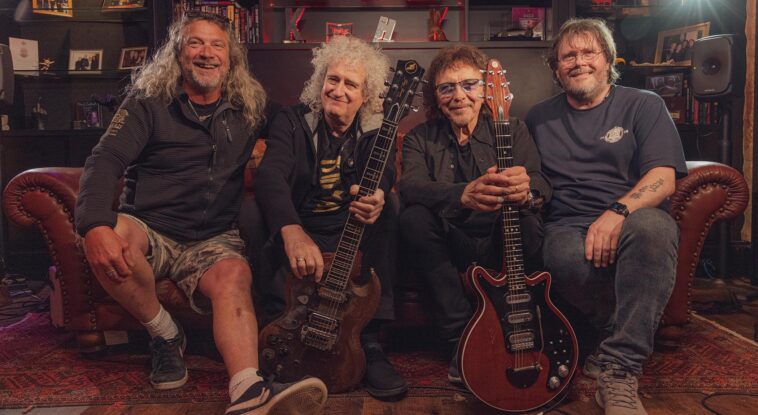
No-one knows Tony Iommi’s electric guitar tone better than Mike Exeter. Iommi’s longstanding guitar tech, producer and friend has been in the trenches with him, helping the Black Sabbath icon evolve his sound.
When GW caught up with Iommi to talk about the release of his long-awaited studio album, From the Dark, the story would not have been complete without hearing from the man in the control booth. And here, Exeter reveals what you hear on record, and explains why we shouldn’t expect Iommi to retread old ground when he’s making a solo record.
What were your audio goals with this album?
Latest Videos FromGuitar World
First off, I don’t think Tony should be defined by Black Sabbath when he’s making a solo album. There’s nothing on From the Dark that sounds like, say, War Pigs.
It sounds much more like a 21st-century album, such as Fused [Iommi’s 2005 album with Glenn Hughes on vocals and bass]. It was put together over a few years, which is why it has a current sound; it wasn’t put together by a band going into a studio and jamming. That’s not what this album’s about.
It’s funny – there was someone commenting on social media, saying something like, “Tony should have done this and he should have done that to sound like old Sabbath” and then added, “I didn’t even like Dehumanizer” [1992 Black Sabbath album]. I thought to myself, “Well, you’re clearly not the target audience here!”
The guitars sound amazing. What’s the secret?
It’s about matching the guitars to the right amp. A lot of the recent recordings are the JayDee Old Boy going into Tony’s [signature] Laney TI100. The way the JayDee pickups push, they work really well with that amp, which was designed about the time he came off the Heaven & Hell album [2009’s The Devil You Know]. The Gibsons sound particularly good with Tony’s [signature] Laney GH100TI, which was his previous amp.
What role did the Kemper Profiler play, if any?
When we started getting together and doing some writing, we didn’t really have a studio as such, so I said to Tony, “I’ll bring my Kemper Profiler down, and you can plug in your Gibsons and JayDee and see if you like it.”
I brought up one of my favorite patches, which was probably a Peavey 5150, and – because it had drive and sustain – it was perfect for the songwriting. If we needed a sound and we weren’t sure where it was going to go, I just dialed up sounds on it, which I could do remotely from my computer.
Which pedals or effects did you use on the album?
Tony doesn’t really need that many effects, to be honest. There’s a Leslie rotary-speaker effect on the opening riff of the first track, which I did either in the Kemper or in Pro Tools. For some of the clean parts we used an Analog Man Chorus, which I could go on about all day. It’s got a shimmer that works on distorted guitars as well as clean parts.
And the distortion?
The distortion is just the amp circuit. The amps aren’t being driven that hard. There’s plenty of gain, but everything else – presence, bass, middle and treble – is at 12 o’clock. Every now and again I’ll try a treble booster, but it’s mostly very simple, as it should be. Sometimes music should just be bare-assed rock ’n’ roll!