
Modifying instruments is a time-honoured tradition. From Eddie Van Halen’s Frankenstein guitar to John Cage’s works for prepared piano, customisation has helped musicians develop styles and sounds all their own. In the realm of digital instruments, the possibilities are even wider – if you’re brave enough.
Tweaking the underlying code of your favourite sampler or synthesiser carries unique risks and, historically, has required a high level of technical know-how. The explosion of AI ‘vibe coding’ tools has changed the calculus somewhat; many of the risks remain, but what was once a steep learning curve is beginning to look decidedly flat. That accessibility has ushered in a new era for firmware modding, and, in an astonishingly short period of time, entire communities have sprung up around hacking specific digital instruments.
“I think if we go back six months we would not be having this chat,” comments Jimmy Myhrman, Chief Technology Officer and head of R&D at Elektron. The Swedish instrument maker has recently found itself in the eye of a fast-moving storm as an increasing number of users have created and shared firmware mods for the company’s products.
Latest Videos FromMusicRadar
“The latest frontier AI models have allowed this really maxed out pace,” explains Myhrman. “We have seen some manual, handcrafted mod projects in the past, but now it’s just at a different energy level.”
“We have seen some manual, handcrafted mod projects in the past, but now it’s just at a different energy level”
One of the devices that received the most attention from modders was Elektron’s Octatrack, a beloved eight-lane groovebox and sampler. Community-made mods added everything from sidechain compression to scale quantize functions to new audio effects. “I was part of the super small team that developed the original Octatrack,” Myhrman remarks. “I feel very enthusiastic following what people are doing with that machine now, using all of these new technologies. It’s quite impressive.”
“If someone has a wild idea and tries to bend it into one of these machines – that’s almost like a feature request to us!” adds Christian Alsing, Elektron’s Chief Product Officer. “When we see that, we get really inspired. It’s like, ‘wow, that’s a pretty good idea’. That’s the fun part.”
Given how many positive things both Myhrman and Alsing have to say about the modding community that has grown up around Elektron products, the company’s decision to ban the sharing of mods on Elektronauts, the brand’s official forum, took some by surprise.
“It escalated pretty fast,” says Myhrman, “People were starting to do modifications of other company’s products as well. The forum is owned by Elektron and it’s Elektron-branded, so for the forum to spread Arturia mods or Teenage Engineering hacks, when these other brands maybe don’t allow this, that would be very complex.”
Citing potential copyright issues and the possibility of damage to user hardware, Elektron instituted a new policy removing posts that distributed mods, stating: “Curiosity is understandable. Bricked boxes – as we are sure people will understand – less so.” The response from the user base has been mixed.
“We are still trying to figure it out,” concedes Myhrman. “I’m not going to say that that policy will be there forever. Maybe it will be updated or changed, but this was the best decision we could do for now.”
Of course, Elektronauts was far from the only place where users could find and share mods. For Elektron products, the foremost destination is now Modwerk, a ‘mod shop’ that Myhrman himself describes as “a great place”.
“The obvious benefit is it allows the end users to finally rectify those small gripes they have with their favourite devices”
Zach “irPina” Louden is one of the site’s originators. His project, Elekloader, is the connecting layer that makes mod development accessible and enables users to safely install them on their instruments. Modwerk serves as the frontend for Louden’s .elemod format, providing a space where users can upload projects which are then tested by the community.
“The obvious benefit is it allows the end users to finally rectify those small gripes they have with their favourite devices,” Louden says of his and other contributors’ motivations. “A proper sample slicer, maybe a dedicated MIDI loopback channel, a reverb that sounds like it was made this decade. All easily achievable with a mod.”
Louden has had a front row seat to the unfolding discourse around Elektron’s decision to ban the sharing of mods on their own forum. “The sentiment of ‘Fuck Elektron! they intentionally deprive their devices of features so they can sell them to you with the next device!’ has been cranked to 11 over the last few weeks. As someone that is deeply in the weeds of Elektron devices – it’s unfounded. These devices are filled to the brim with features, and there is no having it all without compromising something.”
While Louden thinks there has certainly been some overreactions, he’s ultimately critical of the path Elektron decided to take. “I understand it from a business perspective, especially in the new age of AI-assisted development,” he allows. “But I do feel it is shortsighted and will likely lead to splinter communities with both pro- and anti-mod sycophants.”
It’s worth noting that there are very real risks to modding a hardware instrument’s firmware. “It might be that it crashes,” Myhrman warns. “Maybe in a situation where you rely on this product, putting your live performance at risk. It might be that your music project is damaged and you can’t open it anymore. There is even a small risk that the hardware might take some kind of damage if you don’t control it in the right way.”
In the case of Modwerk, Louden says he’s only seen two instances of the worst-case scenario: users left with permanently damaged instruments. “A Model:Cycles where the user was trying to do some risky modifications to the bootloader,” he recalls. “And an Octatrack that seemed to have died due to a power failure mid-upgrade. With mod frameworks like Elekloader, bootloader modifications are checked before a mod ever reaches a device, and we have no documented bricks that have emerged from there.”
While Elektron has so far watched these developments with cautious interest, other brands are moving much more quickly – none more so than Akai Professional. The company has embraced modding as “a meaningful new force around our products” and has released software development kits (SDKs) for the latest MPC, MPC Sample and Force.
Jack O’Donnell, CEO of Akai’s parent company inMusic, says the company has seen energy gathering over the last year – but that it was the modding community’s reaction to the M-VAVE FM-1 that made it clear it was time to get involved.
“We recognise the creativity, interest, and influence of this community,” O’Donnell told MusicRadar. “We also believe that when customers buy and own a product, they have a right to decide what they want to do with it. Rather than push back against that creative impulse, we chose to welcome it and learn from it.”
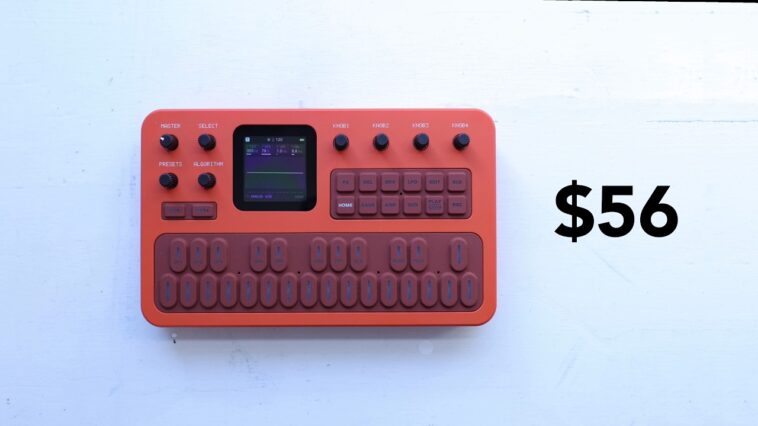
Originally released in June of 2026, the FM-1 was billed as an ultra-affordable pocket synth crammed with classic DX7-style synth tones. It quickly gained a following, and was just as quickly jail-broken for custom firmware mods, becoming a focal point of the AI-assisted modding scene.
In the months since its release hundreds of community-created firmwares have popped up, transforming this FM synth into, among other things, a multi-track groovebox, a granular sampler, a Roland-style drum machine and a hardware port of Serum. In October, M-VAVE embraced the trend and officially forked its operating system, offering users a choice between a closed factory firmware that shipped with the unit and an open source OS that could be tinkered with by users to their heart’s content.
Other companies also quickly moved to meet the moment: Behringer has announced that its new Kick sampler will also be open source, and both Erica Synths and Polyend have moved to publicly share code for some of their existing instruments. Not to be outdone, Akai followed up with teaser videos showing off their forthcoming Sample Key instrument hosting an array of different operating systems, all vibe-coded using Claude Code.
The race is most definitely on. O’Donnell tells us that, for Akai Professional at least, this is more than just a passing trend. “Going forward, we will increasingly build products with software and firmware customisation in mind. We expect most future Akai Professional products to contemplate these possibilities from the beginning rather than treating customization only as something that happens after a product has been released.”
At the same time, O’Donnell also acknowledges many of the same dangers that have given Elektron pause. “Bricked units are a real risk,” he allows. “We do not yet know how significant that risk will be in practice. We are not going to pretend that every situation can be anticipated in advance. As this develops, we will learn from actual use and respond where necessary, most likely on a case-by-case basis.”
Regarding the potential for users to move IP between hardware units, O’Donnell says in instances where “individual activity crosses into conduct that is unethical or misuses protected work, we would clearly discourage it.” Exactly how such activities would, or could, be policed remains fuzzy. Frustrating games of whack-a-mole by individual companies rarely curtails what users choose to share on the open web.
“We are not just selling tools. We are trying to sell something that we have injected a lot of creativity into”
For Elektron, hesitancy around modding stems not only from potential risks to customers and brand IP, but from the company’s philosophy of instrument design. “In our minds we are not just selling tools,” emphasises Alsing. “It’s not like hammers and screwdrivers. We are trying to sell something that we have injected a lot of creativity into.” He points to the decision to have only a basic OLED screen on instruments like the Digitakt II and Tonverk, rather than a larger high-definition colour display, as an example of how limiting the scope of an instrument can give users a more creatively focused experience.
“This is maybe the most sensitive topic for many users,” says Alsing. “I think it’s a common misunderstanding right now that, just because we haven’t put a certain function into a product, that we have lied and said ‘it can’t be done, it’s impossible.’ Nothing is impossible, but we want people to have a good user experience. We want the products to have their own identity.”
“The more computer-like we make a product, the less dedicated that product becomes,” agrees Myhrman. “We want to build dedicated, bespoke experiences: a really good drum machine, a really good synthesizer, a really good sampler. If it was just one product, with all of those personalities, it wouldn’t be as direct or rewarding.”
Funnily enough, Louden has strikingly similar reasons for why he and other members of the Modwerk community choose to focus their efforts on Elektron instruments.
“Money is finite, and people would rather have one box that can do everything they need versus spending double on two boxes”
“Elektron products are in an interesting position within the groovebox ecosystem because you can’t add everything to them,” Louden explains. “They don’t have a lot of buttons, they don’t have a particularly high-resolution screen, and that really limits the scope of what a mod for an Elektron device can be. To me, this is a good thing. The hardware limitations put in place by Elektron allow a mod maker to make very targeted changes that fit within the design philosophy of Elektron.
“The biggest user experience boons for the Elektron ecosystem is the hardware itself,” Louden continues. “The screen is standardised across all devices, and the button placement and UI/UX has been meticulously thought out to make it incredibly easy to program whatever song you have in your head into the device. This doesn’t go away with a mod maker adding a synth to the Digitakt – it’s extended by it.”
At the same time, Louden acknowledges the reality that for some users the attraction might be more utilitarian. “Money is finite, and people would rather have one box that can do everything they need versus spending double on two boxes.”
Therein lies the tension between open-source, do-it-all instruments like the FM-1 and more “bespoke” devices. If instrument makers know that an increasing number of their products will be repurposed using freely available mods, will they continue to spend so much time and money devising, testing and refining firmware and feature sets? Similar to how supermarkets make you scan and bag your own groceries but still charge you the same amount at checkout, some manufacturers might decide that it’s actually good business to release capable hardware with rudimentary software and let the community do the work of development.
Whether or not that’s a bad thing depends on your perspective, and in truth, that train has already left the station. There is an undeniable demand from users right now to have more control over the software that runs their hardware, and as the buzz around AI-assisted modding continues to grow, every manufacturer will be forced to stake out a position on the issue one way or the other.
As Louden puts it: “300 nerds with Claude are going to outcompete any synth manufacturer on the market. You can either lock down your OS via encryption and create that walled garden, or you can do what Akai is doing and embrace the new wave of software by building the platform to house it.”