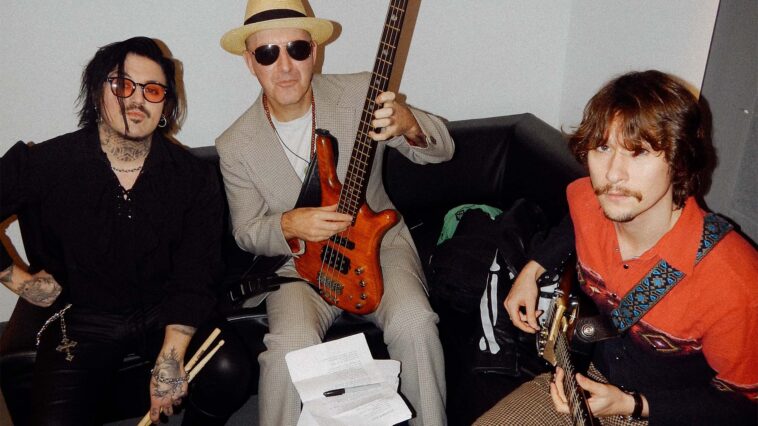
Malcolm Bruce and Kofi Baker had a decision to make when they first put Sons Of Cream together. As the sons of bassist/vocalist Jack Bruce and drummer Ginger Baker, they wanted to honour their fathers’ music, to perform it, but they had no intentions of becoming a tribute act.
Joining MusicRadar over Zoom, having finished making Sons Of Cream’s new studio album, Half And Half, at Marshall Studio, Bruce says that would have defeated the whole ethos of Cream. This Promethean power trio, featuring the world’s first guitar god, Eric Clapton, had a short shelf life, just two-and-a-half years, and yet it was constant reinvention, onstage, in the studio.
If there was one thing Malcolm learned from his father, it was that you had to put your own identity into the music.
Latest Videos FromMusicRadar
“One of the biggest lessons I learned from my dad is that although there’s tradition, there’s also finding yourself within things,” says Bruce. “If you look at Cream, every single time they performed a particular song they were reinventing it, and I think that at the heart of that music is improvisation.
It’s about discovering who I am, my own voice as an artist. And I think that that’s the big lesson from my dad
“There are great tribute bands that dress up like the original band, and they sound like them – and much better than I could do. For better or worse, as an artist, I still feel like I’m at the beginning of my journey. It’s about discovering who I am, my own voice as an artist. And I think that that’s the big lesson from my dad, find your own way to be somebody, not just sound like somebody else. Our approach to doing the Cream music is to be ourselves as much as possible.”
Sons Of Cream do, however, conform to the power-trio format. The lineup is rounded out by Rob Johnson on guitar, and Johnson, crucially, has a familial link to the original Cream lineup. His grandmother was Ginger Baker’s sister, making him Baker’s great nephew. It begs the question as to who has the hardest job in the band. Jack Bruce’s bass guitar playing was peerless, and he was singing at the same time.
As Robin Trower told MusicRadar recently, having played with Bruce in their short-lived BLT project (another power trio), the former Cream frontman was in a class of his own. “It was wonderful working with Jack. He was such a unique musician,” said Trower. “Unique. I don’t think I could learn anything from him. He was on a different level altogether.”
“I agree with him,” says Bruce. “I think my dad was a genius in that way – in the same way that Ginger Baker or Miles Davis, or whoever – every note you hear they do, it sounds like them.”
Bruce is genuinely impressed by those who play in tribute bands, who can play the Cream catalogue front to back, and more power to them. But what people don’t quite get about the magic of Bruce, Baker and Clapton is that their gifts were beyond the limits of technique.
“There are elements of technique, but it’s more just that,” says Bruce. What is more important is this idea of “exploration and discovery”. As Bruce sees it, his father – Baker and Clapton too – was looking for something different in the music each time they performed it. “I find Cream’s music – perhaps because it’s improvisational – that it’s still very much alive,” he says. “To me, it doesn’t sound like classic rock. It doesn’t sound dated to me.”
To best understand Cream today, we have to put them into the context of their time. In the late ‘60s, youth culture was still a new phenomenon. There was still the promise of Free Love. The dream of ‘flower power’ hadn’t yet wilted. There was also the promise of freedom. High-powered Marshall tube amps were transforming electric guitar tone. Rock was getting louder, and it was getting more experimental too.
“I think it was a cultural crossroads,” says Bruce. “The baby boomer generation, everything coming together, a reaction against the establishment, based on love, the emergence of a youth culture that hadn’t really existed before.”
A few years earlier, Bob Dylan had done the Albert Hall, but it was historic to have a rock band in there doing something on that scale
The wider culture was paying attention. 58 years ago today, Cream played their farewell show at the Royal Albert Hall in London. This was a serious moment. Even now, there’s a prestige that comes from playing the venue. Imagine how it was then.
Bruce was yet to be born. But he has Super 16 footage of the Cream Farewell Show, which was shot by his grandfather on his mother’s side. There’s no audio, but even so, that would be something to see.
“I’ve got it somewhere,” says Bruce. “I mean, yeah, it was a historic time. I know Tony Palmer a little bit, who made the film based on that concert. A few years earlier, Bob Dylan had done the Albert Hall, but it was historic to have a rock band in there doing something on that scale.”

Sons Of Cream had the title for Half And Half before they had fully written the record. It was too good, too simple. There are 12 tracks, a real Side A, Side B affair, with six original songs, and six of Cream’s. That they coexist on the same album says a lot about where Sons Of Cream are coming from. Choosing which Cream tracks to cover couldn’t have been easy.
“One of the things we definitely said is, ‘Let’s not do White Room and Sunshine Of Your Love, and Crossroads. Let’s not do the most obvious song,’” says Bruce. “Also, my mum co-wrote a couple of songs on Fresh Cream. She co-wrote Sweet Wine and Sleepy Time Time, so we actually recorded both of those, and ended up just with Sweet Wine on the record. She co-wrote that with Ginger, so it’s nice for her, nice for her bank balance. She’ll get the £27.50 when we stream it 400 million times on Spotify! [Laughs]”

As Bruce reminds us throughout this conversation, he is too close too all this to have any proper distance. If you’re thinking that growing up as the son of Jack Bruce must have been surreal, then yes, Malcolm Bruce can confirm, it was a little surreal.
“Yeah, I’m way too traumatised by the whole thing to really have any objectivity about it,” he laughs. “Remember where my dad was from. He’s from Glasgow. That’s the other thing, it’s a strange path. You have a father who was great. I mean, I love my dad to bits. But he was from a particular background, so there was a tough, survival aspect to him, coming up that way, and then he puts me in a nice private school, and invents a middle-class son. I mean, that’s a whole other deep conversation. [Laughs]
“But as far as the music goes, definitely, it’s a bigger thing than any of us. I try not to listen to it too much, because I’m playing it. I don’t want to be inhibited by any of it. I don’t want to try to copy the way my dad played things. I want to explore and find myself in it, in the music.”

This would be what his father wanted. Jack Bruce encouraged that sense of artistic adventure. What Malcolm Bruce is doing now is no different to what Gary Moore was doing when he was playing with Jack Bruce in BBM (Bruce, Baker Moore).
Moore might not have been family, but in his own way, he also grew up with Cream, with Clapton, and had to find something of himself in those compositions.
“Gary was a right character, a brilliant guitar player, but he was a superfan of Eric, and you can hear that in his playing,” says Bruce. “But also he was incredible to find himself in it as well, and I think my dad would always encourage that.”

Bruce says his father felt a little trapped by Cream’s success. Their rise was meteoric. We are still talking about them today, still have Disraeli Gears and Wheels Of Fire on regular rotation, and yet they were only around for less than three years.
“I feel like he got a little trapped by making a living and being associated with that music, two years of a 55-year career,” says Bruce. “That’s the commercial aspect of being in the business. But I think he also embraced it, too. He gave into it. ‘Okay, I did write a couple of songs that everybody knows, and I’m proud of it as well.’”
But this reluctance to be the rock star explains much of Bruce’s career choices post-Cream. He would join up with Lifetime, the jazz fusion project led by Tony Williams. Williams was coming at this from the opposite side of the aisle. He was the legendary jazz drummer who wanted to be a rock star.
“My dad wanted to be taken seriously as an artist,” says Bruce. “Not just seen as a rock musician, but seen as a musician musician. And I think Tony didn’t want to just be obscured into the jazz world – he wanted to have that mainstream appeal and success, and I think, again, there was that moment in time where, with Lifetime as an example, where for the two of them that was a possibility. It didn’t work out, but it was a possibility!”

Marshall Studio is based at the headquarters of Marshall Amplification, in Bletchley, England, and it gave Bruce and Johnson plenty of options for dialling in a tone that was appreciably late ‘60s. They duly ran their guitars through a hand-wired JTM45 and a modded Plexi for that high-volume mojo.
But again, this was no slavish retread. Johnson used a Les Paul and a Telecaster. Bruce played guitar on the album, too, using his 1974 Gibson SG Deluxe with a walnut laminate finish, plus a Framus Mayfield, a Framus Diablo and a Warwick Jazzman FNR bass.
It was one thing playing and reinterpreting his father’s bass parts, but what about Clapton’s guitar? These are the kinds of things that are unhelpful to think about when you are recording covers of some of the most influential tracks in the classic rock canon. Johnson did a lot of homework on Clapton.
Some things require a certain faithfulness to the original recording. If they are to put Sunshine Of Your Love in the set, Johnson has to nail that solo, much as Clapton played it. The beauty of Cream is that there is this elasticity to how it’s arranged that invites reinterpretation.
When you’re five or six and your dad is playing a Cream record, because it’s his record? I’m not trying to analyse it, but it’s my life
“When I was playing guitar, again, I just take my own approach,” says Bruce. “I don’t even think about Eric, to be honest. That’s not because I don’t have absolute respect for him, but I just, purposefully, I’m not going to try to sound like him. He is him, I am me.
“I have high aspirations as a guitarist, separate from being a bass player, or a piano player, or whatever. And for me, it’s about discovery. I wouldn’t ever dream of comparing myself to any of these guys.”
But then, when you have a name like Bruce and you’re playing Cream songs, other people can do that for you. For Malcolm Bruce, all this is weird and wonderful just as it is without overthinking it.
“When you’re five or six and your dad is playing a Cream record, because it’s his record? I’m not trying to analyse it, but it’s my life. That’s what my experience has been, and so it’s kind of rubbed off, and then hopefully I can take those influences and make it something of my own.”