![Andy Summers Discusses the Creation of The Police's Hit "Message in a Bottle"]](https://backingtracksfullcollection.com/wp-content/uploads/2026/03/Andy-Summers-Discusses-the-Creation-of-The-Polices-Hit-Message-758x426.jpg "Andy Summers Discusses the Creation of The Police's Hit \"Message in a Bottle\"] 1")
“It’s a famous riff, and I have to admit it’s hard to play,” guitarist Andy Summers says. “People want to play it, but a lot of them can’t — the stretches are too big. You have to be a real guitarist to do it well.”
Summers is talking about “Message in a Bottle,” the cascading guitar showcase that opens Reggatta de Blanc, the 1979 sophomore album by the Police.
Released as the album’s lead track, the song became the band’s first number-one hit on the U.K. Singles Chart. More importantly, it captured the trio’s chemistry at full strength — Summers’ shimmering guitar riff, Sting’s elastic bass line and Stewart Copeland’s explosive drumming locking together into one of rock’s most instantly recognizable sounds.
Article continues below
“For me it’s the best of the Police,” Summers says. “There are a lot of other great tracks, but I’ve always particularly liked that one.”
The riff that defined the Police
While many young bands worry about the dreaded sophomore slump, the Police had no shortage of ideas when they began work on Reggatta de Blanc. Their debut album, Outlandos d’Amour, had already produced hits like Roxanne and Can’t Stand Losing You. But according to Summers, Sting had been stockpiling material long before the band formed.
“He had this giant book — a big, thick, hardbound book — with pages that had lyrics all the way through it,” Summers told Classic Rock in 2017. “So we never really ran out of material.”
“Message in a Bottle” was one of those works in progress, though it sounded quite different in its earliest form before the band entered London’s Surrey Sound Studios with producer Nigel Gray.
“Sting had that riff for a while, but there was another tune with it originally,” Summers told L’Historia Bandidio in 1981. “He’d been fiddling about with it during our first American tour. Finally he rearranged the riff slightly and came up with the song.”
Summers immediately saw its potential — and helped transform it.

“Sting showed me the riff he had, but I embellished it,” he told Guitar Player. “I had the chops to make it swing and rock. I could tell right away it had something, and I was thrilled to play something that started to progress our style.”
Rather than simply strumming chords, Summers built the riff by arpeggiating the notes of the progression — a technique he would later use again on the Police’s 1983 hit “Every Breath You Take.”
“Rather than just strumming chords, I was outlining the figures in a way that integrated very well with Stewart’s hi-hat,” he explained.
In the studio, Summers layered a second guitar part over the original figure to create the track’s distinctive chiming harmony.
“Then it goes into more of a rock chorus,” he said. “But the verse is the classic Police sound — outlining the chord.”
That sound, Summers says, was the result of a deliberate effort by the band to shape Sting’s raw material into something uniquely theirs.
“Really the process was about: how could we take some of this basically raw material and ‘Police-ify’ it — make it sound like the way we sounded,” he told Classic Rock. “Which was of course the unique chemistry between the guitar, the bass line, the high vocals that Sting had then and Stewart’s unique drumming. Never to be repeated.”

The sound behind the riff
Summers’ guitar tone is a huge part of what makes the track instantly recognizable. While many listeners assume he used a chorus pedal — or perhaps his Roland JC-120 Jazz Chorus amplifier — Summers has said the shimmering sound actually came from an Electro-Harmonix Electric Mistress Flanger/Filter Matrix pedal.
He used the Electric Mistress extensively on Reggatta de Blanc and its follow-up, Zenyatta Mondatta. (Earlier, on Outlandos d’Amour, he had relied on an MXR Phase 90.)
The setting on “Message in a Bottle” leans more toward chorus than flange, but for players chasing Summers’ tone, the Electric Mistress remains the key ingredient.
Just as important was Summers’ modified early ’60s Fender Telecaster, which he used on many of the Police’s best-known recordings, including “Don’t Stand So Close to Me,” “Every Little Thing She Does Is Magic,” “Spirits in the Material World” and “Every Breath You Take.”
The guitar features a Gibson PAF humbucker in the neck position and a Tele single-coil mounted directly to the body at the bridge. A brass bridge plate, built-in preamp and phase switch helped Summers achieve the bright, glassy rhythm tone that became his signature.

How he acquired the instrument remains something of a mystery.
In a 1997 interview with Guitar World, Summers told writer Vic Garbarini the guitar had originally belonged to Eric Clapton. According to Summers, Clapton was using the Telecaster while recording Fresh Cream with Cream after his famous Les Paul — the one heard on Blues Breakers With Eric Clapton — had been stolen.
Summers said the two eventually traded instruments.
“I brought it to this session he was doing, and he immediately started using it,” he recalled. “That turned out to be the Fresh Cream album. So then I wound up with the Telecaster, which I played all through the Police and still use today.”
Other versions of the story differ. In some tellings, Summers has said he bought the already-modified guitar from one of his students in the early 1970s while studying classical guitar and composition at California State University. In a 2023 interview with Rick Beato, he said he sold Clapton a Les Paul for £200 and made no mention of the Telecaster being part of the deal.
However it came into his possession, the instrument became central to the Police’s sound.
As Summers told Garbarini, he used the Telecaster “almost exclusively onstage and in the studio pretty much up until the Ghost in the Machine album.”

A solo in the age of punk
Once the basic track for “Message in a Bottle” was finished, Summers faced a decision that wasn’t entirely welcome in the late-’70s punk climate: whether to add a guitar solo.
“We were coming out of a sort of religious punk scene, and guitar solos at that time were supposed to be a mark of the old guard,” he explained. “Stewart was vehement about that, but I was a great soloist, so of course I was soloing my ass off.”
The band ultimately left it in after Sting heard Summers’ take.
“As I started playing a solo over the end of the song, Sting went, ‘Oh, actually, this is really good. Keep it in, keep it in,’” Summers said. “It wasn’t up really loud, which I would’ve liked, but it was in there, with a lot of feeling.”
For Summers, the rhythm section’s contribution was just as important.
“I should say that the recorded version of this song is the best drum track Stewart ever did.”
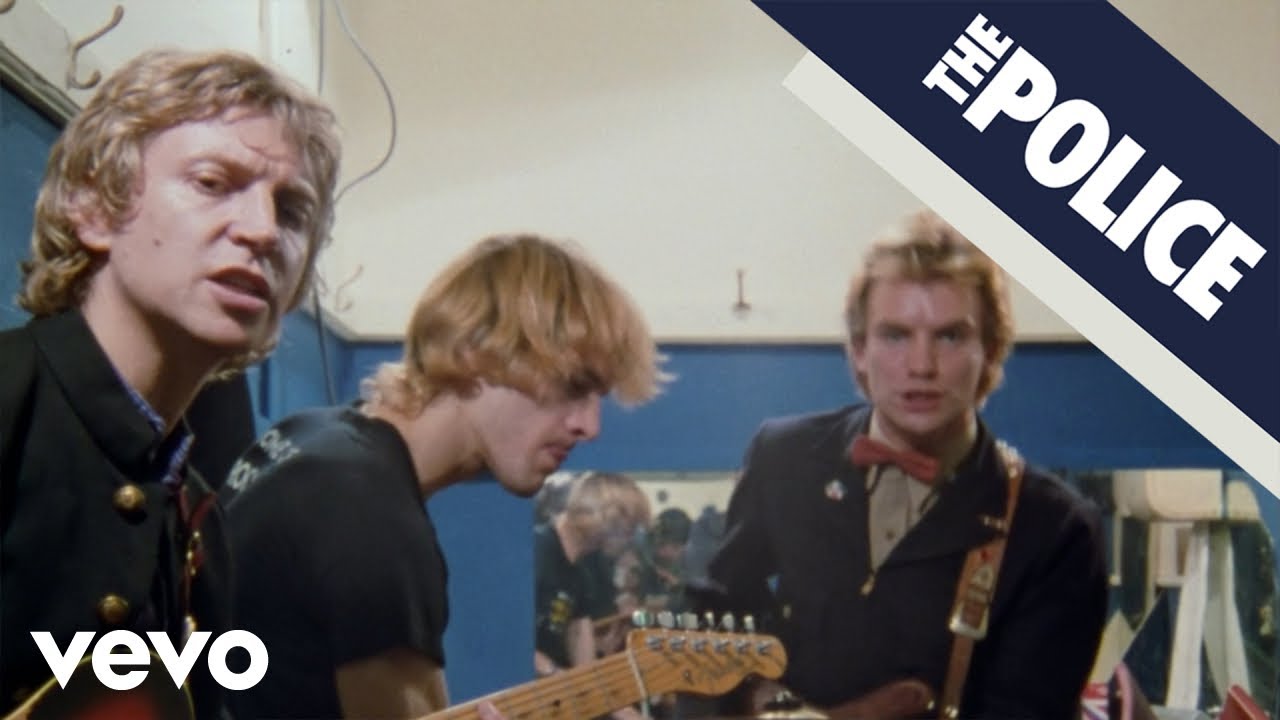
By the time the song was finished, the band knew they had something special.
“Two A&R guys came down from A&M Records, sat down on the couch,” Summers recalled to Classic Rock. “We put that song on, and they were just smiling as widely as they could, because it was a killer track.”
Although the single reached only No. 74 on the Billboard Hot 100, it helped solidify the Police’s growing American audience — a breakthrough the band would fully capitalize on with “Every Breath You Take.”
The song also became a live staple, giving Summers plenty of opportunities to experiment with its famous opening riff.
“I’ve played it a lot of different ways, in a lot of different positions over the years,” he said. “Sometimes playing the second chord, the A, with the open A string rather than going to the obvious shape of the added-ninth chord. It’s pretty cool.”
Forty-five years later, the song remains his favorite from the band’s brief but influential run.
“For me, it’s still the best song Sting ever came up with,” Summers wrote in his memoir One Train Later. “And the best Police track.”