![Gibson ES-5: Set the Stage for a New Era of Electric Blues]](https://backingtracksfullcollection.com/wp-content/uploads/2026/03/Gibson-ES-5-Set-the-Stage-for-a-New-Era-of-758x406.jpg "Gibson ES-5: Set the Stage for a New Era of Electric Blues] 1")
These are both three-pickup Gibson ES-5 models – the earlier example isn’t technically a Switchmaster for the very obvious reason that it doesn’t have a switch.
Gibson introduced the three-pickup ES-5 in 1949 and described it as ‘the supreme electronic version of the famed Gibson L-5’. It’s widely accepted that the ES-5 was the first production guitar with three pickups. Gibson only made 22 examples that year and one of them was to become the instrument that T-Bone Walker used throughout the 1950s and 1960s.
I don’t think that the natural finish became an option until 1951, which is when the first of these guitars was built. I have the original bill of sale and Gibson shipped it out to Germany to a guy whose surname was actually Gibson. He was in the armed services and stationed out there at the time.
Article continues below
The construction details are all very standard. The 17-inch wide body is maple and it has the laminated maple neck construction with an ebony ’board and pearl marker blocks.
In the absence of a switch, Gibson equipped the ES-5 with three volume controls and a master tone control by the cutaway. It’s just like the model T-Bone Walker played, and the stock wiring had the middle pickup magnetically out of phase with the other two. With fully independent volume controls, you can get a very wide range of tones.
In 1955, Gibson put a four-way switch in place of the master tone control and changed to individual tone controls. The switch allows each pickup to be selected individually, and the down position, which is labelled ‘All’, activates all three simultaneously. The next big change occurred in 1957 when the newly introduced ‘Patent Applied For’ humbucker replaced P-90s in the ES-5 and all of Gibson’s prestige models.
I’ve had plenty of time to fool around with these guitars and you can really hear the differences in tone. Most obvious is the warmth that the P-90s give you, although you can almost duplicate that by rolling off the tone controls on the [Patent Applied For] guitar a little bit, but it’s not as sweet.
To me, it’s much more of a true jazz guitar with P-90s. The Patent Applied For pickups are really cool, and they have the full-width pole spacing, but the P-90s sound like a more natural match on this particular model.
If you look closely, you’ll see that the ’51 has the ‘tall boy’ speed knobs, as you tend to find on 1952 Les Paul Goldtops. Of course, the ’57 has the same ‘bell cap’ knobs that were fitted to the ’57 Goldtops.
The tuners are also different because Gibson fitted ‘waffle back’ Klusons in 1951 and Grovers later in the 1950s. Both guitars have the ‘widow’s peak’ at the end of the fretboard, but only the ’57 has the ‘widow’s heel’.
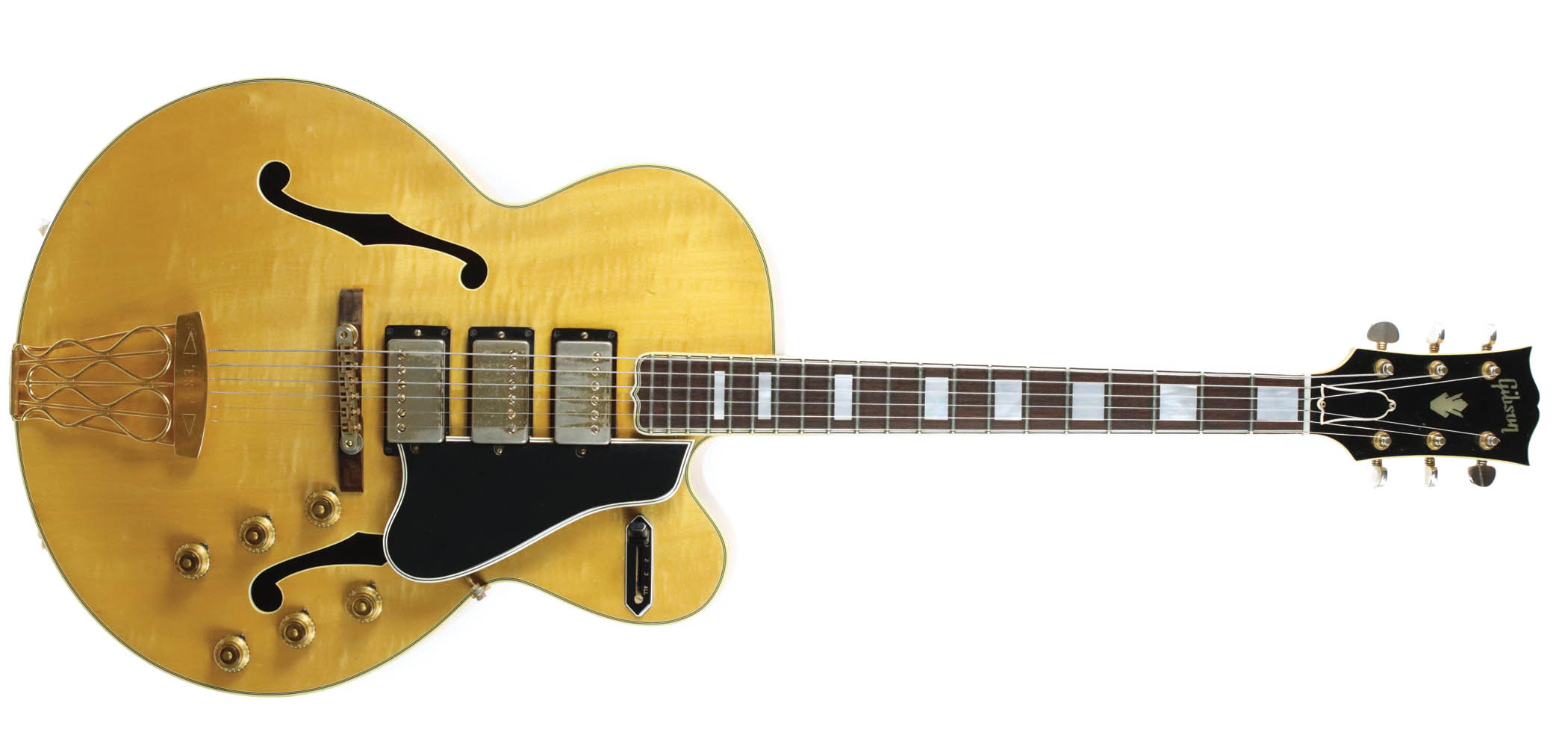
Both guitars are in pretty remarkable condition. Mr Gibson, who owned the 1951 originally, took extreme care of it and it’s virtually brand-new.
I don’t know if he knew somebody at Gibson or he had a bit of local fame and that’s why he got such a special guitar. Or maybe he just ‘hit the lottery’ on the day he ordered it
My feeling is that they didn’t all look like this because the top, back and sides are so wildly flamed. I don’t know if he knew somebody at Gibson or he had a bit of local fame and that’s why he got such a special guitar. Or maybe he just ‘hit the lottery’ on the day he ordered it.
In contrast, the 1957 has some figuring, but it’s nowhere near as pronounced. The neck profiles also vary a little bit, with the 1951 feeling very rounded and club-like, and the 1957 feeling more like a Les Paul Goldtop neck from that year with very soft shoulders and less fullness. Of course, both guitars still have their original cases, but I only have all the paperwork and history for the ’51.
These days, I don’t usually buy archtops unless it’s something very special-looking because most people aren’t really into big-box jazz guitars any more. So they have to have a lot of eye appeal, and the 1951 has that amazing figuring, while the 1957’s gold hardware is still glistening. Against the natural finish it really looks great. The blonde archtops, ES-330s and ES-335s all attract a premium because they’re fairly scarce.