![The revival of the Squeeze concept album that never came to be.]](https://backingtracksfullcollection.com/wp-content/uploads/2026/03/The-revival-of-the-Squeeze-concept-album-that-never-came-758x406.jpg "The revival of the Squeeze concept album that never came to be.] 1")
For Glenn Tilbrook, rediscovering the dusty demo cassette labeled Trixies last year was an out-of-body experience. With a heavy clunk setting the tape in motion, and the first songs written by his teenage self crackling from the speakers, the 68-year-old Squeeze singer and guitarist felt himself beamed back to ’74, watching those long-distant sessions unfold. “Trixies doesn’t even feel like me,” Tilbrook says. “But I know it is.”
By his own admission, Tilbrook couldn’t have released that original Trixies demo; aside from the audio quality, the guitar work by himself (then aged 16) and lifelong writing partner Chris Difford (19) was understandably scrappy.
Still, unlike most of our own first compositional efforts – usually three buzzy power chords, round and round – these early songs already show the scope and sophistication that would set Squeeze amongst the leading lights of Britain’s new wave scene in the late-’70s.
Article continues below
The album is set at a fictional nightclub, isn’t it?
Yeah. For the teenagers that imagined it, Trixies was a bit like the club from the Cabaret movie. A glamorous place full of ne’er-do-wells, set in the distant future of the 1980s, and populated by rock stars of the ’80s – which we would become, to some extent.
What do you remember about those first days of your partnership with Chris?
He was three years older, which is like 10 years when you’re kids. He definitely had more experience, and a different set of influences. You can hear it on Trixies. It’s Over is a beautiful song that Chris wrote, very melodic. The Dancer is very Velvet Underground, and I’d never have come up with that. I was a lover of pop music and [piano player] Jools Holland had boogie-woogie, even then, so we pulled that into the mix.
We were both keen to get on and do something. The first thing Chris gave me was a lyric called Hotel Woman, which I immediately wrote a tune for. Then he gave me six more. The lyrics kept on coming and I could match him tune-for-tune. He was shitting great lyrics, and I was hopefully shitting great tunes.

How did it feel to hear yourself back on the original demo?
If we’d recorded it back in ’74, the producer would have said to us: ‘Shut the f**k up, you’re going to do it this way. Or, if you can’t do it, we’ll get some other musicians in who can, and you’re just going to sing on it’
It’s a mixed bag. The songwriting was the thing we were best at. But my voice is fucking weird. I thought I was Marc Bolan, but I plainly was not. The songs were a good deal more sophisticated than we were capable of playing.
If we’d recorded it [for real] back in ’74, the producer would have said to us: “Shut the fuck up, you’re going to do it this way. Or, if you can’t do it, we’ll get some other musicians in who can, and you’re just going to sing on it.”
And that would have been a horrible experience. It’s such a personal thing to have your playing questioned. But the demos prove we couldn’t play those songs properly. It’s a bunch of kids, playing a lot of chords, not always successfully.
What are your own favorite guitar moments off Trixies?
I think The Place We Call Mars is great because it’s such a tip of the hat to Mick Ronson. And I was proud of the solo because I inverted the WWII song We’ll Meet Again, which I thought was a poignant way to express the desolation of that song. Good Riddance: it’s funny, but to me, that solo is the sound of listening to jazz on a shortwave radio under the bedclothes growing up.
How would you describe yourself and Chris as guitarists at that point?
Chris was meat and potatoes. He’s a great rhythm player and I could play around with embellishments on the top. I was self-taught, but I didn’t really solo a lot until I heard Jimi Hendrix. So, y’know, I was good, but I wasn’t great. The thing I was best at was songwriting. I knew the chords, but not what they were called.
Who were your other guitar influences in that period?
Hendrix’s playing – which was so fluent and light and jazz-influenced – introduced me to Wes Montgomery. As a teenager, my dad took me to see Joe Pass and Barney Kessel at Ronnie Scott’s. And although I said [moaning]: ‘Oh, I don’t want to listen to jazz!’, I got a lot from it.
In fact, when I was 15, I got one of Joe Pass’s records and literally spun the record round very slowly to learn one of his solos. It took me a long while, because it’s absolutely brilliant – and I was not – but I did get it. It taught me such a lot about where to put your fingers.
How did you approach the guitar parts on this re-recorded version of Trixies?
We sat down with Owen [Biddle, bassist/producer], played through the songs and worked out how we were going to approach them. I hadn’t played them since I wrote them. There were a few moments where we went, “Fuck, this is really good. We’ve got something we can work with and we can be the adults in the room now.”
So it was like mentoring ourselves. There were some little adjustments in recording the songs. With You Get The Feeling, that was done originally as a blues thing, so it didn’t have that skip. But then we started imagining: how would Bill Withers have done it?

What do you remember about recording the fingerstyle on You Get The Feeling?
[laughs] Asking Melvin Duffy to do it! Melvin is our pedal steel player, and he does all sorts of other guitar-y things. I can’t fingerpick. I’m useless at that. If I get lucky, I can do it, but I’m not always lucky. So Melvin did that part, and he did it brilliantly.
What gear did you play on the original Trixies demo from the ’70s?
I would have been using a Guyatone that my dad bought me from a second-hand store in Lewisham, and any amp I could borrow, because I didn’t have one when we wrote Trixies.
Later on, I had one of the brown AC30s. But back then, my family used to have a metal electric fire, and I found that if you put the neck of the guitar against it, that would, by osmosis, vibrate and turn into a sound you could listen to. It sounds like I was born in the First World War [laughs]!
How does that compare to your rig on the new recording?
What I’ve got recently is a Gibson 345, and it’s the total opposite of the sound I normally have. It’s very sustaining, sort of Les Paul-y, but different. And I used that a couple of times on Trixies, like on The Place We Call Mars, and the rhythm guitar on Why Don’t You. It just has such a great, meaty sound. I’m not known for a meaty sound, but boy, did I get into that.
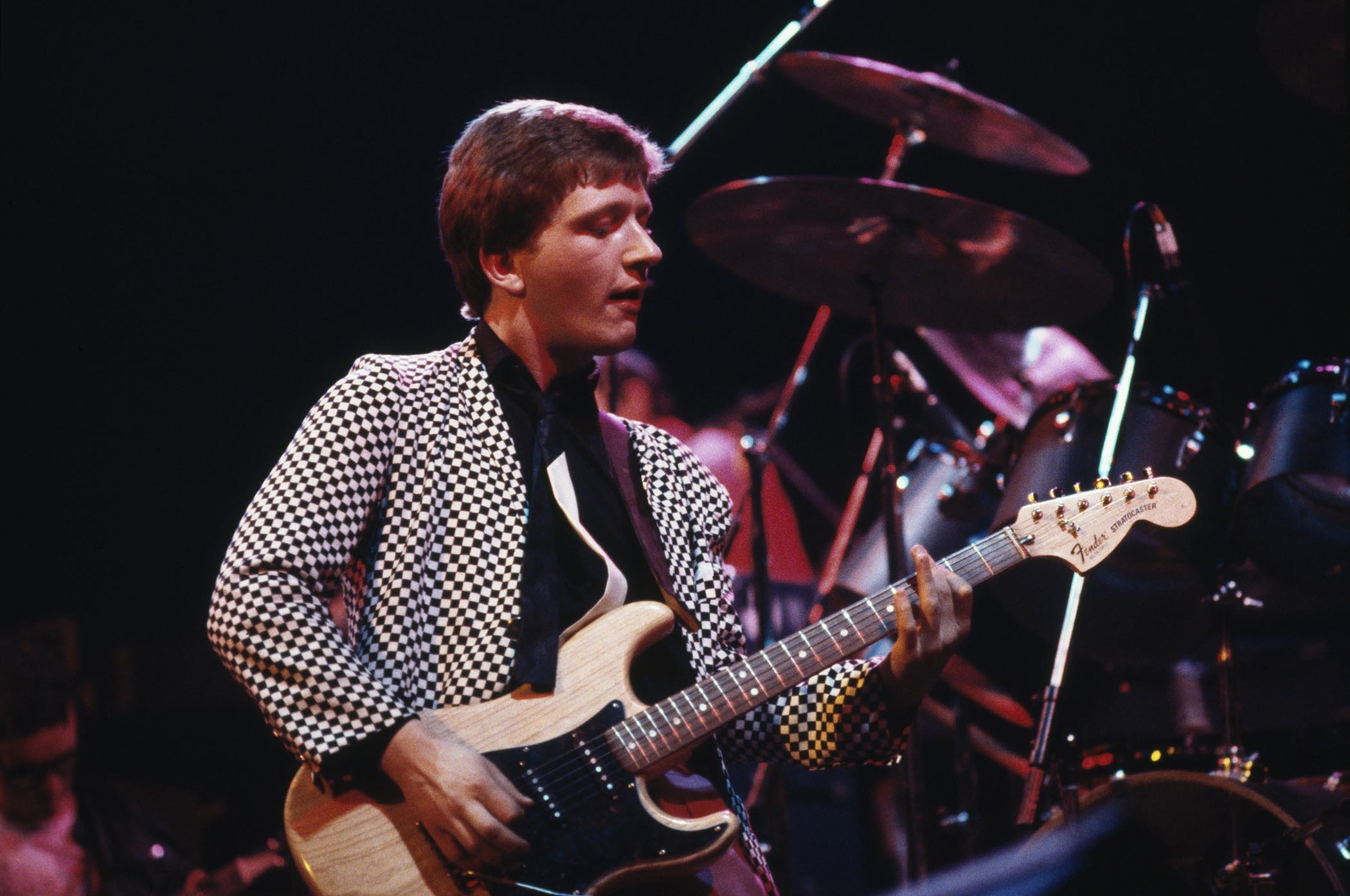
I also used my Telecaster a lot: it’s a 1966 Parsons/White B-Bender model. I’ve got a Gibson 125, which I use for the solo on Good Riddance. The 125 is a lovely guitar with just one jazzy tone, and that’s all it can do. I also used my ’79 Strat I got from Manny’s in New York on It’s Over, and for the solo on Why Don’t You.
It’s a maple neck, slightly thicker body: one of the most unloved versions of the Strat. I’m really attacking it on Why Don’t You, and it was a such a lovely contrast to the 345 on the chords.
Did you have physical guitar amps in the studio?
[pans webcam to show us the Dickinson MkII Combo]. That’s the amp I used. It’s made by Rob Dickinson. And it really is a truly wonderful amp. I don’t know if you’ve ever plugged your electric guitar into a hi-fi. This Dickinson, it can do that sort of crystal-clear sound, right through to a really raucous AC30-type sound, and all points in-between. I also used a Fender Twin and Hot Rod.
How about the key pedals on Trixies?
Well, again, for the solo on The Place We Call Mars, I wanted to get that Mick Ronson sound of having a wah pedal three-quarters open. So it’s quite a trebly, distorted sound through which I play my Ibanez fuzz pedal into my Dickinson, on the 345. When you hit the sweet spot on the wah, it has such a weird overtone, and that’s what I love.
You’ve always said that a song has to demand a solo for you to play one.
Definitely. If I can do something that elevates the song or sounds like it’s a natural thing, that’s when I do it. But I don’t do too many solos. In fact, I probably played more guitar on Trixies than any other Squeeze record. I can compose solos better than I can improvise them.
Like, there’s a song on Cool For Cats [1979] called It’s So Dirty and it has what I would call a blistering solo. And that is me doing three takes and comping it, because I was already learning how to use the studio to make the best of myself.
So how come Squeeze didn’t ultimately pursue the musical direction of Trixies?
I have to say that, as an 18-year-old, although we’d done all these songs with loads of chords and words, punk was very attractive, and also was an easier sell for a band like us
I think that’s down to the time Trixies was written. Rock music had been upended by punk and new wave, which we became a part of. You know, we were advised by our manager to get into that. But I have to say that, as an 18-year-old, although we’d done all these songs with loads of chords and words, punk was very attractive, and also was an easier sell for a band like us.
So we sort of dumbed down and then made a debut album [1978’s self-titled] that was nobody’s baby, really. But with our second album, Cool For Cats, we already sounded like Squeeze. We had the energy of punk, but we also had songwriting chops to make it a bit odder than other people. After that, we carried on writing at such a velocity that there never seemed to be a good reason to go back.
Why did now seem like a good time to release this material?
The thing that really pushed me to do it was thinking, y’know, who else has this story? Who else can say: here’s a set of songs that are 52 years old, and they’re fucking good?
Does it feel good to have these songs out there in the world?
Yeah. I feel very proud of Trixies. Because of who we were then, and who we are now. You know, the old blokes that Chris and I are now, are very happy to show our teenage selves that they weren’t doing so badly. And we’ve already started rehearsing to take it out on the road…