![Ways to Improvise Over One-Chord Blues]](https://backingtracksfullcollection.com/wp-content/uploads/2026/03/Ways-to-Improvise-Over-One-Chord-Blues-758x406.jpg "Ways to Improvise Over One-Chord Blues] 1")
In a world where we’re so often encouraged to expand our vocabulary, learn more scales, play over complex changes and improve our technique, this example solo takes the contrary approach of exploring simple bluesy ideas over a single chord.
It does venture a little outside of the regular pentatonic shapes towards the end (check out Example 3), but this is the exception, rather than the rule. In this section we’re looking for interesting melodic lines instead of deliberately referring to specific chord tones, but – deliberately or not – this is what’s going on during the last four bars…
One of the advantages of staying with a one-chord ‘drone’ backing such as this is that we can experiment with different melodic ideas without having to consider the constantly ‘shifting sands’ of changing chords.
Article continues below
After establishing a riff in Example 1, Example 2 plays around with the shape 1 A minor pentatonic box. None of this requires a huge vocabulary or theoretical knowledge; it’s much more about melody and rhythm. While it’s always good to expand our horizons, most classic solos aren’t derived from esoteric scales and arpeggios!
Example 1
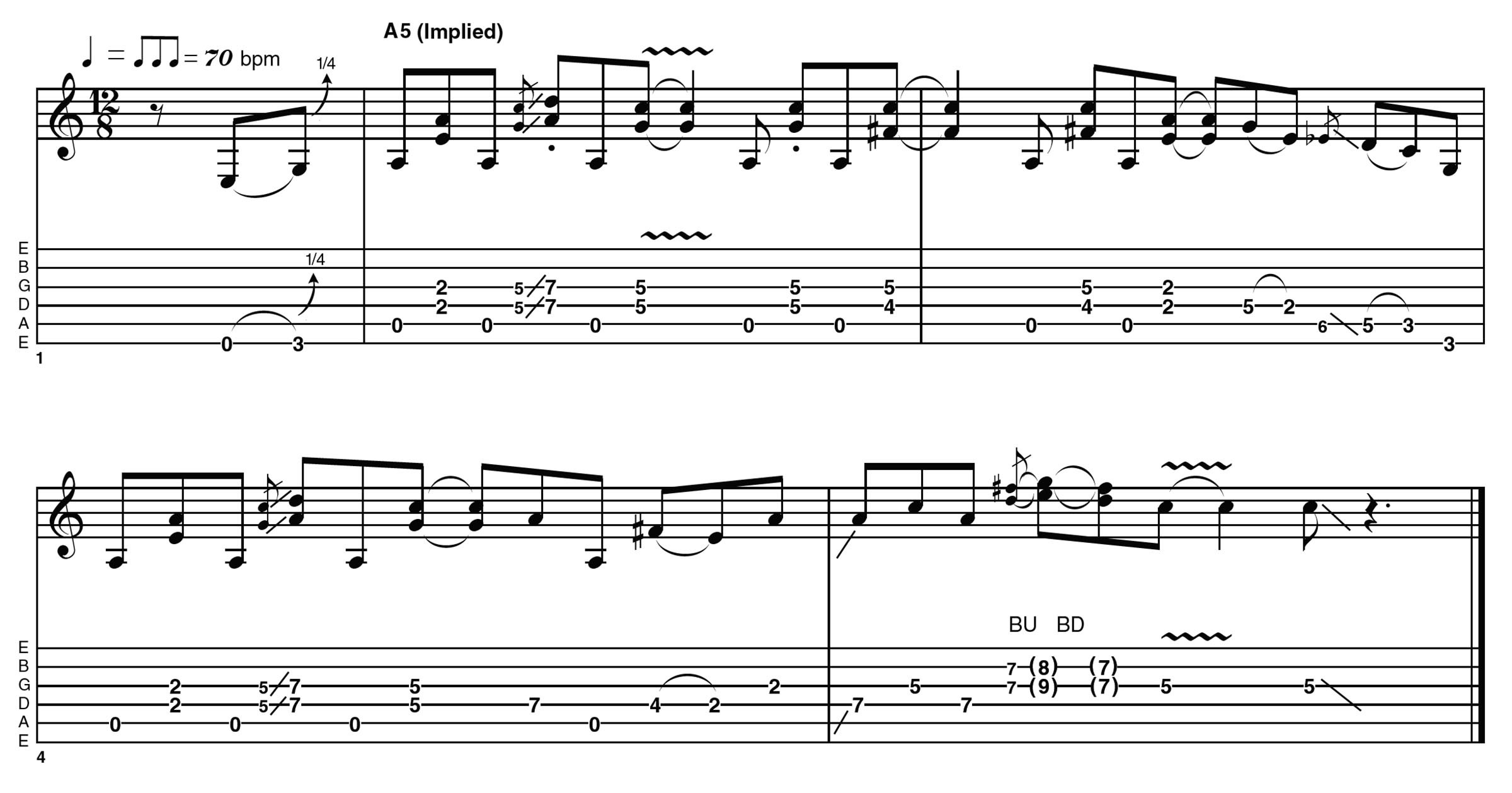
This introductory phrase establishes a riff based around an A chord, though it progresses towards a more pentatonic ‘lead guitar’ approach by the time we reach bar 4. In terms of pentatonic positions, you could say this is based predominantly around shape 5 until bar 4, when we shift up to shape 1.
I’m using fingerstyle to play this, but any version of hybrid or even flatpicking can be made to work. Try them all and see what you prefer.
Example 2
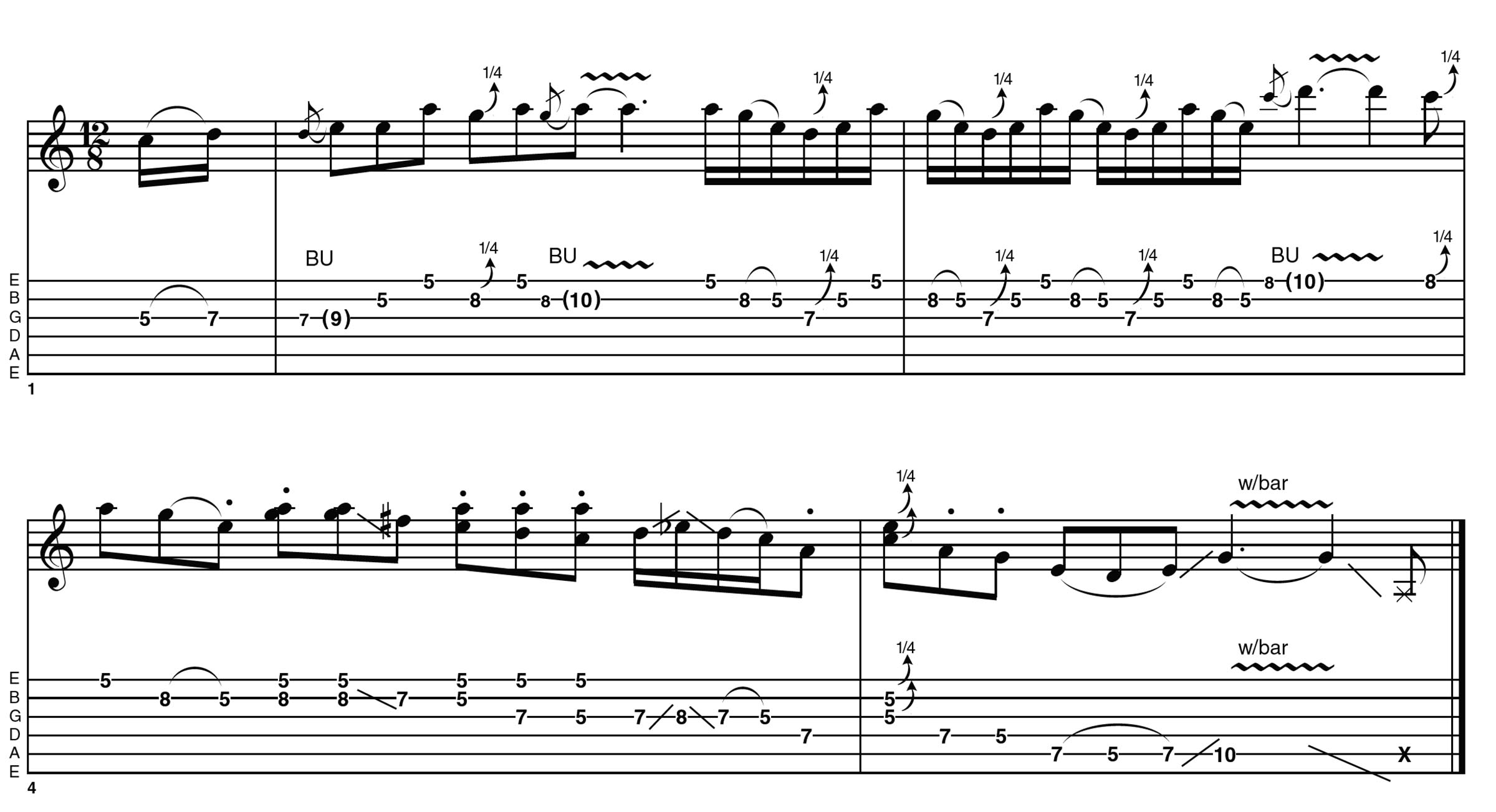
Having established that bluesy groove, we’re now ‘lifting off’ with some solo playing. We stay pretty constantly with the shape 1 A minor pentatonic we shifted to at the end of Example 1.
This phrase isn’t looking to push any boundaries harmonically – it’s about building intensity via that repeated string-bending lick, then breaking it up with some rhythmic doublestops. Maybe a good way of viewing this is to think of Jeff Beck shifting to Billy Gibbons!
Example 3
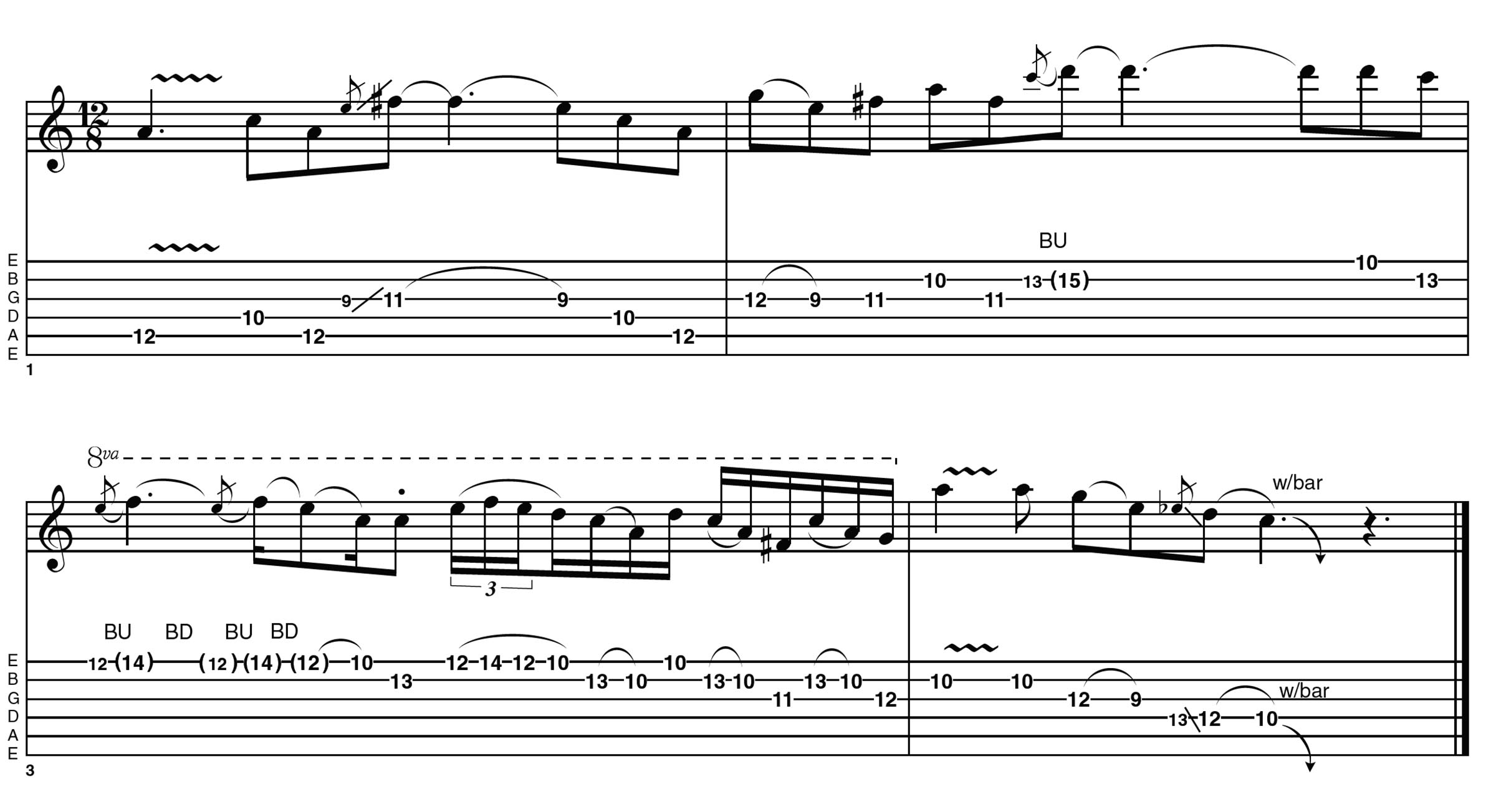
Here’s where we change from a more pentatonic-based approach to experimenting with ‘outside’ ideas – not in the hard bebop sense but non-pentatonic and arpeggio-based shapes based around Am6.
This translates as including lots of F# (the 6th), along with the other notes from A minor (A-C-E). Looking closely, you’ll also spot a good chunk of the shape 3 A minor pentatonic in there, too.
Once again, it’s your choice whether to use fingerstyle, pick or hybrid picking. Arguably, once you add enough gain, the tone difference is minimal, but how you attack the notes will influence your phrasing.
Hear it here
Jeff Beck – Jeff Beck’s Guitar Shop
The title track of 1989’s Jeff Beck’s Guitar Shop was definitely an inspiration for the riff in Example 1 of this issue’s piece, though Stand On It is also in there, too. Staying with that same album, Two Rivers explores some unusual non-pentatonic ideas.
Elsewhere, check out Cause We’ve Ended As Lovers from 75’s Blow By Blow as this contains a mixture of melodic exploration and more recognisably pentatonic themes. A little of this creeps into Example 2 with its repeated string-bend lick.
ZZ Top – Eliminator
Billy Gibbons manages to take blues ideas and incorporate them into a non-traditional context without losing their essence. His riffs and solos on the tracks Legs and Sharp Dressed Man from 1983’s Eliminator illustrate this particularly well, as all the other instruments sound very programmed and ‘1980s’.
The same is true of Rough Boy from Afterburner (1985): the two solos in this track really show Billy stretching out and soloing in a way he doesn’t allow himself on the other two examples.
Oz Noy – Who Gives A Funk

Though he definitely comes from the more technical end of the spectrum, Oz Noy has an understanding of what makes the blues the blues, in the same way that Robben Ford does. In fact, you can check them out playing together on his version of Ice Man from 2016’s Who Gives A Funk album.
Elsewhere, check out Come Dance With Me from Twisted Blues Vol 2, released in 2014, or his incredible soloing on Sit Tight from the Ha! album, from earlier in his career in 2005.