![What's the maximum number of pickups? This guitar features 64.]](https://backingtracksfullcollection.com/wp-content/uploads/2026/05/Whats-the-maximum-number-of-pickups-This-guitar-features-64-758x426.jpg "What's the maximum number of pickups? This guitar features 64.] 1")
How many pickups should a guitar have? One? Two? Three?
How about 64?
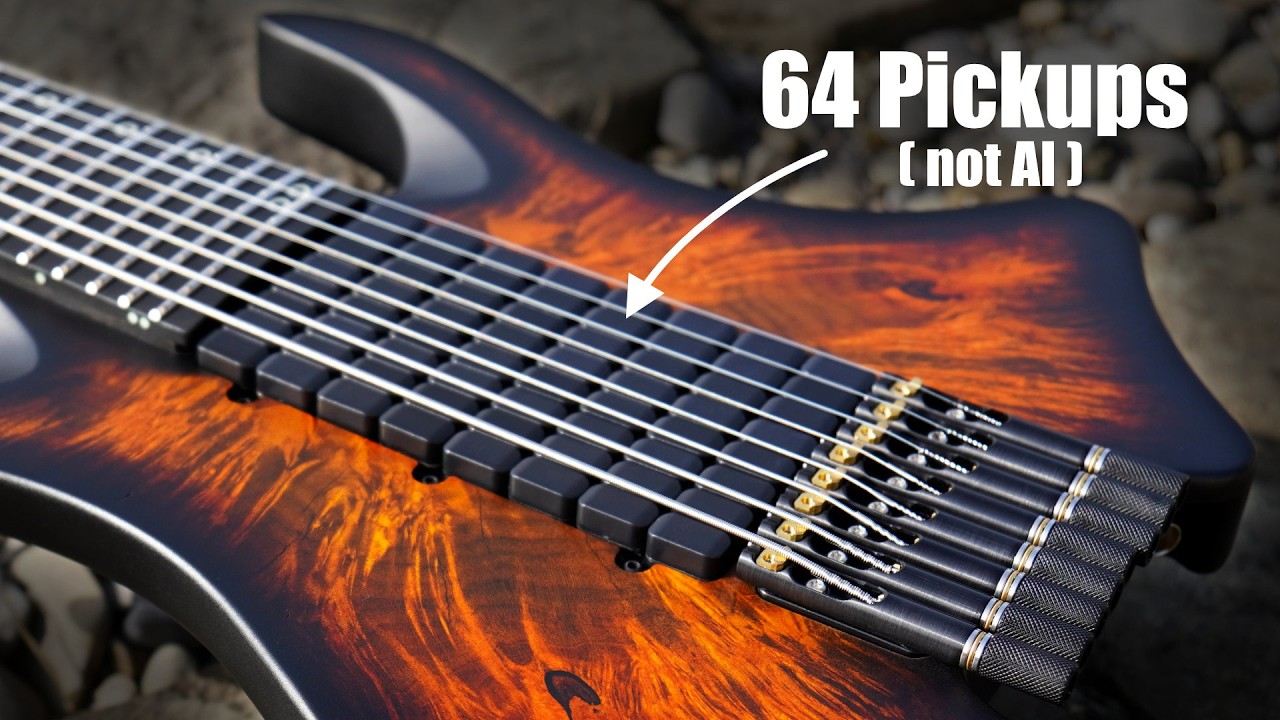
That’s the total number of active pickups in the PolyMap system, a new experimental electric guitar developed by audio engineer David Wieland of Dark Art Guitars.
“Traditional electric guitars have two or three pickups and you have to decide while playing which ones are active,” Wieland explains in a video demonstration of the system. “This can limit what is possible with the playing, which is why I developed PolyMap.”
Traditional electric guitars rely on just two or three pickups to capture the vibration of the strings. Those pickups shape everything from a Stratocaster’s glassy bite to a Les Paul’s thick growl. PolyMap blows up that model entirely. Instead of a handful of magnets, the experimental instrument uses 64 individual pickups arranged in a grid, allowing software to combine them into virtual pickups placed anywhere along the string.
The project is Wieland’s entry in the AES Student Design Competition 2026, where it also serves as his master’s thesis.
“It’s a polyphonic guitar pickup system that detects each string individually at eight different locations,” he says. “Then in software, you can decide which pickups are active, how they are blended, and apply various effects.”
At the heart of PolyMap is an 8×8 pickup grid that samples each of the guitar’s six strings at eight positions along its length. In total, the instrument houses 64 active pickups, each feeding a carefully designed signal path.
Those digital signals pass through buffered, bandwidth-controlled analog stages before entering eight multichannel analog-to-digital converters. From there, the data is aggregated into a Multichannel Audio Digital Interface (MADI) stream and transmitted over a single coaxial cable, which also delivers 12 volts of DC power to the pickups. The system outputs its stereo signal at 24-bit/48 kHz resolution.
Once recorded into a DAW, a specially designed plugin lets users shape their performance via two modes. Manual mode gives players direct control over each pickup’s level, phase, pan and micro-delay. Virtual mode allows users to position a simulated pickup beneath each string while the software blends signals from the sensor grid in real time.
Because the system captures the strings at multiple points simultaneously, players can also reshape the tone of the “virtual pickup” itself — dialing in sounds that mimic everything from vintage passive pickups to ultra-clean modern designs.
The multi-pickup architecture also opens the door to unusual effects. By introducing timing offsets between sensors, the system can create delay and diffusion effects. Players can even route signals independently — sending the lower strings to a bass guitar rig, for example, while the higher strings feed a traditional guitar amp.
PolyMap isn’t commercially available yet, but Wieland has published the project’s hardware designs, software and documentation on GitHub for anyone interested in exploring the system.
If it eventually reaches the market, he estimates the guitar would cost around $2,000.
“I would say at the very least six months until we can even talk about how the final system looks,” Wieland says. “Realistically, it’s probably going to be next year before it’s possibly available.”