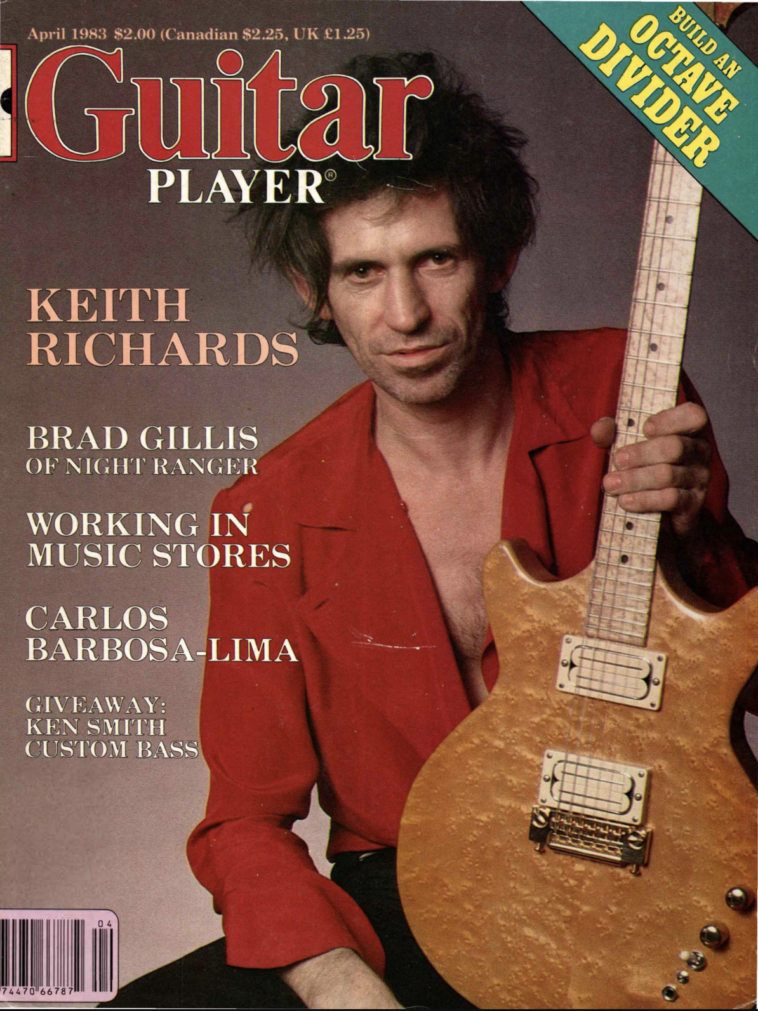
The Rolling Stones release their 25th studio album, Foreign Tongues, today, so it seems like the right time to visit this classic interview with Keith Richards from April 1983. It was a good time for the Stones. As GP Editor Tom Wheeler wrote in his original intro (abridged below), “In most respects the Stones have few peers, and in terms of sheer durability they have none, having somehow survived at or near the top of the rockpile for the last two-thirds of rock and roll’s entire history.
“They’ve gone the distance and still pack a heavyweight punch: Their latest albums (Tattoo You and the live concert LP Still Life) are among their most vital works, and their most recent tour was astonishingly successful – four million fans applied for the New York tickets alone.” Who would have thought that 43 years later, they would still be doing it?
Back in 1964 when Lennon and McCartney wanted to hold your hand, Jagger and Richards were walkin’ the dog. Constantly compared to the Beatles and often to The Who, the Rolling Stones staked out their original turf with gritty music and a don’t-mess-with-me stance. The Beatles disintegrated a dozen years ago, and the Who say they’ve unpacked their road cases for the last time. The Stones are in the studio, and they’re not about to bid farewell to anyone.
Keith Richards stands in the eye of the hurricane. Around him swirls a rock and roll empire with 20 years history and mystery, success and excess, acclaim and controversy. He and his mates have been called many things by discerning critics and impassioned fans. One description recurs: The World’s Greatest Rock And Roll Band.
Some reasons for all this are apparent. First, Keith’s confederates could hardly be more impressive: Mick Jagger, rock’s most prominent singer; guitarist Ron Wood, already a star when he joined the group in 1975; plus a drummer Charlie Watts and bassist Bill Wyman, a powerhouse rhythm section revered the world over by fans and fellow musicians alike. Other strengths are equally obvious – the consistently fine Jagger/Richards compositions, the dynamic arrangements, the meticulous recording. Just as important is the way Keith Richards changes chords from G to C.
The band is built around a two-guitar sound, itself an extension of Richards’ own uniqueness. He helped blur forever the line between lead and rhythm guitar, substituting a riffing technique in which melodic embellishments are grafted onto a vigorous rhythmic treatment of chords, partial chords, and low-register lines. He often employs a 5-string open tuning (with or without capo) that facilitates adding the melodic notes to a major chord–particularly the 4th, the 6th, and the 9th. Among many examples, “Brown Sugar” is a classic killer.
Keith’s most obvious influence is Chuck Berry. The original “Carol” is a textbook of Berry’s double-string licks and was covered on The Rolling Stones, the debut album. Keith has had a taste for Berry flavoring ever since. Perhaps his most highly stylized nod to the St. Louis rocker is his long solo in “Bitch,” where Keith repeatedly turns the beat around, turns it inside out – weaving through the horns, sneaking up on the back-beat, making the style his own.
Chuck Berry adapted boogie-woogie piano techniques for the guitar’s lower register, and this distinctive two-string rhythm pattern became another Stones staple. Richards made his mark on its development by sometimes slowing it down, piledriving the downbeat, and stoking up the tone to a grand raunch: a-ronk a-ronk a-ronk.
Richards’ role in the group has been analyzed countless times. The consensus: Without Keith Richards there wouldn’t be a Rolling Stones. Ron Wood explains, “In other bands they follow the drummer; the Stones follow Keith, and they always have.” While some have even asserted that “Keith Richards is the Rolling Stones,” the guitarist himself is the first to stress that any band member’s indispensability is a two-way street: “The musicians are there to serve the band. All that matters is whether something furthers the overall sound.”
Keith’s vision is rooted in a keen awareness of the power of the guitar – acoustic or electric – not only as a rhythm or solo instrument, but as a musical paintbrush capable of immense sonic canvases. He conceives a complex sound and knows how to get it. And yet to him a piece of music, like a real band, is a living, breathing creature existing apart from his conception of it. So while a particular project may be planned, Keith’s sense of the music’s own inherent magic keeps him flexible and spontaneous, adjusting as he goes.
On many contemporary recording sessions, musicians are put in compartments to minimize leakage (one instrument “leaking” into another’s microphone), and the result is a compressed sound that fills every niche. Stones records are virtual opposites, roaring with heavy artillery but airy and spacious as well. While every sound counts, the spaces, the holes, are no less important.
The band’s raw materials may be the deceptively simple basics of rhythm and blues, but with the air crashing around like a cyclone, the effect is complex, even abstract.
Rough edges on doubled guitars may be as important as seamless overlaps. An “extra” guitar part – mixed far in the distance to work on subconscious levels – may be as essential as obvious elements. As co-producer (credited or uncredited) on virtually every record, Keith Richards has proved to be both a master of the bold stroke and a subtle colorist, evoking not only the thunder and lightning but also a sky to put it in. For the Rolling Stones, atmosphere is everything.
For many the sound and fury of the band is a transcendental experience. Although the musicians are gifted, the songs excellent, and the recordings finely tuned, the effect is not so much that of hearing sophisticated technicians processed through state-of-the-art technology. It’s more like hearing the world’s greatest garage band in the world’s biggest garage.
Up in his hotel room (classic Keith Richards, it is part Versailles Palace, part blues dive), Keith’s dad Bert is smoking a pipe, and his son Marlon – who could dial room service before he could read – is drawing. A cassette bag is crammed with rockabilly, early Dylan, reggae, unmixed Stones, the raunchiest R&B, and more. An old Everly Brothers hit is playing, and delighted Keith Richards identifies a distinctive lead guitar lick: “Chet Atkins!”
An hour later, Keith is in the corner playing piano like Ray Charles and singing ballads to himself in a voice cracked with emotion. He plays a wistful “Somewhere Over The Rainbow” and then launches into some Jerry Lee Lewis, his foot bashing the floor in tempo.
Ron Wood blows in and warmly embraces his partner-in-guitar. In minutes, the two old friends are plugged in, guitars barely in tune, jamming on a medium-tempo 12-bar blues in A. Keith leans over to the black Fender Deluxe Reverb and twists the volume knob from 2 to 6. Ron Wood grins and rips into a solo. The real Keith Richards goes a-ronk a-ronk a-ronk.
Chuck Berry was a major influence on your guitar style.
That’s quite a left hand he’s got there [laughs].
Are the reports true that he punched you in the face?
Yeah, a little while back he did. I came up behind him to say hello. He didn’t know it was me and didn’t want to be bothered, but I got a nice note from him a little later, actually.
The “Bitch” solo is in a Chuck Berry style…
Which I do every night.
…and the beat turns around several times. Was that completely spontaneous, or semi-planned?
Maybe listeners knew a year or six months later that the beat turned around, but at the moment I wasn’t conscious of that. It comes so naturally, as it’s always happened, and it’s always given that extra kick when the right moment comes back down again.
That’s what rock and roll records are all about. I mean, nowadays it’s “rock” music. But rock and roll records should be two minutes, 35 seconds long, and it doesn’t matter if you ramble on longer after that. It should be, you know – wang, concise, right there. Rambling on and on, blah blah blah, repeating things for no point – I mean, rock and roll is in one way a highly structured music played in a very unstructured way, and it’s those things like turning the beat around that we’d get hung up on when we were starting out: “Did you hear what we just did? We totally turned the beat around [laughs]!” If it’s done with conviction, if nothing is forced, if it flows in, then it gives quite an extra kick to it.
You turn the beat around often. There’s the intro to “Start Me Up,” where it turns around twice in the first ten seconds, “Little Queenie,” where Charlie turns around the intro, and the end of the bass part on “Street Fighting Man,” which you played yourself.
Right. You can do that in a band that’s got enough confidence not to collapse when it happens. It can make things much more interesting, and it sounds great as long as nobody’s fazed by it. You have to be able to keep it straight, thinking about what you’re doing at the moment and also about where you’re going to take it. I guess that just comes from 20 years, same location.
So many of the things you play, if you were to put them on paper and analyze them musically….
What a mess [laughs]!
For example, the opening of “Start Me Up” is a simple chord change, and yet it’s recognizable as the Rolling Stones. The sound is so specific. Would altering anything about it – the echo, tone setting, string gauge – change the impact?
I just can’t get the things to sound any different [laughs]. They always come out just about the same when it comes to recording, because without really thinking about it I shift slowly as I go. And no matter where I start, no matter what the guitar or the string, sooner or later I’ll get to where the rest of the band is going.
It’s sort of a trademark sound, but it’s more than that because of the way I go about getting it, working it through with what’s going on, rather than getting the sound first and then pushing it on the band. A lot of it is adjusting to Ronnie, and Ronnie to me, which brings a certain continuity as well as a certain flexibility.

You’ve often mentioned the two-guitar sound as a cornerstone of the band. On Still Life there’s a different kind of interplay – probably tighter than ever.
Well, Ron’s getting better [laughs]. I think that’s due to the fact that Ron and I have been working together now since ’75, and the more we play together the tighter we get it.
It sounds like you and he are two sides of the same coin, like you could almost change places.
We do [laughs]. If he drops a cigarette I’ll play his bit, and we’ll realize later that I’ve covered for him or he’s covered for me. And you think at the time, “Oh, my God, what a gap,” but when you listen to the tape, you find that it’s been fixed right there at the moment, in a very un-thought-about way. We pick it up and cover each other so that sometimes you can’t really tell who’s playing.
When Ron joined in 1975, did the band have to make a change in the way you interact or rehearse?
No, that was the beauty of it. He was already so familiar with our stuff. After Mick Taylor left, we rehearsed for about six months with a lot of good guitar players from all over the world. And we could work with them, you know; they could work with us. But when Ronnie became available and suddenly walked in, that was it, there was no doubt. It was easy.
With Mick Taylor’s style so well defined as a lead guitarist, there seemed to be a clear distinction between the two of you.
It was much harder to get a Rolling Stones sound with Mick Taylor. It was much more lead and rhythm, one way or the other. As fabulous as he is as a lead guitarist, he wasn’t a great rhythm player, so we ended up taking roles. When Brian and I started, it was never like that. It’s much easier than with Brian, personally.
But also with Ron, the basic way we play is much more similar, and this isn’t in any way to knock Mick. I mean, he’s a fantastic guitar player. But even if he couldn’t play shit, I’d love the guy. But chemically we didn’t have that flexibility in the band. It was, “You do this, and I’ll do that, and never the twain shall meet.” With Ron, if he drops his pick, then I can play his lick until he picks it up, and you can’t even tell the difference.

Had you and Ron worked together very much before he joined the group?
Yes, for about 18 months. And I did a lot of work on Ronnie’s first and second solo albums. He’s never been the same since.
Have you found that your styles affected each other, now that you’ve been working together for several years?
Yeah, that’s what’s great about it. I neglect something, and he makes up for it. That’s the great thing about two guitar players, because if you get it right, you know when to lift one of his licks, and vice versa, without thinking about it. He lifts more of mine than I do of his [laughs].
When the two of you are onstage, how much of your interaction is subject to change?
It depends on the sound system. If you’re going to make a change, you need to hear what you’re doing in the first place, so a lot of that gets down to technicalities of the stage monitoring. On our last tour in ’81 we had those long ramps out to the sides of the stage. The idea of having that stage is to get out where most performers don’t get with audiences of that size. Well, if the monitors aren’t working out there, and you’re just making signs at the sound guys instead of concentrating on your playing, then you forget it, just leave it. But if the sound’s good and you can hear everything, then you tend to give it a bit more, adjust more to what’s going on, change as you go.
Do you have much trouble communicating onstage at that volume?
It’s all done by semaphore and eye signals. It’s the only way you can really do it. But the thing is, there isn’t that much need for communication or looking at each other, except when things go wrong. Otherwise the communication is just through the music. But if things are going wrong, then everybody’s looking at me: “How’s he going to get out of this?”
Your records have sort of an indoor sound, the effect of enclosed space. Are you happy with your outdoor concert sound?
Never totally satisfied with live things, no. If you were, you wouldn’t keep trying to make it better. But I’m not disappointed with it. You just look forward to being able to do it better. You’re always wondering about the people way at the back, what they’re hearing. There are so many people and they’re so far away – you have no idea what’s being heard out there. You’re hoping for the best and taking it for granted that the sound crew are doing the job for you and giving out the sound onstage as much as possible to everywhere in the place. But there’s the one problem, always that nagging doubt there – they’re not all getting it the way they should.
Your live versions of songs are often faster than their studio counterparts – for example, “Shattered” on Still Life. Is that intentional, to make it more exciting for the audience, or is it the adrenaline of performing?
It’s the tempo of the whole gig, the adrenaline – especially the huge gigs. The show just takes its own speed from the start, and you go with it. It might be great or it might be terrible, but the tempos one night may be twice as fast as the night after. And you can always learn when you listen back, you see? You may find, “Wow, that should’ve been that tempo all along–we made the record too slow [laughs]!”
On the live version of “Just My Imagination,” in the second half the guitar figure changes some notes and sustains others for a country feel, almost like a pedal steel feeling.
That’s Ron and me doing the parts together, and you get that sustaining thing. We aren’t using a pull-string or a lot of slide right now, but Ron plays pedal steel, a bit on “Shattered” and “Faraway Eyes.” Country music’s a part of the way we do that kind of thing, and it comes through even if it’s done with straight guitars sort of pulling up against each other.
Isn’t there some slide in “Neighbours” on Tattoo You?
No, but it sounds like it. Ron plays that solo, and a lot of his things on regular guitar sound like they’re slide. He’s wangled a way of playing it without them, because he keeps losing them [laughs]. At the start of that solo he’s bending about four strings. Sounds like slide.
On Still Life’s “Let Spend The Night Together,” is that a 12-string doubling the vocal melody on the interlude, which ends with “keep on smilin’ baby”?
That’s one reason we haven’t done that one a lot on stage – we could never figure a way ‘round that middle bit. No 12-string – just the two run-of-the-mill guitars together, doin’ it tight.
The mix of the two guitars on Still Life adjusts in places to the parts you’re playing. Is that sort of detail up to your discretion?
Well, I listen for those things, but I may not be there for the first mix. Especially with live stuff, I’d rather let the guy who recorded it get his work into it. Then I get sent the dubs. From the whole tour you have several takes of each song to pick from.
The set opened with “Under My Thumb,” and it’s hard to get the right take, because you’re playing right there early, when everybody’s trying to get together and nobody knows what’s going on. Every night it takes 15 minutes for the sound guys and the recording guys and everybody to fall in and get adjusted, so choosing the take for the first number requires a bit of work.
The endings, too. You always wish you could get a couple of takes of the beginning and ending of a show as good as it is in the middle. But every night it’s a different problem – you’re in a different place, so you see what happens when you get going and take it from there.

On recent tours you’ve taken occasional breaks from the outdoor arenas, getting into clubs. Do you miss the smaller venues?
Yeah, always. You hate to do the same thing all the time. I love playing the ballparks and the domes, you know. For the satisfaction of the band it gives you a terrific buzz – so many people. But by doing just one thing all the time you forget how to do anything else. You just become good at playing the domes and never learn anything else again.
I’ve always found that if you put in a few 3,000-seaters on the tour, and even 300, it gives the band itself a confidence quite apart from anything else. Then you can deal with 300 people or 90,000 and know how to play it. And probably the band feels that working in one of the nice old places like the Fox Theater in Atlanta is kind of more satisfying most of the time.
Because of the immediacy?
Yeah. The sound isn’t dissipated totally, and you don’t have to worry about the wind factor and things like that. It’s much simpler and easier to get – it’s just [snaps fingers] turn it up, get to it.
Didn’t you change to Mesa/Boogie amplifiers on this last tour?
The ’81 tour of the States was the first time we used the big Mesa/Boogie amp and speaker setups on the road, but we’ve been using Boogie amps in the studio since about ’77, and on the stage since the ’78 tour, slaving small Boogies through Ampeg cabinets.
Do you pay much attention to speakers?
No. I only think about them when I don’t like ‘em. If I plug in and to me it sounds like crap, then I ask a question, but otherwise, I leave it, because there are guys far more versed. I don’t know what speakers are coming out every year. I find something and I stick with it for five or six years. It’s like some of the gadgets I use. Guys who work with us and are close to us, will say, “You should try this: I think this is going to add to what you’re doing.” I might try it, although I don’t go around looking at specifications and all that.
Were you using any effects onstage in ’81?
An MXR analog delay on a few numbers, and a phaser on “Beast Of Burden” and on or two others.
How about the very unusual sound on “Shattered”?
That was the MXR phaser – the 100 model – and I damped the guitar. That’s what gives it that sound on the studio version as well.
What kind of wireless systems were you and Ron using on the last tour? Can you get the right tones as easily?
We’ve been using Nady wireless things since ’78, and the tone is a lot better, because cords get stepped on and knotted up and they start rattling a little bit, and you lose tone.
In the last few years there’s been a new aspect of your tone – more distinct, with a slight click, almost like a slap bass in rockabilly. “Hang Fire” and “She’s So Cold” are examples, and especially the last section of “Little T&A.”
It’s our equivalent of that rockabilly thing. I think you’ll find that comes from using a lot of analog delay on Ron’s guitar or my guitar or both of them, and I dampen it. That’ll give you that ticka-tacka-ticka. I always use that green MXR analog delay. I’m told it’s quite out of date now and old-fashioned, but I got it free and I forgot that time marches on and they make better ones or so they say. I don’t know. I’ve worked very well with those MXR things, and they’ve been very reliable.
Which guitar are you playing for that sort of stripped-down rockabilly sound on “Little T&A”?
A Telecaster, a ’57 set up in 5-string tuning. It’s open G 5-string, without the heavy string. Right there from the bottom up it’s: G, D, G, B, D. The whole idea of getting rid of the sixth string in the open tuning was having the root on the bottom.
The suspended chords in the verses of that song are typical of your riffing style.
That’s just one of the things you can do with open tuning. You can get a drone going, so you have the effect of two chords playing against each other. One hangs on because you’ve just got to move one finger – or two at the most – to change the chord, so you’ve still got the other strings ringing. It’s a big sound.
Mick was using an Ovation Adamas steel-string on the tour. Were you satisfied with the instrument’s performance?
I think they’re very nice-sounding guitars. A nice neck. But I can never get used to that shape, that… dish. They’re probably the best way of amplifying an acoustic guitar and having it still sound like an acoustic. There’s no doubt. Probably a million readers will write in and say the Stones don’t use acoustic guitar that much onstage, so we don’t know shit, but for what we need, for a couple of numbers, it’s adequate.
How did you come about acquiring your new guitars?
Friends of mine introduced me to Doug Young, who built them. After seeing some of his things, I knew he was capable of exceptionally fine work, so I more or less commissioned him to build me a guitar. He ended up making me two – the red one is a gift for my girlfriend, actually. Basically, that’s the lowdown.
Did you specify exactly what you wanted?
Not really. We didn’t have to say very much about it. I was very impressed by the things I saw, and I wanted a similar guitar for myself. But it’s also this patronage that players and builders can get involved with – Renaissance man, and all that, the old system of someone like me encouraging guys like Doug. His guitars are too good not to be given help.
So you didn’t request a certain wood for the fingerboard, a certain pickup design?
Not too much, no. I said, “Make me a guitar.” I figure that’s the difference between working with an artist, as opposed to just anyone. I mean, if you want a suit made, you don’t want to have to tell the tailor how to do everything. You want to find someone who doesn’t need all that, you see? It’s more, “I want to see what you can build for me.” There are very few people like that. Most people, you have to sit on their ass and watch them: with Doug I just left him to it. I was in Paris for months, recording. I’d almost forgotten it was going on until I saw what he’d done.
Have you had a chance to play them in the studio yet?
Not in the studio, but I went out and banged on them a bit. I’ll be back in the studio soon, and then we’ll beat them into shape [laughs].
After playing hundreds of guitars, what quality in these instruments made you take notice?
It’s a recognition you develop. I think, and I’m sort of instinctive about these things – sit down and play it, feel it. I knew that Doug was thinking along the same lines as myself, but far ahead, because I’m not technical. Only after the event of building it when I’ve got it in my hands, can I know what’s right. I can’t say, “Well, it was the magnificent electronics,” or “the wonderful bonding of the woods,” and each specific thing. It was simply a fine instrument. Lovely wood!
Can you judge the sound of an electric before you plug it in?
Maybe to a certain extent. If the neck and the action feel right, you’re more than halfway home, even before hearing the electronics. Things like weight and the density of the wood indicate certain things, but you simply need to play it to really tell. And it doesn’t take long.
On record you’ve used several very different types of guitars – Gibson Les Pauls and ES-335s, Fender Telecasters, and others. And yet a listener can tell right away that it’s you, from stylistic clues, but also from the sound alone.
I use a whole load of different guitars, that’s true, but they’re not all that dissimilar in type. I mean, ninety percent are probably Telecasters, old ones, but more than that, you can’t really separate style and sound, you see. People do separate them when they’re talking about music, but all of that often misses the whole point.
You’re suggesting that the style is the sound?
Yes, part of it, more than any particular tone setting or pickup or anything like that. I’ll just adjust to the sound of the track as we go – the sound of the bass drum and especially Ronnie’s guitar. The style is adjusting along with the sound. There’s never a conscious effort to get that “Honky Tonk Woman” tone or a thing like that. You may get it or you may not. But that’s not what you’re thinking about. You’re thinking about the track.
Some people were amazed to read in your first Guitar Player cover story that on “Street Fighting Man” there are no electric guitars.
Two acoustics, one of them put through the first Philips cassette player they made. It was overloaded, recorded on that, and then hooked up through a little extension speaker, and then onto the studio tape through a microphone.

You’ve paid quite a bit of attention to acoustic guitars in rock music.
Well, I started on acoustic guitar, and you have to recognize what it’s got to offer. But also you can’t say it’s an acoustic guitar sound, actually, because with the cassette player and then a microphone and then the tape, really it’s just a different process of electrifying it. You see, I couldn’t have done that song or that record in that way with a straight electric, or the sustain would have been too much. It would have flooded too much. The reason I did that one like that was because I already had the sound right there on the guitar before we recorded. I just loved it, and when I wrote the thing I thought, “I’m not going to get a better sound than this.” And “Jumpin’ Jack Flash” is the same, too. That’s acoustic guitar.
Early Everly Brothers records have huge acoustic guitar sounds. Were any of them influential?
Yeah, all of their records, and also there’s the fact that the first major tour we ever did was supporting the Everly Brothers, Little Richard, and Bo Diddley. Plenty to learn [laughs] in a real short time, following those guys around. The Everlys came on with just their trio and themselves, and it was great. On their recordings there is a certain power in the steel-string.
It’s a different instrument from electric – not that different in the way you play it, but in terms of the sound. There are times when an acoustic guitar will make a track. You’ll be despairing, nothing working, hashing away, Take 43 on electric guitar, and somebody will say, “Why don’t you try it on acoustic?” And you try it one time and you’ve got it.
What kind of acoustics do you like to use?
Old Martins – several types of them – and certain Gibsons, particularly old Hummingbirds.
Do you have a certain kind of room that you like to record in?
Yes, but it’s hard to tell whether it’ll work until we get in there. And when we find a room I hate to lose it. Over the years we’ve been through four or five or maybe more of these ace rooms. Sometimes you walk in and it just happens, but whether it takes a long time or not to produce the sound you want, you don’t want to lose it.
We’re still working in the same place now that we’ve been in since Some Girls, a good big room. Pathe Marconi is the name – it’s EMI’s studio in Paris. The room we use is what they consider their sort of storeroom for the orchestra, or a rehearsal place. It’s not Studio A, B, or C. It doesn’t even have a number.
How important is the sound of the room itself?
The room is as important as the band and the producer and the song and the engineer. The room is at least as important as all that to the total sound. You can’t separate rock and roll music instrument by instrument. You destroy the whole structure of it. Rock and roll music can only be recorded by jamming the sound all together.
Once you’ve got something to work right in the studio, do you try to use all the same equipment onstage?
Yeah, pretty much, just a larger version. I’ve never found the Stones or anybody else made great records by using huge stacks in the studio and blasting away. You can get very powerful-sounding records playing very quietly, and with relatively small amps. Small amps turned way up have the tension you’re trying to get anyway, and it sounds big. It also gets back to that recognition of the acoustic guitar and what it can do, and what you can get if you’re thinking of the mix right from the beginning and all the way through the recording.
Years ago, the mixing technique on many of your records broke quite a few rules. Did you realize from the outset of your career that a new way of mixing would be necessary?
We knew we wanted it without knowing the way to get it. It was just what sounded right to us, and also because we were brought up in the era when a four-track was a rarity. We started recording at a point when the best sound you got was all air and all the room sound and everything was leakage and jammed together, and the vocal fought its battle with the rest of the instruments.
We tried it the usual way, but whenever we brought the vocals up we’d never like the mix as much. What always amazed me was that if the record was popular, most people would know the words – at least the key ones – within a few weeks, no matter how much the voice was buried. Years back, in the studio, I always thought about those other records where the voice was too far forward, so you never really got a sound. You just got a vocalist with some accompaniment.
Which wasn’t what you were after?
Not for us, but you see, you’ve got to treat each type of music in the appropriate fashion. I mean, if you’re mixing the Everly Brothers, then you’ve got those fantastic goddamn voices and you put them out front as much as you can! But even those guys never sacrificed the sound of the record for the sound of their voices. They had it all there, quite a light sound, but always very powerful as well, never wimpy.
Did record companies ever tell you or your producers and engineers that you should be mixing Mick Jagger like the Everly Brothers?
They’d try, but we set it up so there was no way they had anything to say about it. They’d complain, and we’d tell them to @#$%& off.
Do you ever splice takes, either rhythm tracks or solos?
Sometimes. Not so much on solos. We tend to record them real long – go on and on, but as long as I know that somewhere in that seven or eight or eleven minutes there is that two-and-a-half minutes that says it all, then I don’t mind going on, because I’ll ferret it out and find it.
Is it too soon to start talking about what’s on the next album?
I can only report that it’s going magnificently for us, so much stuff coming out and starting to sound real good. We’ve only been in the studio a little over two weeks, which is only like a warm-up, and we’ve cut about a dozen cassettes of tape already. Everybody’s happy about it. When we’re done, we’ll start thinking about the next tour.

In the choruses of “Honky Tonk Woman” and “Start Me Up,” the bass leaves huge holes for the guitars to fill. Does Bill Wyman get a lot of direction from you in that regard, or is that something he’s always done on his own?
I would say in the late ’60s, early ’70s, Bill would be given more direction – not always the right direction [laughs] – but Mick and I would be more inclined to say, “Do this and that.” Sometimes he comes and asks, but less and less. You know, relationships change.
But Bill, he’s kind of like Charlie. He just keeps [long pause] amazing me. He just keeps getting better. He’s not always what I’m expecting. I know he’s good, and he’s always there. But I kind of take his playing for granted. And then when I listen to what he’s doing, I realize he’s not always playing the same thing. He’s much better than we think. You see, we’re the world’s worst Rolling Stones critics [laughs]. We tear the shit apart before anybody gets a chance to hear it.
Do you practice very much aside from band rehearsals for tours or recording sessions?
In a way I do, because the guitar is always there, and I always play it or the piano. I do it in bursts. You kind of wait for it. You can’t force it and sit down and say, “Now I’m going to write a hit song.”
You’ve recorded a lot of material on your own – just vocals with piano or guitar. Do you plan to ever release any of it?
No, not releasing it as such. I just do it because I like to play a lot of great songs for myself, and it helps me to write. The way I write songs is to sit down and play 25 great songs by other people and hope that one of mine drips off the end.
Have many of the songs that you’ve written for the Stones been composed on the piano?
Sometimes, yeah. I’m such an amateur on piano, and that can help. You play guitar every night and get to know it so well, and a lot of great songs are really accidents. On the piano, I may come across something I wouldn’t have done on guitar.
You’ve sung lead on some of the band’s hits, and sang “Little T&A” on the last tour, but none of your lead vocals are included on the album.
Well, if I sing the lead vocals, then what’s he going to do [laughs]? There’s quite a bit for each of us to think about already. And I do sing lots of parts with Mick, always.
For years Mick has been reported to be a proficient guitar player, and yet he only started to play a lot onstage during the Still Life tour. Why now?
I think he feels a little more confident about it. He’s a fine drummer, too. And he’s not bad on keyboards, in his own way – in the same way that I am, fiddling about to write and to get some interesting ideas.
One thing that’s held Mick back with guitar onstage is that playing is one thing – knowing how to get an instantly good sound off the amp is another. That is something he’s still got to work on. It keeps him back from doing so much, because if it doesn’t sound good to him in the first six bars, he doesn’t have the experience and the knowledge of dealing with the amplifier. He might be playing great, but he’s got a shitty sound on the amp – and then he’s got his singing to think about.
Are you playing much National or Dobro these days?
Not doing as much of that as I’d like – that goes with not living anywhere in particular. You need to sort of sit down every day and do that. I hate to travel with instruments like that. I think you just need a certain environment when you’re playing like that, and since that’s not the way we are able to live, and probably wouldn’t anyway, I don’t get as much of a chance. You know, some things you don’t get as much of a chance to do as you wish you had.
For young guitarists who are into Chuck Berry or the Rolling Stones today, what do they face, trying to make records now? Compared to when you started, what’s different?
24-track machines. Otherwise, not that much has changed from what we faced. There’s all this stuff about new equipment and changing styles and all that, but the point is, you still face a lot of rip-off artists, and you face a lot of work.
You and Pete Townshend seem to have much in common, at least on the surface – the components of your styles, your use of the guitar, the way your bands are compared in the press. Do you feel any particular kinship with him?
You mean Trousers? Now let me see – one reason for that is probably that we started playing the same clubs almost at the same time. I never took credit for this, but apparently he said that he lifted that arm swing he does from seeing me. I don’t recall doing it, but I guess if he says so, he did. It’s something I’ve never been aware of. In certain respects, yeah, we’re both coming out in the same place at the same time, more than anything else.
He was quoted as saying that there comes a time for a band to retire, to pass on the torch, so to speak, to younger bands.
I love Peter, but the time to stop is when you can’t do it anymore, or when you’re fed up. There’s no passing on of the goddamn torches. Other people will pick them up anyway, and besides, that’s not the point. I don’t know if he was accurately quoted, but other people have said it anyway when they can’t think of anything else to say.
You see, if rock and roll is what you do, then that’s what you do, and that’s all. You don’t sort of say, “Oh, now I give up and I’ll hand it on to this band who I think is quite good.” You don’t hand it on that way. Pete already handed it on, the same as we did, to some young guys that are playing now, the way we played Chuck Berry. It’s not, “Here, I’ve got to hand you a document.” It’s the records that you’ve done that the younger players have listened to and grown up with and sat around learning.
What would you like to be doing a year from now?
Accepting a platinum record, for one thing [laughs]. I’d like nothing to change too much, just to do what we do, but be able to do it better.
After one of your court trials you commented on systems of justice and juries of your peers, and how that all related to being a musician.
Yeah, I was trying to make the point that when I am thrown in a court, or anybody like myself is thrown in court, the jury has got absolutely no experience in the musician’s way of life, so they’re not your peers. I know justice is often rough and so on, but they don’t know what it’s like to be on the road for 20 years, and I can’t explain it to them now. So I was saying, give me a jury of my peers, with Chuck Berry, with Muddy Waters. And put Ron in there, too [laughs] – I mean, I can drop him a few bucks.
People keep calling you the world’s greatest rock and roll band, and they have been for a long time.
It’s embarrassing.
Are there any drawbacks to their saying that?
Yeah, you’ve gotta keep being it [laughs]! I’ve decided that every night there’s another world’s greatest rock and roll band, because one night somebody has an off gig, and some other shit band has a great gig. That’s one of the great things about rock and roll – every night there’s a different world’s greatest band.
We’ve been maybe a little more consistent, for whatever reason, mainly when we’re going together on a tour and also because we’ve managed to stick together. The chemistry – that’s got nothing to do with musicianship. It’s got to do with personality and characters and being able to live with each other for 20 years.
People have been predicting the end of the Stones…
…from the beginning [laughs]!
With the kind of life you seem to lead, longevity might appear to be the last thing you’d be able to gain. What’s the secret?
The secret is, there is no secret. It’s finding people that not only play well with you, but that you can get along with. There’s no constant battle about who’s Mister Big, none of those problems. When I see Charlie and Bill – I ain’t seen ‘em for a few weeks – it’s like a pleasure. Ron says we’re his closest friends. I guess that’s the only secret.
Is that what it means to play in a band?
Most people don’t know what a band is. People have heroes, and they copy them – I mean, we copied things very carefully when we started. But you don’t get this picture and then do everything to fit it. You do what you do.
The musicians are there to contribute to the band sound. The band isn’t there for showing off solos or egos. A lick on a record – it doesn’t matter who played it. All that matters is how it fits. The chemistry to work together like that has to be there. You have to work on it, always – figure out what to do with it.
But basically it’s not an intellectual thing you can think up and just put there. It has to be there. You have to find it.
This interview was originally published in the April 1983 issue of Guitar Player. The Rolling Stones’ new album, Foreign Tongues, is out now.
![Array]](https://backingtracksfullcollection.com/wp-content/uploads/2026/05/Array.svg.svg+xml "“My favorite Ibanez was always the 550. That’s not to say I felt I needed to improve on it, but I wanted to make one RG that had all my favorite variables”: Nili Brosh on Danny Elfman, shredding with intent and augmenting Ibanez's most popular guitar 30")