How do you play the opening chord to “A Hard Day’s Night,” the Beatles’ hit single released on this day in 1964?
More than 60 years later, no one can say with complete certainty.
One of the most recognizable sounds in rock history has inspired decades of debate among musicians, scholars and Beatles obsessives. Even George Harrison gave conflicting accounts over the years of exactly what he played, and with John Lennon, Harrison and producer George Martin all gone, the mystery may never be fully solved.
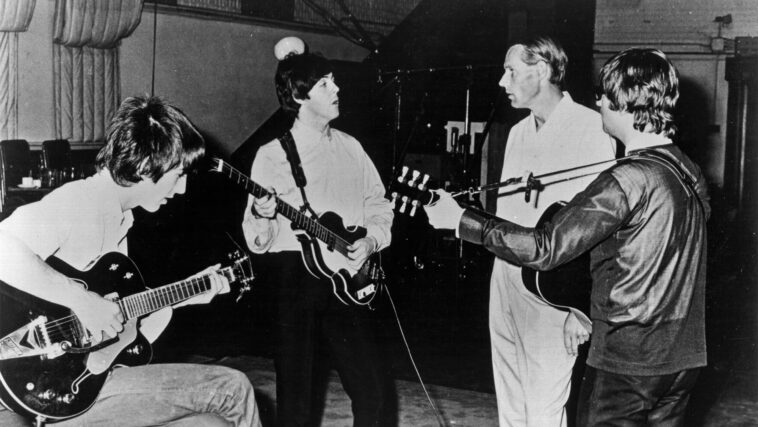
Part of the challenge is that what listeners hear as a single chord is actually the combined sound of as many as four instruments: Martin’s piano, Lennon’s Gibson J-160E acoustic-electric, Harrison’s Rickenbacker 360/12 12-string electric and Paul McCartney’s Höfner bass. Some analyses omit Martin’s contribution altogether, but however you account for the parts, the famous opening can’t be reproduced faithfully by a single guitarist.
We knew it would open both the film and the soundtrack album, so we wanted a particularly strong and effective beginning.”
— George Martin
“We knew it would open both the film and the soundtrack album, so we wanted a particularly strong and effective beginning,” Martin explained. “The strident guitar chord was the perfect match.”
Indeed it was. More than six decades later, the chord remains a favorite subject for YouTube creators, with countless videos attempting to decode its secrets. But one of the earliest serious investigations appeared in the pages of Guitar Player magazine in 2005, roughly a year before YouTube’s public rollout.
The investigator was Dr. Jason I. Brown, a professor of mathematics and computer science at Dalhousie University in Halifax, who used a mathematical technique known as Fourier transform to decompose the recording into its component frequencies.
As Brown explained, one of the most common transcriptions at the time defined the chord as G, D, F, C, D and G, all played on a single guitar. The Beatles Complete Scores, meanwhile, described it as a composite chord made up of G, D, G, C, D and G played by Harrison on his Rickenbacker 12-string, D, G, C and G played by Lennon on his Gibson acoustic-electric, and a low D played by McCartney on bass.
It was impossible to match the other low notes to Harrison’s 12-string, even taking into account the notes played on Lennon’s six-string.”
— Dr. Jason I. Brown
To test those theories, Brown analyzed a one-second digital recording of the chord. After applying a Fourier transform to the audio, he rounded the 48 loudest frequencies to their nearest semitone.
“These are the notes that comprise that marvelous chord,” he wrote. The analysis identified nearly two dozen distinct pitches spanning nearly five octaves: A2, D3, F3, G3, A3, C4 (middle C), D4, G4, A4, C5, D5, G5, B5, C6, D6, E6, F#6, G#6, A6, D7, E7, F7 and G7.
“We see now why the most popular versions of the chord must be wrong,” Brown wrote. “Each shows a low G2 being played, but this note is definitely not included in the frequency analysis. Examining the frequencies, I found that one D3 is louder than the others, which suggests it is a bass note played by McCartney—but it was impossible to match the other low notes to Harrison’s 12-string, even taking into account the notes played on Lennon’s six-string.”

The breakthrough came when Brown stopped assuming the sound came entirely from guitars.
“With a bit more deductive work, I found the presence of the piano did indeed solve the frequency problem,” he wrote. “The important point is that the piano is there because the math says it is.”
Brown’s conclusion doesn’t answer every question surrounding the famous opening chord, and it’s unlikely the debate will ever disappear entirely. But it does explain why generations of guitarists have struggled to recreate it: they were trying to play what was never the work of a single guitar in the first place.