
![Array]](https://backingtracksfullcollection.com/wp-content/uploads/2026/05/Array.svg.svg+xml "“Kurt would always say, ‘I’m gonna get a Chet Atkins.’ But he never did. It wasn’t until he died that I went and looked at one”: Courtney Love refused to turn Celebrity Skin into “a grieving widow’s memoir” – but she paid tribute with the gear she played 18")
The whole world was watching when Courtney Love’s husband, Nirvana frontman Kurt Cobain, was found dead on April 8, 1994.
Two months later, Kristen Pfaff, bassist for Love’s band Hole, died from a heroin overdose. The group were forced to put a tour on hold and pull out of an appearance at Lollapalooza.
But Love refused to let these tragedies define Hole’s 1998 album, Celebrity Skin. The last thing she wanted was to write “a grieving widow’s memoir,” as she called it in a 1999 Guitar World interview.

“I think that’s the kind of satisfaction some people would really want. But I’m not in the mood for that. That’s not what I’m about. This isn’t Lucinda Williams. I’m not some confessional singer/songwriter. My whole history in this business has been to find the hook.”
A media circus. The aftermath of two major deaths. A new bass player. An intense touring schedule. Hiatus. Relocation to New Orleans, New York, Nashville, and Memphis. All contributed to Celebrity Skin.
But Love also used Los Angeles, fame, and celebrity culture as her muse. The result was a record that captured the zeitgeist.

And although she didn’t want to dwell on her departed partner in the album’s lyrics, her guitar work paid subtle homage through her gear choices.
All the latest guitar news, interviews, lessons, reviews, deals and more, direct to your inbox!
The most poignant of these was a big-bodied Gretsch that few would associate with Cobain – but for the Nirvana frontman, it was the one that got away.
“Kurt would always say, ‘I’m gonna get a Chet Atkins.’ But he never did. I don’t think he could find a left-handed one. It wasn’t until he died that I went and looked at one, and it was really beautiful.”
Love’s other primary guitar during this era was her signature Fender Vista Venus – a part Mercury, part Stratocaster, and part Rickenbacker hybrid – which broke new ground as only the second signature guitar ever released for a female guitarist, following Bonnie Raitt.
“I didn’t want it all teched out,” she said of its H/S pickup configuration. “I wanted it real simple, with just one pickup switch. Because I think that cultural revolutions are in the hands of guitar players.”
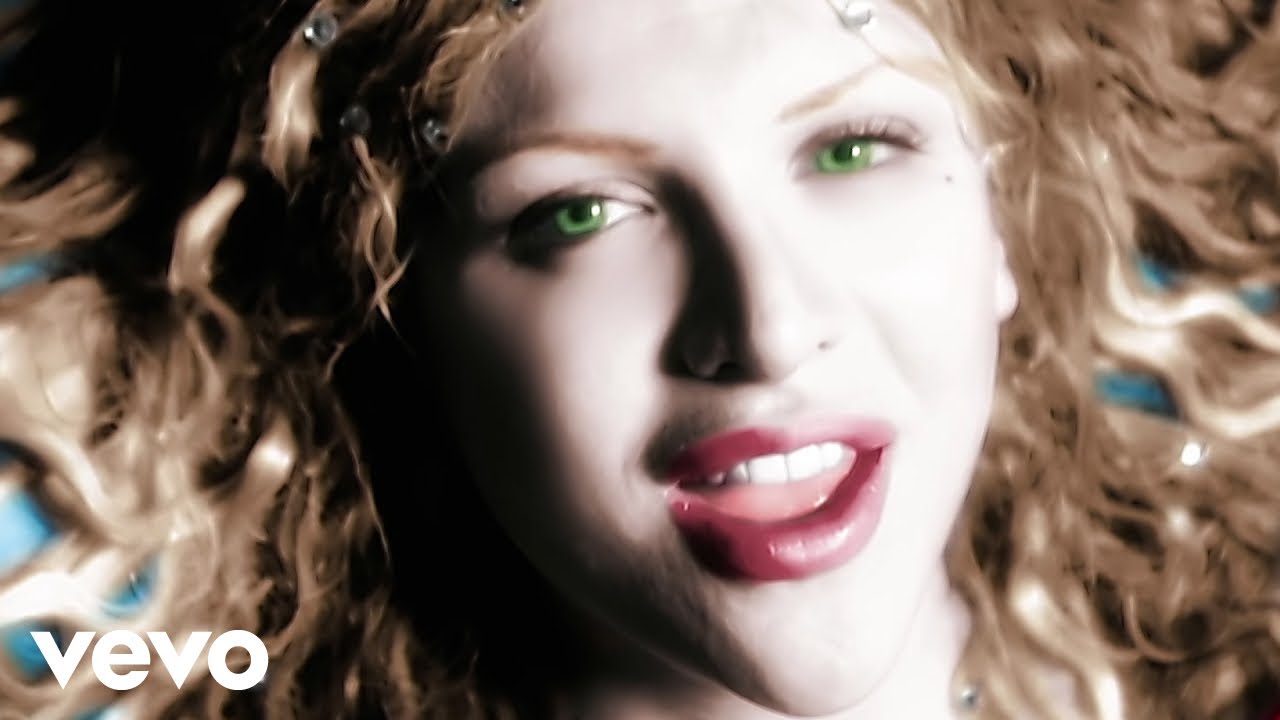
Another key piece of gear was a solid-state 1976 Randall Commander that formerly belonged to Cobain (“He did like his Randall Commander”).
Meanwhile, the Boss DS-1 Distortion, a firm favorite of Cobain’s, was a mainstay, as was the Electro-Harmonix Big Muff Pi fuzz. Love was such a fan of the latter, she reckoned she beat her husband and Celebrity Skin co-writer Billy Corgan to the punch.
“I contend that I was the first person to actually have a Super Fuzz Big Muff, before the rest of the boys. It was when I was in this purist ’60s garage band called the Venerays, with Kat Bjelland.
“And just recently, I started using a box called the Mystic Blue. I like a good box, and I’ll try any one – if it has a good-sounding name. Especially if they made a box with some kind of girly name,” she quips. “If they made one called Cherry Apple Blossom, I’d run with it every night!”
Released on September 8, 1998, Celebrity Skin turned out to be the last album – and most commercially successful – before Hole parted ways in 2002, and featured contributions from Corgan, The Go-Go’s guitarist Charlotte Caffey, and frequent Love collaborator Jordon Zadorozny.
“I genuinely did feel antisocial, and the first two albums reflect that,” she says of Celebrity Skin’s more “palatable” sound.
“But now I’m into mainstreaming. I’m just doing mainstreaming correctly… During grunge and during metal, they couldn’t sell shit to us because we were too cynical.
“There’s a way to mainstream things with integrity.”
![Array]](https://backingtracksfullcollection.com/wp-content/uploads/2026/05/1779850244_Array.svg.svg+xml "“I’ve thought this through... I’m giving him the benefit of the doubt here, and assuming he doesn’t really think I’m the antichrist”: Phil Collins thinks he might know why Noel Gallagher called him “the antichrist of music” back in the ‘90s 29")