
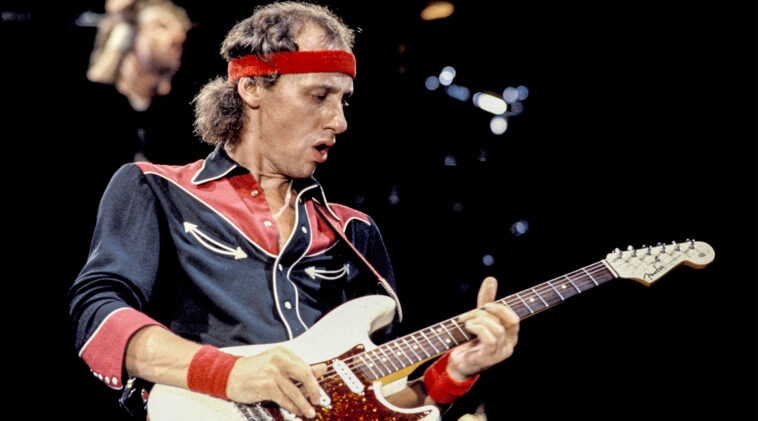
Before Mark Knopfler wrote “Sultans of Swing,” “Money for Nothing” and countless other classics, he was chasing a different kind of story.
Prior to becoming one of rock’s most admired guitarists, Knopfler worked as a newspaper reporter, covering everything from local news to court cases. Looking back, he says those early years didn’t just prepare him for a career — they taught him how to write songs.
Though his fluid electric guitar playing made him a household name, it’s the people who populate his songs that have always set him apart. Mechanics, truck drivers, musicians, lovers and dreamers all feel startlingly authentic because, in many cases, they began as real people Knopfler observed rather than fictional characters he invented.
“It was a great thing to do as a kid,” he told Stuff in 2009. “I went to college after being a newspaper lackey, and it was a great introduction to ‘life’ as a concept, to the world in general.
“I then moved into court reporting,” he added. “I just remember it all as being a very good thing to be doing, a way to see how society is organized.”
Just as importantly, journalism taught him to listen.
“It influenced me and allowed me to meet people,” he said. “To eavesdrop too, to take stories of other people home.”

Few Dire Straits songs illustrate that better than “Money for Nothing.”
Its narrator — the disgruntled appliance-store employee mocking rock stars on MTV — wasn’t dreamed up in isolation. Knopfler overheard the man’s complaints while shopping and began scribbling lyrics on a borrowed piece of paper right there in the store.
“The lead character in ‘Money for Nothing’ is a guy who works in the hardware department in an appliance store,” he told Musician. “He’s singing the song. I wrote the song when I was actually in the store. I borrowed a bit of paper and started to write the song down.
“I wanted to use a lot of the language that the real guy actually used when I heard him, because it was more real. It just went better with the song; it was more muscular… I mean, that is the way people speak.”

The same curiosity drove “Private Dancer,” his quietly devastating portrait of a sex worker longing for something better. Knopfler ultimately gave the song to Tina Turner, whose recording became an international hit, but its emotional power came from the same instinct he’d developed as a reporter: observing other people’s lives and imagining the world from their perspective.
It’s why so many of Knopfler’s songs blur the line between reportage and fiction. He borrows voices, conversations and tiny everyday details, then shapes them into stories that feel lived-in rather than invented.
For Knopfler, that’s the defining difference between being a musician and being a songwriter.
“First of all, you start to think of yourself as a guitar player of sorts, and then the songwriter,” he told Forbes in 2024. “I’ve come to realize the songwriter is different from a musician.”
It’s a revealing admission from a player celebrated for some of rock’s most iconic guitar work. Knopfler may be revered for his touch and tone, but the foundation of his music was laid years earlier — in courtrooms, on newsroom assignments and in overheard conversations — where he learned that the smallest details often tell the biggest stories.
![Array]](https://backingtracksfullcollection.com/wp-content/uploads/2026/05/Array.svg.svg+xml "My pick of the best new guitar gear this week (07.17.26) 27")