
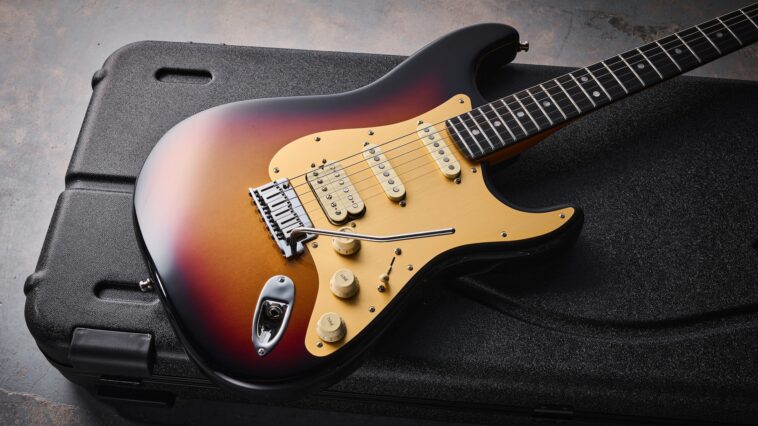
The battle over who can legally sell Stratocaster-style guitars in Europe has escalated, with Fender filing a copyright infringement lawsuit against musical instrument retailer Thomann.
In a statement, Fender said its infringement claim is “the expected next step in the legal process” after Thomann filed a Declaration of Non-Infringement action against the company.
The latest development follows Thomann’s lawsuit, filed after Fender sent cease-and-desist letters to Harley Benton, Yamaha, PRS Guitars, LsL Instruments and other manufacturers it believes are producing “copies” of its Stratocaster electric guitar.
Thomann, which owns the Harley Benton brand, said it was acting on behalf of both major manufacturers and smaller builders, specifically naming companies including Tom Anderson, Suhr, Pensa and Maybach.
Fender, however, argues that Harley Benton guitars infringe on its Stratocaster design and says Thomann’s legal action is an attempt to secure the right to continue selling those instruments.
“Thomann isn’t a small independent guitar builder. It is one of the world’s largest musical instrument retailers, one of Fender’s largest retail partners, and the owner of Harley Benton, one of Europe’s largest guitar brands.
According to Fender, it previously sought to resolve the dispute by discussing “practical ways to differentiate products while respecting Fender’s intellectual property,” but those discussions were unsuccessful, leading Thomann to file suit and prompting Fender’s countersuit.
“Thomann isn’t a small independent guitar builder,” Fender said. “It is one of the world’s largest musical instrument retailers, one of Fender’s largest retail partners, and the owner of Harley Benton, one of Europe’s largest guitar brands.
“From the beginning, our goal was simple: have a conversation. Like many other companies across Europe, we reached out to Thomann to discuss practical ways to differentiate products while respecting Fender’s intellectual property. Our preference has always been dialogue and practical solutions—not litigation.
“Unfortunately, Thomann chose a different path.Rather than continuing that dialogue, it initiated legal proceedings asking the court to determine that it can continue selling guitar body designs that Fender believes copies the iconic Stratocaster. Today’s filing is Fender’s response and the expected next step in the legal process.”

In the statement accompanying its Declaration of Non-Infringement filing, Thomann said it had taken legal action “for the many manufacturers, dealers and guitar makers who have shaped our industry for decades and continue to shape it.”
“We urge Fender to stop issuing cease-and-desist demands against manufacturers, distributors and dealers and to return to a fair, cooperative partnership,” the retailer said.
Fender rejects the suggestion that it has avoided cooperation, maintaining that collaboration has been central to its approach. The company says it has successfully worked with other manufacturers to modify guitar designs so they are clearly differentiated from the Stratocaster while remaining commercially viable.
“Our preference has always been to resolve these matters through direct dialogue rather than litigation,” Fender said. “In many instances, companies have chosen to work collaboratively with us to explore practical solutions, including design modifications that clearly differentiate their products while continuing to serve musicians. This matter is different.”
The countersuit marks the latest chapter in the widening dispute over Stratocaster body-shape rights. The conflict intensified after Fender secured a default judgment in a German court that it says grants it enforceable rights against guitars using the Stratocaster body shape within the European Union.
![Array]](https://backingtracksfullcollection.com/wp-content/uploads/2026/05/Array.svg.svg+xml "“A rare and often overlooked chapter in amplifier history”: IK Multimedia makes 9 elusive lost era Fender amps available as a TONEX plugin 26")
![Array]](https://backingtracksfullcollection.com/wp-content/uploads/2026/05/1779850244_Array.svg.svg+xml "This free browser-based sampler turns YouTube into an MPC 27")