Switch guitar chords faster with this handy exercise
A big challenge for anyone starting out playing the guitar is training their fret-hand fingers to memorize the proper placement on the strings to form various chord shapes, so that the notes ring clearly when strummed.
I’ve seen many beginner students struggle to form open chords cleanly and accurately and switch from one chord to anotherin a timely manner, meaning in a prescribed rhythm, such as every two or four beats, at a steady tempo.
A simple, effective exercise to address this technical issue is to practice switching back and forth between any two chords at a relaxed (fairly slow) tempo, holding each chord for a few beats or just a single beat. Ideally, this should be done along with a metronome or while tapping your foot in steady quarter-note beats.
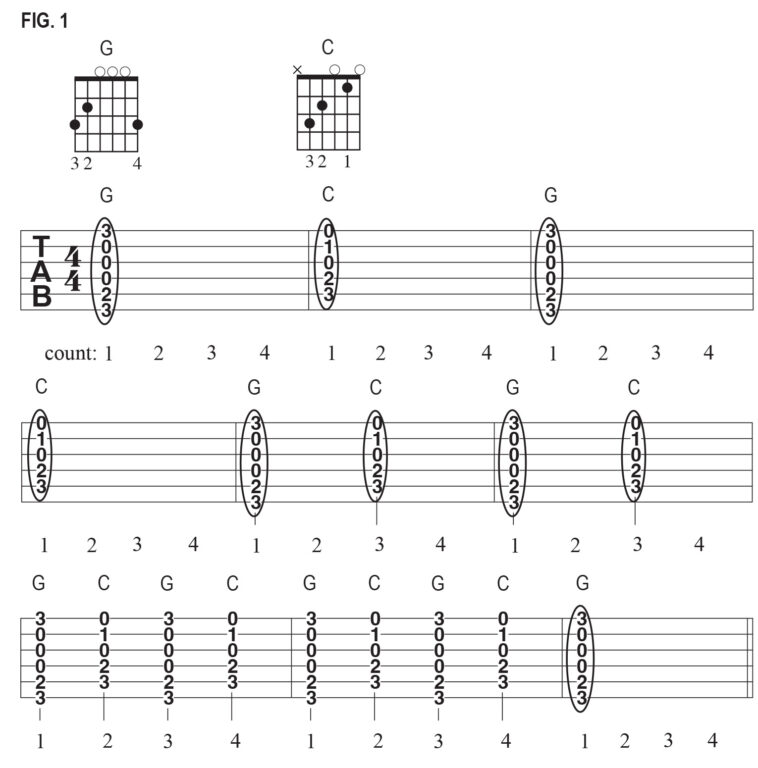
For example, practice moving back and forth between open G and C chords repeatedly (see FIGURE 1). Start out with easy whole-note rhythms, holding each chord for four beats while counting “1, 2, 3, 4.” This gives you a good amount of time to mentally get ready for the next chord.
Do this a few times then “double-up” the rhythm to half notes, for which you’ll hold each chord for only two beats before changing to the next chord. This is more challenging, as you now have half as much time to mentally prepare for the next chord change.
Do this at least a couple of times, then double-up the rhythm again, to quarter notes, now changing chords on every beat, which, again, is twice as challenging. Doing this will help ingrain the movement into your brain and fingers.
A couple of things to keep in mind when performing this chord changing exercise:
All the latest guitar news, interviews, lessons, reviews, deals and more, direct to your inbox!
1) Try to hold the chord for its full prescribed duration before moving to the next chord. I’ve seen beginner students strum a chord that’s supposed to be held for four beats (a whole note) but “let go” of the shape too early, on beat 4 or beat 3, in order to give their fingers more time to get ready to form the next chord shape “on time.”
This is a bad habit. You should strive to not cheat a rhythmic value out of its full duration. Try to hold the chord as long as possible, letting go of the shape “at the last second,” which is sometime during beat 4, such as on the eighth-note upbeat (on “4 and”).
(Image credit: Future)
2) When changing from one chord to another, make a point of setting your fretting fingers down onto the strings together, at the same time, not one at a time, which is another bad habit I’ve seen beginners fall into; doing that ultimately ends up slowing you down mentally and physically.
The fingers need to learn to move together as a team and “stick the landing” in tandem. This is the only way you’ll be able to keep up with the tempo. Try applying this exercise to any chords you’ve recently learned. Doing so will help to quickly establish the neurological connections between your brain, fingers, ears and eyes.
(Image credit: Future)
Here’s another example. Toggle back and forth between Em and Am (see FIGURE 2). Or do the same thing with Em and D, Em and C, G and B7, or any other newly acquainted chords that you want to quickly get to know, in terms of muscle, visual and auditory memory.