
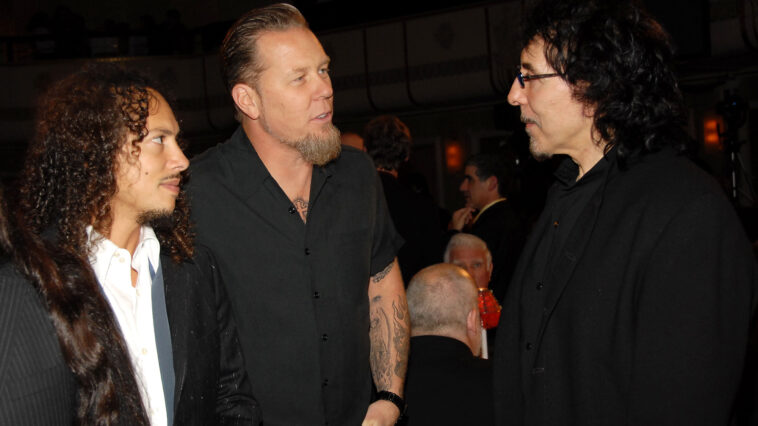
James Hetfield has named Tony Iommi as the single biggest influence on his rhythm guitar playing and songwriting — and pointed specifically to Black Sabbath’s “Children of the Grave” as a masterclass in riff construction.
“Tony Iommi is the riff lord, in my mind, and he is the one that has inspired me the most out of any guitar player for my rhythm guitar playing and songwriting,” Hetfield says in the latest episode of James Hetfield’s Riff Life on SiriusXM’s Maximum Metallica.
Discussing “Children of the Grave,” Hetfield breaks down what makes Iommi’s playing so effective, from the song’s central electric guitar riff to the way the guitarist uses chords, percussion and effects to expand its sound.
“Obviously, Tony is the riff lord and everyone starts the song together on the one riff,” he says. “Tony plays off that riff, goes in to hit the big giant chords, which opens the song up. I really love the drum overdub that they did to help with that percussion of the riff and the real cool ghostly guitar sounds at the very, very end.”
Hetfield’s admiration for Iommi is hardly surprising. Metallica took up the mantle of heavy metal’s original architects when they emerged in the 1980s, with Black Sabbath’s influence running throughout the band’s music. Iommi acknowledged that lineage in 2024, saying it was “brilliant to hear about other musicians liking what I’d done, taking the same kind of idea and improving on it, evolving it into their own sound.”

Metallica made that connection especially clear at Black Sabbath’s star-studded “Back to the Beginning” farewell show last year, performing “Johnny Blade” from Sabbath’s 1978 album Never Say Die! — a deeper cut rather than one of the band’s most obvious classics.
Metallica guitarist Kirk Hammett has been equally emphatic about what Black Sabbath’s four original members mean to heavy music. Reflecting on the band’s influence ahead of the farewell show, he said:
“If it wasn’t for those four guys, man, we might still be just kind of like wandering around in the dark. But the fact that they created a genre — not only created it, but then developed it and then turned it into like a few different things over the course of their career — is completely awe inspiring to me and my peers musically.”