
Like most guitarists, I waste way too much of my life mindlessly staring at Instagram. When I’m not ogling vintage six-strings I’ll never afford, I’m scrolling through what seems like a relentless feed of targeted ads for online gear giveaways. I can’t be the only one who’s noticed a sharp increase in the number of these sites popping up lately.
Honestly, it’s hard to blame anyone for taking the bait. The thought of snagging your dream electric guitar for less than a set of Slinkys is pretty damn tempting, and I’m certainly not strong enough to resist it.
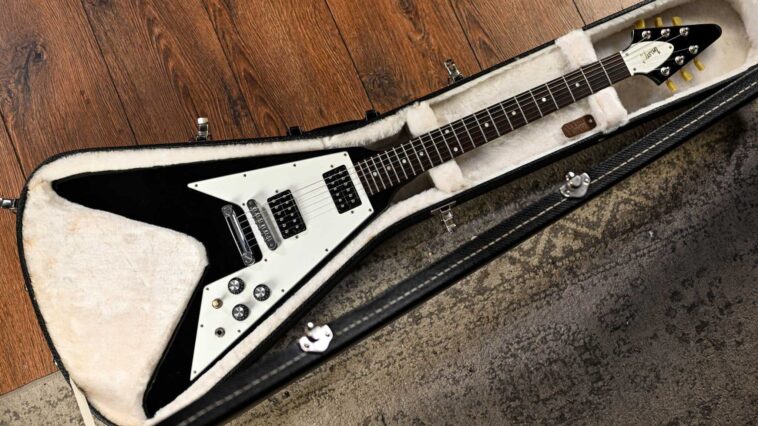
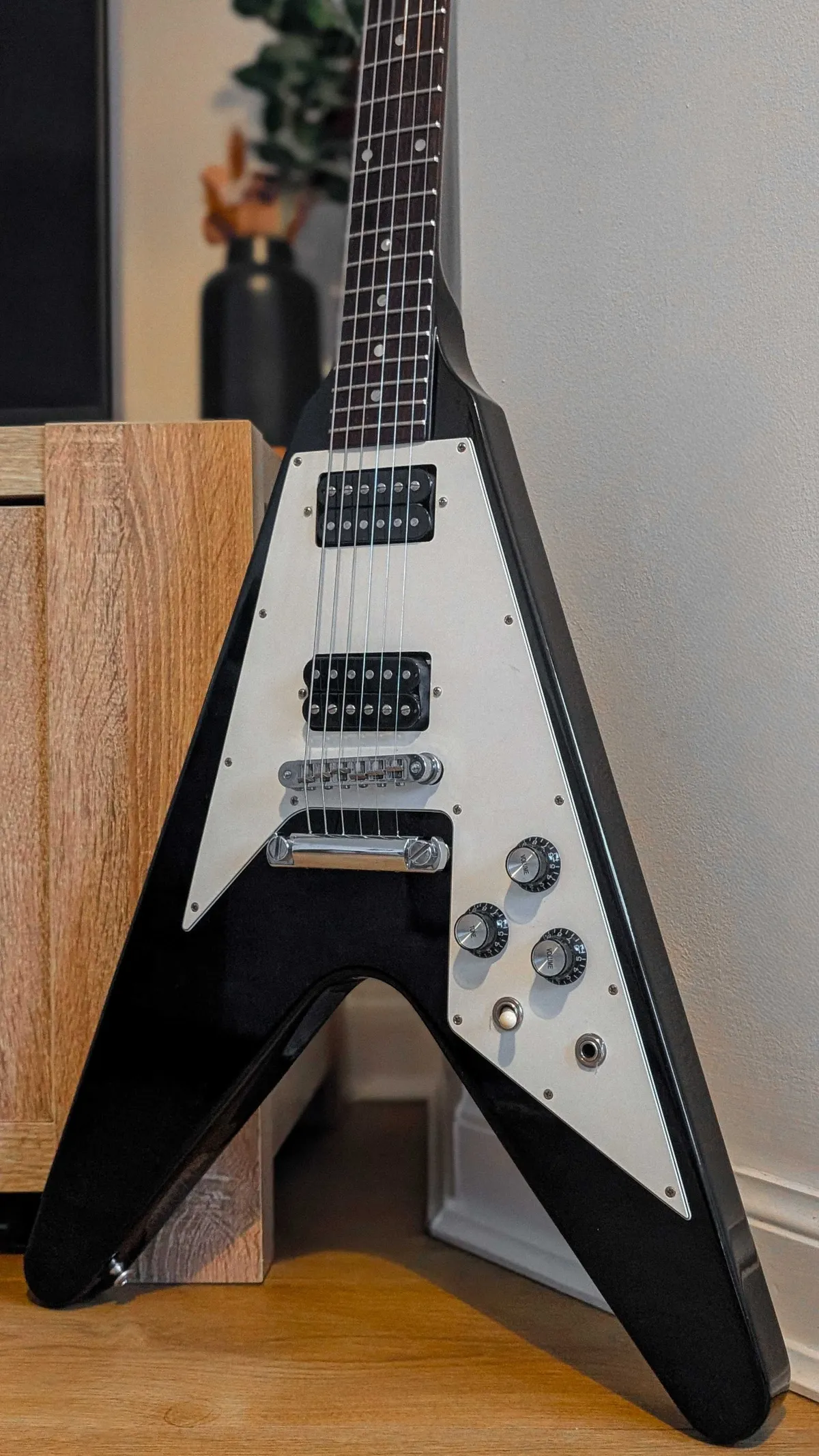
I’ll be the first to admit that I don’t need any more guitars. At my last count, I have around 26 of them, but I seem to always be looking to add just one more to the collection – and that brings me to this rather nice Ebony Flying V.
Latest Videos FromGuitar World
I’ve been obsessed with Metallica since I was 12, especially Kirk Hammett’s battle-scarred ’79 Gibson Flying V, you know, the one he played heavily in the band’s early days. So when an ad flashed up on my phone for a 2009 V, with more than a passing resemblance, I jumped on it. Tickets were 48p. So I thought, “Screw it. What’s 48p?”
My wife didn’t seem to share my enthusiasm. “Really? You know it’s a scam, right?” At this point I’m skeptical myself. After all, the internet is littered with suspicious-looking prize websites promising everything from luxury supercars to houses. I mean, if it’s too good to be true, it probably is, right?
Well, if it was a scam, best-case scenario I lose a couple of quid. Worst case, they steal my bank account details and go on a spending spree. Thankfully, that didn’t happen.
Only hours after entering, I got an email with the header “Congratulations, you’re a winner!” I had gone and won the damn thing. I still didn’t fully trust it. Of course, I was ecstatic to win such a beast of an instrument, but I wasn’t going to celebrate until the courier handed over the massive box and there was a guitar inside. Well, I can tell you, the guitar did, in fact, arrive, and no, it wasn’t a Chibson.
Turns out this is a fully functional, totally legit, and ridiculously lucrative business model, and it’s taking over the guitar world, at least in the UK. So with that in mind, I want to take a closer look at this new industry, find out how it’s regulated, and also how to spot the real sites from the dodgy ones.

In the past few years, online prize competitions have exploded across the UK. Driven by aggressive social media marketing and the irresistible dream of securing a holy-grail instrument for less than the price of a coffee, the market has gone from niche internet raffles with a few hundred participants into a major operation with thousands of players entering every day.
To understand how a garage-born idea became an industry behemoth, I spoke with Sam Boxell, co-founder of Guitar Gear Giveaway and one of the pioneers behind the UK’s first exclusive guitar competition site.
Launched in April 2019 and starting out with a single 1980s Japanese Fender Hendrix Strat loaned by his business partner’s father, the platform now moves an impressive number of high-end instruments every month. So much so that it could comfortably compete with some of the country’s biggest retailers.
“We ship out over 125 guitars a month, and they’re not Squiers,” proudly states Boxell. “They’re £2,000 Les Pauls. They’re five-grand Murphy Labs. These are expensive guitars.”
Rather than competing directly with traditional brick-and-mortar guitar stores, these giveaway sites have become essential customers for dealers, buying up huge quantities of vintage, preowned, and new stock.
As Boxell explains, around 90% of their instruments are sourced secondhand, and that is by design, as they buy up stock from GuitarGuitar, Andertons, Peach Guitars, and even eBay.
“I love the hunt for the incredibly cool guitars,” he says. “Rather than doing a new ’70s reissue Les Paul Custom, let’s just find a real ’70s Custom. That way someone hasn’t got to go and spend five grand on that guitar – they can win it for next to nothing,” he continues.
To show how unstable the industry was in its infancy, the founders hit major corporate roadblocks in the early days that nearly killed the venture before it really got started.
“We were running on Shopify and using things like Stripe and PayPal for payments, which swiftly blocked us and took all of our money and froze it for 500 days until eventually we found a merchant who understood the industry and they took us onboard,” recalls Boxell.
We went from 5,000 to 25,000 users in two months on the site
You don’t need me to tell you that when COVID-19 hit, many businesses struggled, but the sudden shutdown gave the new business an unexpected boost. People were locked down, many traditional guitar shops closed, and well, more importantly, the costs of Facebook ads plummeted.
“When everything shut down, everybody turned off their Facebook ads because all the shops were closed. Our cost per acquisition went from maybe £1.50 to get a new customer down to like 15p. We went from 5,000 to 25,000 users in two months on the site,” says Boxell.

Nothing illustrates the wild shift in the company’s trading quite like going from listing a borrowed Japanese Strat as their first comp to a 1952 Les Paul Goldtop. As Boxell recalls, they originally ran the all-original holy grail about three years ago. The lucky winner was initially over the moon, but panic quickly set in at the thought of holding such a valuable piece of guitar history.
“He was having a panic attack,” Boxell tells me. “He was like, ‘I don’t know what I’m going to do with this; my house insurance won’t cover it.’” Thankfully, the platform helped facilitate a buyout, matching a dealer’s offer so the winner could walk away with a cool £20,000 in cash to buy a modern Custom Shop model and pocket the rest.
Boxell’s business partner Andy Willett ended up acquiring the Goldtop, even loaning the guitar to blues-rock virtuoso Jared James Nichols to play live on stage at The Fleece in Bristol.
Oh, and by the way, if you’re curious about the guitar, Guitar Gear Giveaway is actually preparing to put the legendary instrument back into a draw in December. That’ll be one hell of a Christmas present for someone.

For years, prize competition sites operated in somewhat of a grey area. Because they include skill elements, like simple questions to answer or free postal entries, they fall just outside a lot of the traditional gambling legislation for lotteries or raffles. However, this lack of formal oversight left the sector vulnerable to bad actors and lingering consumer mistrust.
The killer early on was the social media comments. That was brutal
Thankfully, the government has stepped in with a voluntary code of conduct run by the Department for Culture, Media and Sport, as well as oversight from the Prize Competitions Council.
Before new regulations and public trust caught up, the early days involved fighting a constant PR battle in the comment sections online just to prove the whole thing wasn’t an elaborate scam to separate you from your cash.
“The killer early on was the social media comments. That was brutal,” laughs Boxell. “I realized pretty quickly that the easiest thing to do is to just respond through video. Because if you just start a typing war with someone, it obviously never ends.”
Now, this new framework introduces strict operational standards across the industry. Third-party verified random number generators help keep things as fair as possible. This means basic Google RNGs are no longer sufficient. Operators must use independently audited software that date-and-time-stamps every draw with a unique public token.
The government also now has a verified, compliant list of operators listed on official government trade registers, giving players a way to instantly check a site is real.
Of course, responsible gaming controls are now in place, too. Platforms must enforce monthly spending caps, restrict credit card use, and you can even lock your account if things get out of hand.

Rather than fearing tighter government rules, established platforms see them as crucial to long-term credibility.
“You’ve always got this feeling of, well, anyone could come in at any point and just shut this down. Then what happens not just to us as a business, but to the guys we’ve employed whose livelihoods are riding on this job?
“Sure, the regulation might mean we make a little less money in the short term, but it turns this industry into something with real longevity behind it. For me as an owner, it’s just a massive weight off, having some structure and some guidance,” says Boxell.
You’ve always got this feeling of, well, anyone could come in at any point and just shut this down
When asked about expanding internationally across the Atlantic, Sam explained why the UK model is uniquely difficult to replicate abroad.
“The rule set is so different in every single jurisdiction that you can’t possibly comply with everyone. And that’s the reason the US is such an issue, basically, because every state just has a completely different view on all of this stuff. I think you would never be able to run a competition in America like you can in the UK,” he continues.
While legitimate sites are safer and more transparent than ever, pop-up scams still occasionally surface, so players entering giveaways should still be as vigilant as possible.
Obviously, the first thing to do is to confirm the operator appears on the government code of conduct register. It’s the quickest way to ensure a site is legit.
Above-board sites may not have their credentials yet, but it’s always best to play it safe and only use sites that you can verify.
Next, you can confirm the draw system. It’s best to make sure the website uses an independently verified, third-party random number generator with public, searchable draw logs rather than an unverified live feed. This helps ensure there’s no funny business with the draws.
You can also look at reviews and see what other players are saying online about the site. If the site is dodgy, you can guarantee someone will be sounding off about it online. So, take an extra five minutes to check independent review platforms like Trustpilot. Watch for common complaints about unfulfilled prizes, unfair draws, or anything else that seems a bit sus.
Lastly, look for total transparency. Legitimate businesses feature real winners with photos, have public company registration details, clear postal entry routes, and easy email contact.

Winning a dream instrument for such a silly price is thrilling. I genuinely thought it was a scam until a Gibson Flying V arrived at my door. For gear nuts like me, competition sites offer a legitimate shot at dream instruments that would otherwise remain financially out of reach, and that is exciting.
But it’s vital to keep your feet on the ground. At its core, entering prize draws is a form of gambling. Yes, the odds are transparent, but they are still odds. It should never replace your standard budget or be seen as a reliable investment strategy.
Honestly, I think you should treat it as a bit of fun. Never spend more than you can afford. Set hard limits, and play responsibly, because yes, you could win a guitar, but you could also lose a lot of money if you’re not careful. If you are worried about gambling and need help, be sure to check out the UK Gambling Commission for some very helpful advice.
Anyway, I’m under strict instructions not to bring any more guitars into the house, so I’d better make the most of this one. I’m off to play Seek and Destroy at an ungodly volume until my neighbors call the fuzz.