Looking back, 1955 was the year of slim pickings at Gibson, with the introduction of three new ‘thinline’ archtop models: the Byrdland, ES-350T and the single-pickup ES-225.
Available in Sunburst ($395) and Natural ($410), the ES-350T looked much like the ES-350 from the front, but the body depth was reduced from 3 ½ inches to 2 ¼ inches. The most significant difference between the ES-350 and ES-350T, however, was the latter’s shorter 23 ½-inch scale length.
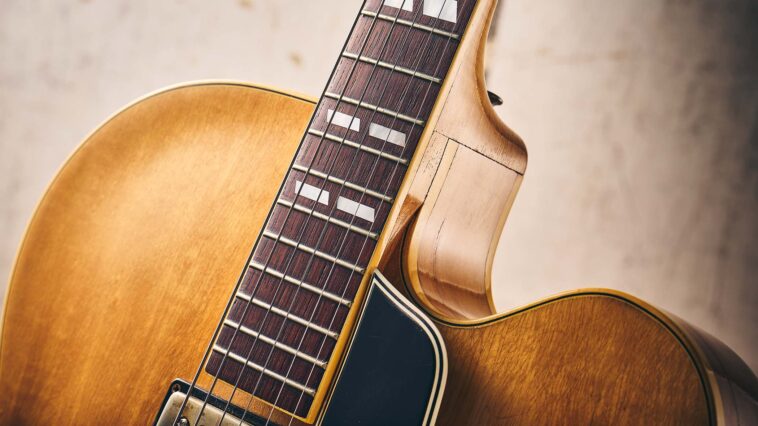
Constructed with a laminated maple body, a two-piece maple neck with a centre stripe, and a rosewood fretboard, the ES-350T was equipped with Gibson’s newly designed tune-o-matic bridge and a brace of P-90 pickups. The ES-350 was dropped from Gibson’s catalogue in 1956, and ES-350T production continued until 1963.
Latest Videos FromGuitar World
Patent Applied For humbuckers replaced the P-90s in 1957; in the ES-350T, Byrdland, L-5CE and Super 400CE they all had slightly narrower pole spacing than standard. Most of these pickups measure 1 15/16 inches between the centres of the outer pole screws, but the tighter spacing was 1 13/16 inches. More changes followed, with the nut width increasing from 1 5/8 to 1 11/16 inches in 1959. In 1960 the cutaway style was altered from Venetian to Florentine, and in 1962 three-piece necks were introduced.
When it comes to famous players, the Gibson ES-350T is mostly associated with Chuck Berry. He used one with P-90s for all of the mid-’50s recordings he made for Chess Records, and he appears with it in countless photos from that era. Chuck bought one of the first Patent Applied For pickup-equipped ES-350Ts in 1957, but he was playing an earlier P-90 model when he appeared at the Newport Jazz Festival in 1958.
It’s hard to overestimate Chuck’s influence on the young rock ’n’ roll, R&B and blues guitarists that eventually found fame in the ’60s. None seemed interested in using ES-350Ts as their main guitars – probably because they were poorly suited to the high volume levels of the blues-rock era – but Eric Clapton, Keith Richards and Jimmy Page have all owned them.
The example featured here belongs to former XTC guitarist Dave Gregory, who joins us to share the story.
“My ES-350T dates to December 1957, so it would have been part of the first production run with Gibson’s new amazing humbucking pickup,” Dave tells us. “Before I owned this guitar, I hadn’t fully appreciated exactly what a brilliant pickup a 1950s [Patent Applied For humbucker] can be and why people are willing to spend so much money on them.
“I’d always wanted an ES-350T, not because it was going to be a primary guitar but just because it would be something lovely to own. It was coming up for auction at Gardiner Houlgate and I asked them if I could have a go. As soon as I plugged it into this little amp they gave me, I was amazed by its responsiveness.
“Regardless of which pickup was selected, there were no flat or dead spots. Each note, anywhere on the scale, had the same output and same sort of response. The timbre is what a harpsichord player might describe as ‘well tempered’, and it felt like a really brilliant piece of music-making technology despite being [more than] 50 years old.”

(Image credit: Future/Phil Barker)


“I was so glad I’d had a chance to sit down and experience it, but at the time I thought it was way out of my league. Even so, I thought I’d put a bid in. I was lucky because it didn’t reach its full value at all, and that’s the only way I could afford to buy it. I suppose not everyone wants a great big hollow-bodied guitar.
“It had suffered some damage because it had probably been hung up somewhere and fallen off. A chunk of wood had been taken out from the end-pin area, and there was a crack that went the whole way around the lower bout and almost up to the neck joint. It was just a hairline split that had been professionally repaired, and I noticed that the top and sides had been oversprayed with lacquer.
“The frets are tiny, so I’m pretty sure they’re the original factory ones, and they have very little wear. I imagine the ES-350T was intended for jazz players who wanted to fly around on the neck, and from that point of view it’s really comfortable. You might wonder why Chuck Berry chose to play one, but if you listen to how he played, you’ll get it. I’m a huge fan of Chuck’s – but even more for his lyrics than his guitar playing. I think he is underrated as a lyricist.”

(Image credit: Future/Phil Barker)


“I struggle a bit with the small frets because I’m not a jazz player by any means and I like to dig in and wail. But I can sit down with that guitar and spend hours noodling on it because it just feels comfortable and perfectly balanced. You’ve got to find a bit of extra elbow room for the picking hand, which takes some getting used to, but the fretting-hand positioning is perfect.
“The neck is quarter-sawn curly maple with the stinger at the top – I love all of that ancient Gibson stuff. I haven’t played any medium-scale Gibsons other than my ES-350T, so I can’t say it’s a typical ’57 neck profile. It’s sort of a massive fistful, but it’s easy to play and I think that even if you have small hands or short fingers, you will still find an ES-350T very accommodating.
“Having said that, Gibson’s shorter 23 ½-inch scale length is something that I struggle with, to be honest. The nut width is 1 5/8 inches and the neck width at the 12th fret is 1 7/8 inches. With only a quarter-inch increase from the nut to the 12th fret, it feels almost parallel and it does take some getting used to.”

“Unlike many of Gibson’s other high-end jazz guitars, the ES-350T has a gold-plated tune-o-matic bridge on a wooden base, rather than a rosewood bridge. I have to use double-sided tape to keep it in position otherwise whenever I change strings, and take them all off as a set as I do, the bridge will go floating.
“Despite owning some amazing-sounding [Patent Applied For pickups] in my ’63 ES-335, the ones in the ES-350T were better than I was expecting. Perhaps the application of them in that big hollow body without the centre block allows you to hear more of the strings. They just draw out the music and I find them more sonically accurate and musical. You can hear every note in chords and they don’t fluff out or overload.
“Higher gain pickups can produce an instant distortion, but the ES-350T’s bridge pickup is 7.6k and the neck is 7.1k. I do have a 1960 ES-335 that also has Patent Applied For pickups, and they’re probably closer to the ’57’s in tone and response.
“The potentiometers had virtually seized up, so I thought I’d pull the loom out and give them a squirt with DeoxIT. Having pulled it out, I noticed the pots were in metal casings sealed by heavy-duty solder joints. I had a little brainwave and squirted some DeoxIT down through the shafts of the pots and that fixed them. They still don’t exactly fly around, but I don’t need to move them that often.”

(Image credit: Future/Phil Barker)


“When I bought it, the ES-350T had a modern Gibson case with one of those silly combination locks. It was decent enough, but I did not like the aftermarket pickguard.
I find it extraordinary that so many of these guitars pre-date rock ’n’ roll and they were mostly designed as a means of amplifying strings
“If you have very deep pockets and you’re desperate enough, a company called Vintage Correct Parts is quite a good source for this sort of stuff and they had an original ’57 pickguard, plus an immaculate Lifton case for either a Birdland or a 350. By the time I’d paid for shipping and duty I got them both for £988.
“I bought the guitar in 2017 and in total I’ve spent around £5,000, so I expect it would repay me if I needed the money. Meanwhile, I’ve got a fantastic instrument to enjoy. I find it extraordinary that so many of these guitars pre-date rock ’n’ roll and they were mostly designed as a means of amplifying strings. And yet they’re some of the best instruments ever made.
“I haven’t played my ES-350T on any records or sessions yet, but I’ve used it a lot for home recording and I have written a couple of pieces of music on it. When I first got it home and changed the strings, my fingers just fell under these chord shapes and I had a sequence within 10 minutes of sitting down with the guitar. It’s funny how a new instrument can inspire you.”
- With thanks to Dave Gregory.
- This article first appeared in Guitarist. Subscribe and save.