
You can trust Guitar Player.
Our expert reviewers spend hours testing and comparing guitar products so you can choose the best for you. Find out more about how we test.
If your music-making headspace is pretty siloed in the guitar realm, it might be tempting to snicker at Teenage Engineering’s new rechargeable, 35-watt EP-35 K.O. combo amp. It might look like the spawn of an early-aughts Nintendo GameCube and, say, a worksite space heater — or perhaps a personal fan designed in Minecraft. Even so, the EP-35 — TE’s first guitar-centric offering — is decidedly not a juvenile gimmick, company name be damned.
Since its founding in 2005, Teenage Engineering has established a reputation as the Apple of music gear. Seventeen years on, the Swedish outfit’s flagship OP-1 synthesizer ($1,999 street) is still heralded as much for its design elegance, portability, and simplicity as it is for its stellar sound capabilities. Meanwhile, TE’s Pocket Operator series puts calculator-sized synths, drum machines, and other noise generators in your palm for as low as $59.
Between those price extremes is an exhilarating array of pro-quality products, from condenser microphones to rhythm composers, sequencers, samplers, mixers, and more—many designed to accommodate one another intuitively, in both form and function.
Latest Videos FromGuitarPlayer
In the EP-35, this holistic design ethos is evident in details virtually invisible to the naked eye. For example, the right side of the seven-pound enclosure is molded to facilitate attachment (via the K.O. Dock kit, $15 street) of complementary TE gear, such as the EP-133 K.O. II sampler/composer or EP-40 rhythm machine (each of which weighs just 1.36 pounds and goes for $329 street).
And while it’s got the typical Bluetooth, line-in, headphone, and USB connectivity, there’s also a proprietary jack for TE’s Amptenna ($29 street), which gives the EP-35 FM-radio capability for jamming along to your favorite station. You can also plug in a USB flash drive and the amp will immediately begin playing its sound files. These features are mere shavings off the top of the EP-35 iceberg, though, so let’s dive deeper.
A top-down view of the K.O. reveals a large orange master-volume thumbwheel sitting astride the molded handgrip, and in tribute to Spinal Tap’s Nigel Tufnel, it goes to 11. At the handle’s opposite end are two pairs of rotary dials: one for the 1/4-inch guitar/bass input, and one for the XLR mic input. Each channel avails eight multi-effect presets named by genre or instrument type, and an adjacent dial for selecting the intensity of the effects.
Instrument presets are: Clean (chorus, reverb, and delay), Twang (gain, delay, reverb, and tremolo), Blues (reverb and drive), OD (distortion, delay, and reverb), Indie (drive, reverb, delay, flanger), Env (auto wah, phaser, flanger, delay), AG (reverb), and B (flanger and drive) — the latter two being intended for acoustic guitar and bass, respectively. Vocal effects are represented on the dial by glyphs for Clean, Radio, Pop, Rock, Bass Synth, Robo Choir, Frog, and Megaphone.
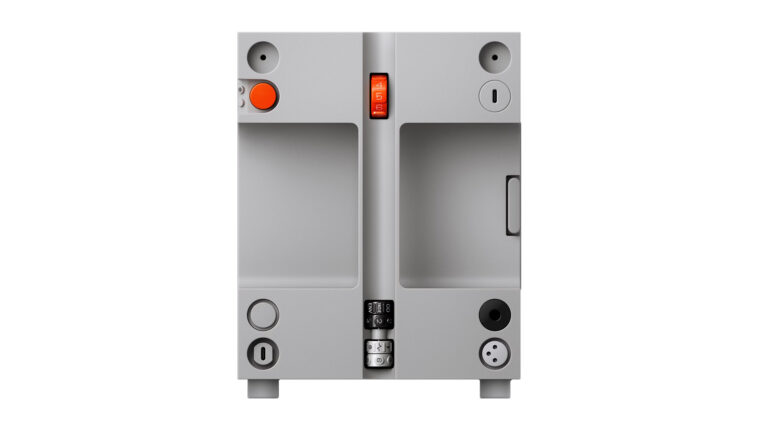
The EP-35’s sound is broadcast via a four-inch woofer and one-inch tweeter. Around back, a hatch door yields access to a storage space with room for your strap, a cable, and maybe a beverage. Here you’ll also find small knobs for guitar gain, guitar tone, mic gain, and line-in gain, plus a USB port for charging the amp, and buttons for high-gain distortion, +48V phantom power for condenser mics, and amp mute. The compartment also features a handy light that can be set to engage only when the hatch is open, to stay on while the amp is in use, or to react to the incoming signals in “disco” mode.
One of the 35’s coolest add-ons is the EP-127 K.O. — a seven-by-three-by-one-inch Bluetooth foot controller with a space-conscious dot-matrix display and two large, pressure-sensitive switches. The switches operate in four modes: FX, looper, metronome, and music playback. Depending on which guitar preset you’ve selected on the amp’s effects dial, the EP-127’s FX mode lets you use the multi-function foot switches to, say, tap in echo tempo, and manipulate the delay’s feedback parameter or the rate of a modulation effect. This is achieved by rocking the applicable switch forward or backward like you would an expression pedal. The foot switches are similarly intuitive in the EP-127’s three other modes.

After spending hours with the EP-35, I feel pretty confident in guessing that the company’s primary objective was to facilitate intuitive fun via a package that’s as portable as it is affordable. Considering that it accommodates electric, acoustic, and bass guitar, as well as vocals, for a street price of just $399, it goes without saying that there’d have to be a few compromises along the way. Probably the most obvious is the lack of tuner functionality. Another is that only selected effects can be controlled via the EP-127 foot switch.
But overall, whenever TE came to a fork in the design road, it chose ease and inspiration over complexity. For example, there’s only so much you can do with two foot switches. But who would argue that being able to tweak parameters in realtime isn’t more of a blast than dedicating the switches to tuner functionality — particularly with the ubiquity of app and headstock tuners?
The 35’s reasonable price point likewise affects the quantity and quality of sound one can reasonably expect. Between sonics, weight, and compact footprint, something’s gotta give. But again, TE did an impeccable job of balancing considerations and maximizing bang for buck. I tested the amp with a variety of electric and acoustic guitars, including a Telecaster, a Jaguar, a Les Paul Special, and a ’60s Harmony Sovereign 1203 outfitted with a Seymour Duncan SA-6 Mag Mic pickup. And from the outset, I was kind of in awe of how little I wanted to tweak things.

My solid-bodies yielded their signature sounds with minimal knob twiddling, prompting me to get caught up in the musical moment instead. TE somehow managed to pack the EP-35 with a variety of guitar sounds that are ready to go, as-is, for meat-and-potatoes playing of all sorts. (Use with an acoustic guitar and mic was trickier simply for the usual feedback battles, but this was less of an issue than you’d expect, given that the amp is not equipped with a notch filter.)
Meanwhile, the choice of effects and parameters that can be manipulated via foot switch is pretty ingenious, both for inexperienced players dipping their toes into expression-pedal territory and for seasoned players eager to embellish their sound beyond the basics. The EP-35 K.O. is quite an engineering feat and a damn good deal.

SPECIFICATIONS
CONTACT teenage.engineering
PRICE $399 street
CONTROLS Power, volume, guitar fx, guitar fx amount, mic fx, mic fx amount, mode, mic gain, guitar gain, tone, line-in gain, phantom power, hi-gain, amp light, mute.
FEATURES 1/4” instrument input, XLR input, two USB ports (one for flash-drive, one for charging), line input, line output.
SIZE 9″h x 10.6″w x 6.3″d
ASSEMBLED China
PROS Inspiringly simple design with just about everything you could want (for guitar and vocals) in a rechargeable amp. Functionality easily — and brilliantly — expandable via smart, intuitive add-ons. Nice-sounding onboard effects sans menu diving. Separate effects for vocal channel. Light (7lb.), rugged, “splash-proof” enclosure with approximately 12 hours of play per charge. Broadcast mode facilitates stereo playback or linkage of multiple EP-35s. Ability to control levels (guitar, mic, line-in, etc.) via six MIDI channels.
CONS Possibly polarizing visual aesthetic. Decently loud, but probably not enough to hang with drums. Limited ability to alter effect parameters. No tuner function. Some vocal effects are of questionable usefulness.