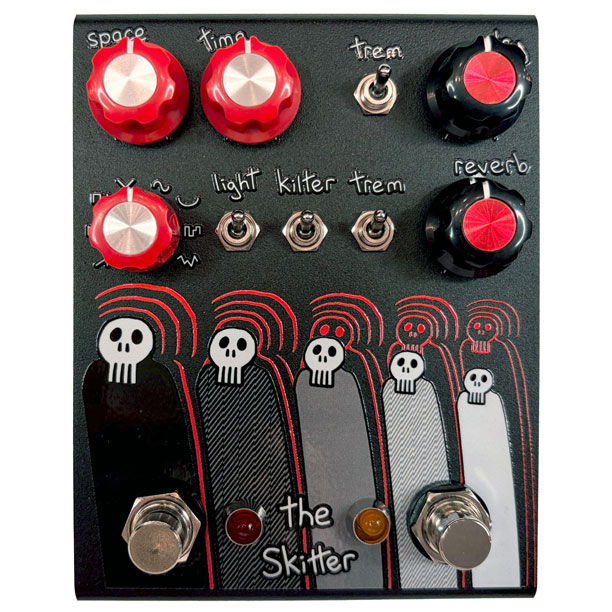
The Champion Leccy Skitter is back after a long hiatus, and Woolly at Champion Leccy didn’t just dust off the old design, upgrading it to V3.
Core concept is the same: a Belton Brick reverb with a tremolo you can route to the dry signal, the reverb, or both. Independent level controls for each path. Independent footswitches for each effect. The Light switch brightens or darkens the reverb voicing. The Kilter switch reverses the tremolo phase between dry and reverb paths so they duck in and out against each other. Space and Time control the tremolo depth and speed, and the waveform selector gives you square, triangle, and random shapes.
What’s new in V3: The power section is improved. Gain staging is cleaner. But the headline addition is phase cancellation tremolo on either the dry or reverb path. Crank the LFO speed and it turns into ring modulation. Ring mod reverb. That’s not a typo. The reverb signal gets amplitude-modulated into metallic, clangorous textures that sound nothing like a standard tremolo. It’s the kind of feature that makes you wonder why nobody thought of it sooner.
Also new: they’re in folded enclosures now. Fancy folded enclosures. The V2s were in standard boxes; the V3 gets the same treatment as the Woozy and Swan Hunter.
$265. First batch with limited edition art is on preorder now. Full relaunch hit in May 2026. 200mA on standard 9V center negative.
If you already own a V2, the ring mod trick alone might be worth the upgrade. If you don’t, this is the version to get.
—
Champion Leccy The Skitter V2
With its charming DIY graphics and creative pedal designs, Champion Leccy has slowly carved out a niche in the ever-expanding universe of pedal circuits.
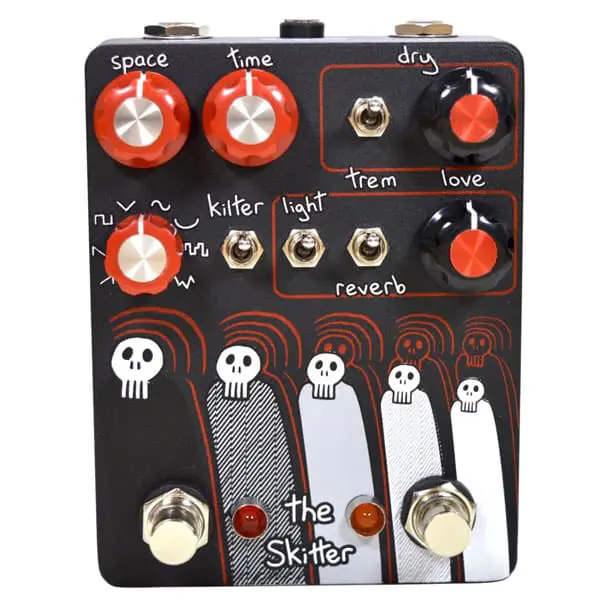
The company’s latest mode, named The Skitter, is an intriguing variation on the reverb & tremolo combo, with a unique routing section that (through the Kilter switch) lets you apply the modulation either to the wet (reverberated) or to the clean signal only.
It features eight LFO waves for the tremolo (list under the videos, in red), with the Space and Time knobs controlling, respectively, its depth and speed. The reverb is fixed in size but features a three-way toggle switch that can tame its high end for warmer, “vintagey” tones.
We added this pedal to our list of the Best Reverb-Tremolo Combo Pedals.
Here are the videos of the Champion Leccy Skitter!
The Skitter is both a reverb and a tremolo. With some fancy pants switching you can apply the tremolo in any combination to the dry and reverb signals, giving you incredibly flexible modulation options.
Controls:
Dry controls:
Love – direct signal volume.
Trem – this turns the tremolo function on/ off for the direct signal. Up is on, down is off.
Reverb controls:
Love – reverb volume
Trem – this turns the tremolo effect on/ off for your reverb signal. Up is on, down is off.
Light – this is a three way low pass filter switch for your reverb. It allows you to roll some of the treble off for darker reverb sounds.
The red knobs control the LFO:
Space – This knob controls the depth of the modulation.
Time – This knob adjusts the speed of the LFO which will make your modulations slow and elegantly undulating or frantic and trill-tastic!
The smaller red knob with the squiggly lines around it – This is the LFO waveform selector, and it’s the heart of the Skitter’s versatility. The lines may not quite match up exactly to the waveform symbols, but they’re in the right order and they shouldn’t be too far off. From left to right, the waveforms are ramp up, ramp down, square wave, triangle, sine, sweep, random (levels), random (slopes). You can see the wave form change as you turn the knob if you watch the red indicator LED. Please note that if you’ve selected one of the random waveforms, it’ll sound like the LFO isn’t taking the tap tempo/ time knob too seriously, that’s due to the random nature of the waveform.
Kilter – This switch lets you select whether the reverb tremolo is in sync with the dry tremolo or whether it mirrors it. The up position modulates both signals at the same time. Down is ‘off-kilter’. When the reverb is off-kilter, you get a swing from dry to reverb according to the selected LFO waveform. Basically the reverb gets loud when the dry signal gets quiet and vice versa.
- There are two trim pots inside the Skitter. Please don’t mess with them.