Vincent Furnier found fame as his alter ego, Alice Cooper. The rise and recurring reinvention of Cooper is one of the most storied careers in rock music, and after seven decades immersed in the highs and lows of the music industry, Furnier has finally written his memoir. But as he explains, his life story could have been much shorter.
In a key moment of Devil on My Shoulder, Furnier has Alice confront Vince over his drug and alcohol use, accusing him of indulging in his addictions in part to live up to the bad-boy reputation he had created with his stage character.
“You wanted to make people wonder, ‘Did he really sell his soul for rock and roll?’” Alice tells him. “Admit it, Vince. The myth made the man.”
In a new interview with The Telegraph, Cooper explains that his addictions were very much a product of the times.
“You have to remember the time,” Cooper explains. “It was the roaring end of the ‘60s into the ‘70s, with the sexual revolution, the drug revolution, and we were right in the middle of it.
“[Today], if you’re in a touring band, nobody gets high, nobody ever drinks, because now it’s a big business and you can’t afford to have a guy that’s doing that,” he adds. “In the ’70s, you didn’t hire the guy unless he got high, so everybody was on the same level.”
Furnier was raised a Christian. His father was an ordained minister in the Church of Jesus Christ, and Furnier went to church three times a week. His friends were Christians, too. It was the only world he knew.
But the creation of Alice Cooper drove a wedge between Furnier and the church. Songs such as “School’s Out,” “No More Mr. Nice Guy” and “Elected” cemented his status as an antiestablishment provocateur who seemed intent on corrupting the morals of the youth. Far from simply enjoying the notoriety, though, Cooper was conflicted by it.
“When I did a show, I’d feel really guilty, and when I went to church, the old ladies there would whisper and ‘tsk’ like I was a dangerous outlaw,” he recalls. “It pulled me farther away from the church.
“And it did disturb me, because I still believed in all the Christian things, but here I was, way out there now, we’re at every Hollywood party, and I’m at just that age… I became educated. And I was getting farther and farther away from the core.”
Alcohol became his greatest vice. Today, he has been sober since circa 1983, a period when his drinking nearly broke up his marriage. He credits rehab with saving him.
“I was sort of the Dean Martin of rock and roll,” he says. “I was never drunk. I was always on this golden buzz, and I knew how to keep that buzz going. The problem was it was constant. And pretty soon your body’s going to say, ‘Hey, we’re in trouble here.’ I started throwing up blood, and that’s when you know that you’re not in control.”
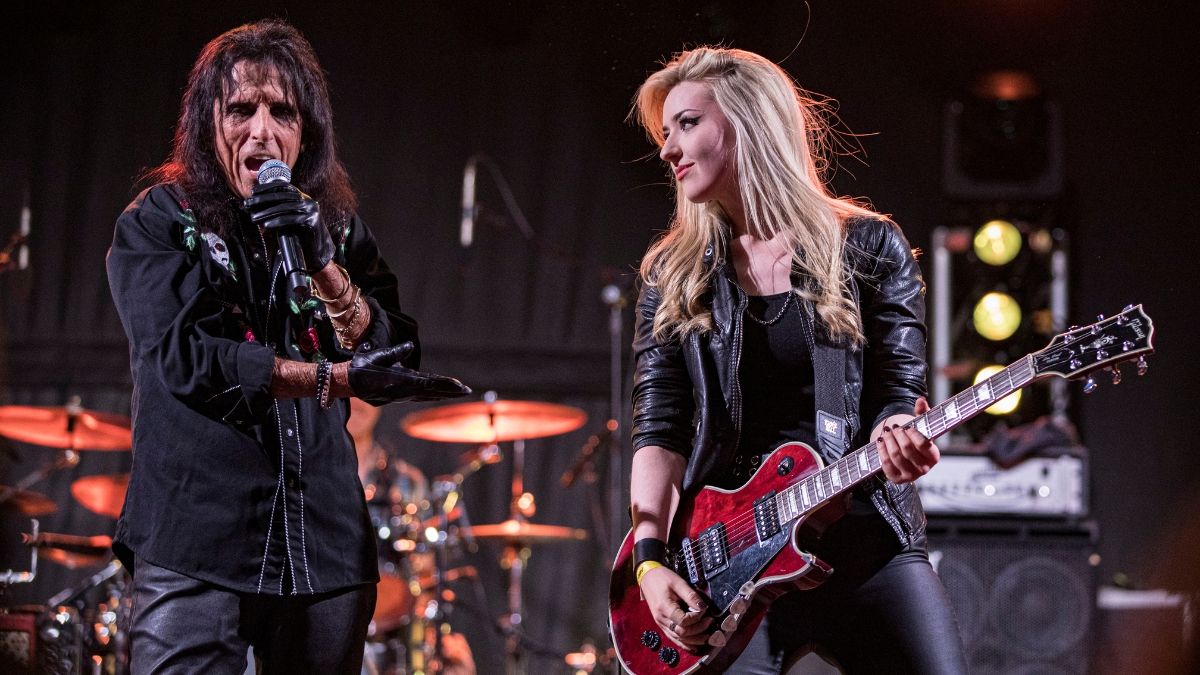
Cooper subsequently got his life and career back in order. And as his career entered its next phase, he increasingly became a champion of guitarists who needed a break. One of his most notable discoveries was Kane Roberts, a struggling young player whom Cooper brought into his band in the mid-’80s as he rebuilt his own career. Decades later, he gave another unknown young guitarist, 19-year-old Anna Cara, her first major break.
“I’m always looking for the next guitar hero,” Cooper said in 2022 (via Ultimate Guitar).
He has certainly found his share. Cooper also changed Nita Strauss’ life for the better, bringing her into his band in 2014 and helping turn her into one of the most recognizable guitarists of her generation. Strauss is set to return to the fold this fall after giving birth to her first child, having recently reinvented a Smashing Pumpkins classic on guitar for the group’s upcoming tribute album.