
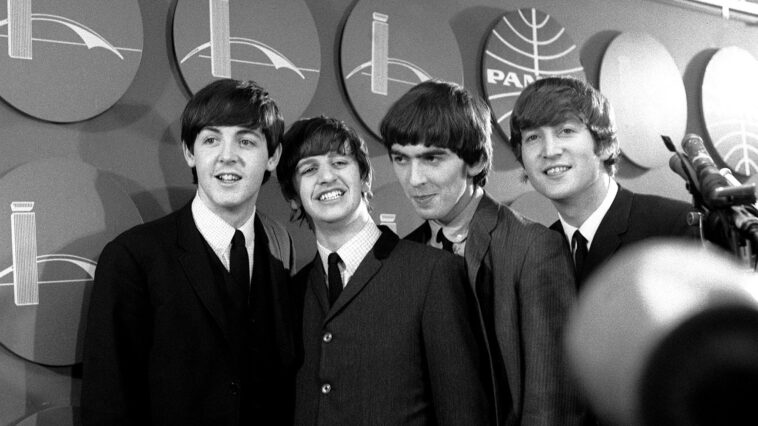
The Beatles’ business empire is about to get a new chapter.
Universal Music Group and Apple Corps have unveiled a new exclusive, long-term global partnership that will expand how The Beatles’ brand is managed and presented to fans around the world. The agreement will bring together Apple Corps’ stewardship of the Beatles’ legacy with UMG’s global expertise in music, merchandising, retail and fan experiences.
It’s a far cry from the way the Beatles’ licensing business began.
In early 1964, as Beatlemania landed in America, Beatles manager Brian Epstein was facing a problem almost no music manager had ever encountered before. U.S. companies wanted to put the Beatles’ name and image on everything they could sell.
There were offers for electric and acoustic guitars, dolls, wigs, T-shirts, clocks, games, jewelry and countless other products. Overwhelmed, Epstein told his lawyer David Jacobs to find someone who could take over the Beatles’ increasingly lucrative merchandising business.
Jacobs turned to an entrepreneur named Nicky Byrne. Byrne agreed to handle the business through two companies: Stramsact in Britain and Seltaeb — “Beatles” spelled backward — in the United States.
In return, Byrne proposed that his company would receive 90 percent of the money, leaving just 10 percent for NEMS and the Beatles.
It was a remarkable proposal. More remarkable still, Epstein accepted.
He simply had no idea how valuable the Beatles’ name was about to become in the American marketplace.

Epstein was a gifted manager with a remarkable instinct for the Beatles’ image. But his background was running his family-owned NEMS record shop in Liverpool, not international merchandising. And there was little precedent for what was happening. Even Elvis Presley had never generated a consumer frenzy on the Beatles’ scale.
Tony Bramwell, a NEMS executive, later explained that they were thinking about the arrangement much like a record deal: the company making and selling the products would do the work, while the Beatles simply collected a percentage.
“Nothing Brian. That’s your 10 percent.”
— Nicky Byrne
They were about to discover just how badly they had misjudged the market.
In February 1964, during the Beatles’ first American trip, Epstein was bombarded with samples and offers from manufacturers. He directed all of them to Byrne, who had already established himself in New York as the man handling the Beatles’ merchandising.
The money quickly began pouring in. The Reliant Shirt Corporation paid $100,000 for a license and sold more than a million Beatles T-shirts in three days. Remco Toys had made 100,000 Beatles dolls and already had orders for another 500,000. A company selling Beatles wigs was producing them faster than it could keep up with demand. Seltaeb would eventually license more than 150 different products.
Then Epstein received a check for $9,700. He was impressed, but wondered how much of that Byrne was owed.
“Nothing Brian,” Byrne replied. “That’s your 10 percent.”

in an instant, Epstein realized the colossal blunder he’d made. He had effectively handed Byrne control of a potential merchandising gold mine and kept only a fraction of the proceeds.
To his credit, Epstein ordered Jacobs to renegotiate the contract immediately. In August 1964, the Beatles’ share was raised to 49 percent.
On the business end he ripped us off on the Seltaeb thing.”
— John Lennon
But by then, the original agreement had created a much larger problem. Epstein and Byrne became embroiled in a bitter legal fight over the contract, licensing rights and money owed.
The timing was disastrous. Major American retailers that had been eager to sell Beatles merchandise suddenly faced uncertainty over who had the authority to license the band’s name. Woolworth’s, J.C. Penney and other companies cancelled or refused to finalize deals worth a reported $78 million. The legal battle dragged on for nearly three years.
By then, the Beatlemania frenzy had cooled. Estimates of the money the Beatles and NEMS lost as a result of the Seltaeb affair have reached $100 million. That figure is an estimate of potential income rather than a precise accounting, but there is little doubt that enormous sums were left on the table.
In Epstein’s defense, he had no playbook to follow. The Beatles were creating something new: a pop group whose name had become a global consumer brand almost overnight. American businesses saw the opportunity immediately. Epstein took longer to understand it.

Today, of course, the Beatles’ name is one of the most valuable brands in popular culture. Apple Corps has spent decades building systems for protecting and developing the group’s intellectual property, while UMG has become a global force in music, merchandising and brand management. The new partnership reflects how sophisticated the business surrounding the Beatles has become.
It also shows just how far the Beatles’ commercial operation has come since 1964, when their first major American merchandising deal nearly gave away the store.
Years later, John Lennon was blunt about the episode: “On the business end he [Epstein] ripped us off on the Seltaeb thing.”
But for whatever business instinct he lacked, Epstein had the gift of seeing what the Beatles could become.
The Seltaeb affair showed that seeing their potential and knowing how to turn that potential into money were two very different things.