
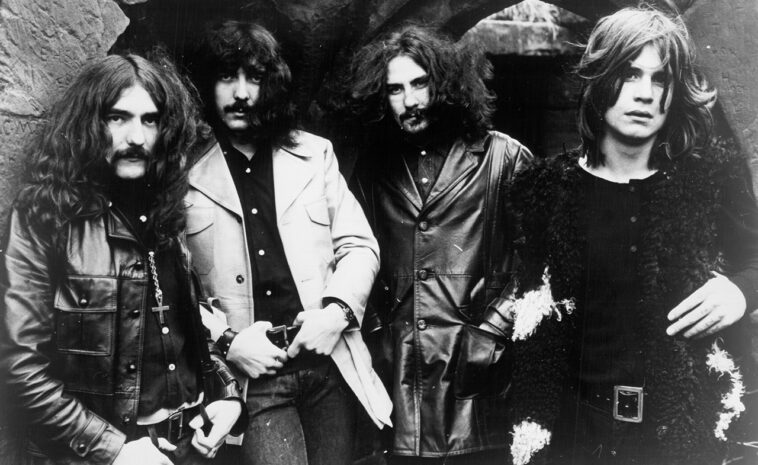
Black Sabbath’s first manager said it was important that their 1969 demo tapes be released so fans could hear the development of Tony Iommi as a world-changing guitarist.
The tracks were laid down in Birmingham during the brief period when the band called themselves Earth, with a sound that was still rooted in blues and jazz. They’d started out as the Polka Tulk Blues Band in 1968 before shortening the name to Polka Tulk, then becoming Earth. They took on their best-known name in August 1969.
Jim Simpson looked after their affairs in those early days and was instrumental in making the recordings, which he wanted to release in 2025 as Earth: The Legendary Lost Tapes. Those plans were stalled after Sharon Osbourne stepped in, and the masters have since been handed over to the band.
In an interview earlier this year (via Blabbermouth), Simpson explained what he thought had gone wrong.
“The sleeve notes, which I wrote, talked about those great days when Birmingham established itself as the U.K. home of rock and roll. And it exalted some of the names that were coming through and the people who made us famous musically.
“It ended up by saying, ‘At the end of the decade came along one band who would not only change the face of music in the U.K., but create their own style and go on to world domination.’ I didn’t mention Black Sabbath, electric guitarist Tony Iommi, bass guitarist Geezer Butler, singer Ozzy Osbourne and drummer Bill Ward. It irked somebody.”
No release plans have been revealed, although Iommi said in July 2026 that they’d appear “at some point.” Simpson said: “Right at the beginning I was told that the band didn’t want it to happen.” He went on to argue that, regardless of the musicians’ concerns, it was important for the music to be heard.

“They were a blues band when I met them,” he emphasised. “And the album’s nine tracks. It starts off with four blues tracks [and] a couple of jazz tracks, because of Tony Iommi’s love of gypsy jazz. The two jazz tracks are both called Song For Jim. One featured Tony on guitar, the other featured Tony on flute. We’d already recorded one with guitar, so we recorded it again with flute. And he did a good job.
“They all did a good job. But after the first few tracks, the remaining four tracks get towards, but never quite reach, what you know of as Black Sabbath. It slowly got heavier and heavier. It’s a historical document. Any real Black Sabbath fans will really want to hear this.”

Earlier this year, Iommi — who joined fellow flautist Ian Anderson in Jethro Tull for a few weeks in 1969 before returning to Sabbath to apply what he’d learned — said he’d enjoyed listening to the Earth recordings. “It’s weird when you hear stuff from so long ago; all these things crop up that you forgot about,” he told Rolling Stone. “I sat listening to them all, and it was good because there’s some jazzy stuff and bluesy stuff we done on them where we just used to jam. On a lot of the jams, it was all guitar, and I forgot about half of that. I can’t play that now.”