
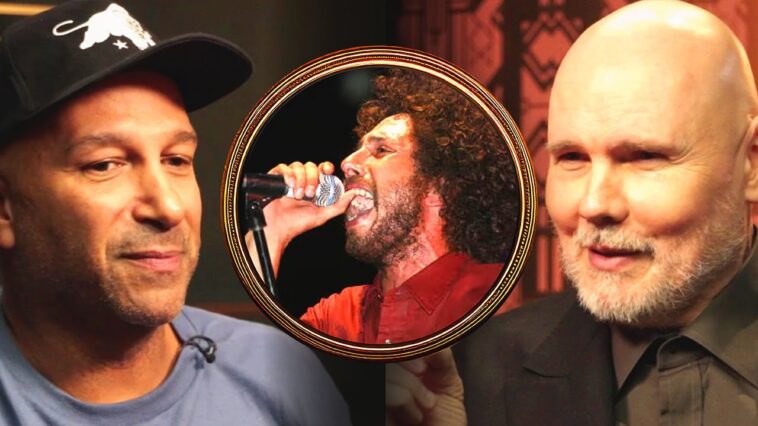
Rage Against the Machine guitarist Tom Morello has often used the phrase “punk rock guilt” to describe one of the great contradictions of the grunge explosion: musicians raised on underground, anti-establishment music suddenly found themselves at the center of the mainstream.
In a 2006 interview, Soundgarden frontman Chris Cornell suggested that the same conflict may have been part of the pressure surrounding Kurt Cobain.
Cornell was speaking while he and Morello were bandmates in Audioslave, promoting what would become the group’s third and final album, Revelations. Looking back at the grunge generation, Cornell remembered an awkward period when bands rooted in punk and underground culture were suddenly enjoying enormous commercial success.
“It felt to me like there was a definite awkward period, and what Tom Morello refers to as the ‘punk rock guilt,’” Cornell said. “This was the first generation of people who were raised on punk rock music and followed the punk rock Bible, but suddenly were having incredible commercial success.
“I think that what happened with Kurt Cobain is probably the easiest way to present that and say this was the worst example, I think, of the outcome of that kind of clash.”
Morello later explained the idea in greater detail on Billy Corgan’s The Magnificent Others podcast. He pointed to the strange musical collision at the heart of the era: bands such as Soundgarden and Nirvana could love Kiss and Black Sabbath while simultaneously embracing Minor Threat, Fugazi and Bad Brains.
That contradiction became the sound of grunge: punk’s anti-establishment attitude combined with the weight and power of heavy rock.
But once that music became hugely successful, the contradiction became personal.
“There was a real synergy of awesome kick-ass music with ideas and art and poetry,” Morello said. “But there was a part of the ethos that was ‘I can’t stand the success that is happening because it makes me feel like I’ve betrayed principles.’”
Cornell — who, like Cobain, died by suicide, in 2017 — knew the feeling firsthand.
“When you would look through a magazine and see a Soundgarden or a Pearl Jam article, and then you turn the page, and it would be an article on Great White, we started feeling a little bit uncomfortable and self-conscious,” he explained. “Like, does that make us the same thing?”
For Nirvana, that contradiction was magnified beyond anything Soundgarden experienced.
Nevermind and In Utero both topped the U.S. charts. Each sold millions of copies worldwide and inspired a new breed of alt-rock electric guitarists. Nirvana transformed from an underground band to one of the biggest acts in the world.
Cobain openly acknowledged how difficult that transformation was. Speaking to Rolling Stone in January 1994, he described Nirvana’s success as “fast and explosive.”
“I didn’t know how to deal with it,” he said. “If there was a Rock Star 101 course, I would have liked to take it. It might have helped me.”
Just three months later, he was dead.

That timing makes Cornell’s comments haunting, but it would be too simplistic to suggest that “punk rock guilt” explains Cobain’s suicide. His death was the result of deeply complicated personal circumstances, and no single cultural conflict can account for it.
What Cornell’s theory does illuminate is the strange psychological territory occupied by Cobain and his peers. They had grown up believing that authenticity meant standing outside the mainstream. Then the mainstream came looking for them.
The irony was unavoidable: the music industry didn’t destroy the underground by ignoring it. It destroyed the boundary between underground and mainstream by embracing it. For Cobain, that contradiction never seemed entirely resolved.
And perhaps that’s one reason Nirvana’s music still feels so conflicted — simultaneously triumphant and alienated, enormously popular yet deeply suspicious of its own popularity.
“Punk rock guilt” may not explain Kurt Cobain’s death. But it may help explain the world in which he was trying to survive.