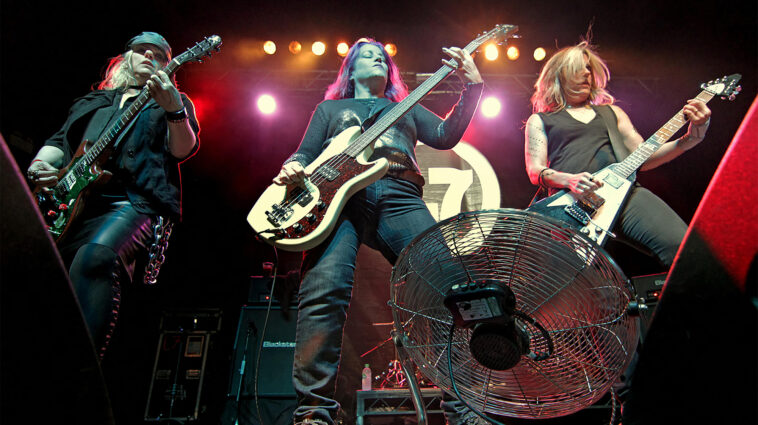
As they take their Last Hurrah Tour through North America — with Europe and Asia on tap for 2027 — L7 are discovering that parting is, indeed, sweet sorrow.
“We’re doing meet and greets on this tour, and it’s really great meeting all these fans,” says Donita Sparks, who formed the all-female alt-rock outfit with fellow singer-guitarist Suzi Gardner in 1985 in Los Angeles. “They’re just very, very sweet, and it gets emotional. One woman said we took her from puberty to menopause — wow.
“So it’s been great, wonderful. They get to tell us how they feel, and we tell them how we feel.”
But, Sparks adds, it’s not enough to change L7’s mind about packing it in, at least on the touring side.
“Oh, that’s highly doubtful,” Sparks says with a chuckle. “It’s just… time.”
L7 are certainly leaving with a legacy. The group scored with an amalgam of punk, metal, hardcore and alternative rock, with an occasional political bent to its lyrics. It had one major hit — “Pretend We’re Dead,” a top 10 Billboard Modern Rock Chart hit in 1992 — and released six albums before splitting up in 2001, then one more, Scatter the Rats, in 2019, after reforming in 2014. L7 were also a principal force behind Rock for Choice, an annual concert series from 1991 to 2001 that focused on women’s issues, and was the subject of a 2016 documentary, L7: Pretend We’re Dead.
Sparks and Gardner remain from the original lineup, while bassist Jennifer Finch passed away in July from brain cancer. That brought Janis Tanaka back for a second tenure with the group, while drummer Demetra Plakas has been part of the band since 1989. L7 may be going out, but they won’t do so quietly.
The Last Hurrah — say it ain’t so.
It is so. We reunited 11 years ago, and it was just supposed to be for, like, a year. Then people still wanted us around, so we had to make a record so we could have some fresh stuff out there, and we made a new single.
When we hit our 40th anniversary last year, we started to discuss wrapping up while we’re still on high, while we’re still loved and we’re still relevant, somehow, even 40 years later. We know what it feels like to sputter out; we did [in 2001], when the wheels fell off and that was it. It was very painful not to say goodbye to our fans.
So this is a different way to do it. And there have been some health concerns over the years. We’re not spring chickens. So it’s time.

Any second thoughts?
Oh, I don’t think so. It is really hard to say, like, “Goodbye, Cleveland… thank you for the years.” It gets heavy. It’s like, Fuck, these people have been fans for decades; or some of them are little kids and just got turned on to us, and they’re like, “Please, no, don’t break up.”
I think people are maybe a little bit starved for outspoken bands who have shit to say about the current situation, make cultural commentary, occasional political commentary, mixed with humor. I just think they’re starved for it. So for us to be saying goodbye, especially right now… it’s a weird thing. But we are.
What’s your overall feeling, or perspective, as you view an end to this road?
I feel very triumphant about our entire career. I always thought we were special. I always thought we were different. We knew we were unique. Looking back as objectively as I can, things I thought were weak spots were not — especially onstage, whether it was our playing or being in sync or in time with each other. I’ve seen live footage of us, and we were pretty fucking tight. We were, and we are, a pretty tight rock and roll band, so I look back in pride at that.
And, y’know, we gave back to the community with Rock for Choice, and we did a lot of benefits and were always outspoken, so we weren’t just these selfish rock whores who would take and take and take. We gave back, and we continue to do so.
Would I have liked it if we had been a bigger band? Absolutely. But these shows have been packed, so I feel like we’ve built an audience that cares about us and what we have to say, and that feels really good.
I would bet you five bucks most women in music really don’t care about their gender.”
— Donita Sparks
As a band of all women, for the most part, L7 broke down some barriers, especially in the hard rock world. Did you feel like pioneers at the time — or now?
Well, first of all, we did not start out to be an all-female band; we just couldn’t get guys to play with us. Our first drummer [Roy Koutsky] was a guy, and we were punk rockers doing, like, a very stripped-down metal thing. So many guys who played like that, who wanted to play metal, didn’t want to play with chicks. So we just slowly pieced the band together, and it turned out to be all female.
But we’re not hung up on being women. I would say most women in rock and roll are not hung up on being women. Maybe some pop stars are, but most women who are writing and performing and making records, they don’t give a fuck if they’re female or not, and it’s always been that way. I would bet you five bucks most women in music really don’t care about their gender.
For us, I would say the way we would describe ourselves as a band, being all female wouldn’t be the first adjective. It might be the second. I know some people would use it as the first adjective, that we’re all-female, but we wouldn’t, and we don’t.

Yet, do you feel like there are greater opportunities or more of an open door than maybe L7 had back in the mid ’80s?
I really don’t know. I’m older and considered, like, an elder spokesperson right now. We are a self-contained entity, so I don’t know what it’s like for your younger bands now. I hope for the younger bands that people don’t harp on it, the all-female thing, like they did for us.
I think sometimes when you’re a younger band, people tend to sexualize you more. We’re older, so people aren’t sexualizing us anymore. [laughs] But if you’re good-looking kids or whatever, people are just more fixated on it — the way you look, your gender, how you present yourself. But we’re kind of established, so we don’t get it as much.
The younger artists have an L7 to look up to, though. Who did you have?
The Ramones. I know you’re looking for a woman angle, but I’m telling you that’s not the case. Our favorite bands were the Ramones, the Rolling Stones. Of course we loved Blondie and Patti Smith and everyone, but it wasn’t because they were female. It was because they were great. We like greatness. It doesn’t matter if it’s a pussy or a penis, you gotta be good.
We kept it simple. We’re not hung up on technique, or what we couldn’t do. We did what we could do, and that’s what made us unique.”
— Donita Sparks
How did you and Suzi develop as a guitar tandem?
We both wanted to play rhythm and lead guitar. I would say I go for hookier stuff than she does; she likes it a little more jammy. She’s more Ozzy, I’m more Bowie; her older brother was really into hard rock, while my older sisters were into glitter rock, early punk rock, New Wave. I never had a Black Sabbath record or a Led Zeppelin record; I had other records, but she had those records.
I would say we started influencing each other as we went along. I’ve written heavy stuff and she’s written poppy stuff. Thankfully, our limited chops didn’t get us into doodley-doodley wankville.
We kept it simple. We’re not hung up on technique, or what we couldn’t do. If you’re playing scales all day long, you might start to sound like somebody else. But because of our limitations as musicians, we got into our own sound. We did what we could do, and that’s what made us unique.
We’re very different people, too. We didn’t go to school together. We weren’t big buddies or anything like that. We don’t hang out. We came together for the music. We collided on the underground scene of Los Angeles, and we both wanted to do the same thing. We were punk rockers, and we wanted to play hard rock.

You’re a Flying V girl. How did that happen?
I’ve probably got about 12 of ’em, mostly Epiphones. The first one was a rent payment from our first drummer, Roy, who was my roommate. I just thought it was very ironic for me to be playing a Flying V, because it looked so metal. And yet it was a cool look. No one was playing a V that I knew of as a punk rocker.
Then I found out later that Bob Mould played a V, but he was not on my radar at the time. That first V was in a museum in London — my fucked-up first V, covered in stickers of Elvis and Jesus, was in a museum next to Chrissie Hynde’s and Paul McCartney’s guitars, all these famous people. It’s like, “What is my piece of trash doing up there?”
But it looked cool, I have to say. It looked very punk rock. It’s currently in a case, which is also covered with stickers — and looks like a museum piece as well. People want to buy that guitar, but I’m not selling it yet.
I’m not sure I’ve processed it completely yet. When she passed, I had so many tasks to do for this tour.”
— Jennifer Finch
Is there a favorite sticker?
I’ve got Jesus. I’ve got hot-rod flames on the back, which is really bitchin’. And then I’ve got Elvis and Frankenstein on the front. All the greats, right — Frankenstein, Elvis and Jesus.
We lost Jennifer Finch a few months ago. How is that sitting as you’re out on tour?
We were all so heartbroken. Y’know, I’m not sure I’ve processed it completely yet. When she passed, I had so many tasks to do for this tour. Every day my mantra was, like, “Just move the ball forward, just move the ball forward…” Every day I was slammed.
We do mention her onstage, and we had a Jennifer moment showing some photos of her, and it was just… “We can’t do that.” It was just too heavy. I got a little verklempt. Grief hits you and you’re in front of all these people and you get tears in your eyes. It’s just too much of a bummer right now.
We do respect her and thank her every night on stage, but showing photos with her birth date and death date was crazy intense. We’ll probably do something in Los Angeles on our final show [November 14], but as a nightly, major thing, it’s not happening.

What made her so right for L7?
Her stage presence made her a great bass player. She admittedly was not very musical, and she wasn’t a bass player when she joined our band. She had a lot of chutzpah.
She learned to play bass; I taught her a bit, so did her boyfriend. I said, “Play what we’re playing,” and at first it was just a wall of sound, playing the same notes. There weren’t bass runs or anything like that. She was more of a stage presence and a hustler than a musician, but it worked for what we were doing.
She was a dynamo onstage and someone who was really driven to make the band work and get somewhere. She was very driven, and she got very far with her limited musicality — those are her words, not mine.
Bringing back Janis at least provided a degree of continuity, then.
We hadn’t been in that much contact with Janis. We had some immediate shows coming when Jennifer was still sick. She thought she was gonna make the shows, if everything went well — which it did not.
So there’s a gal named Tsuzumi Okai in L.A. She’s a piano teacher by day and rock and roll bass player by night, and I knew her. She picks things up very fast, so she covered those shows.
Then we had a very short list. I contacted Janis, and she was available and in Southern California, which was great. She’s one of us; she had been in the band before, she knows our vernacular, she’s funny, she’s a little goofy, she’s politically in tune with us. She’s a punk rocker doing all kinds of music. She plays bluegrass in a band in San Francisco. So she’s perfect, and we’re happy to have her.
You have a new song out, “Loma Linda.” Where did that come from?
“Loma Linda” was on a hard drive, and Demetra and I had recorded the basic tracks ourselves when the band was kind of in flux, and Janis came in and played bass. It was unfinished, and Dee had been bugging me to release it for years. I thought, Y’know, we’re going to be kicking off this tour with Janis back in the band, and there’s been such heaviness in losing Jennifer Finch. Why don’t we finish this single and release it with the joy of having Janis back in the band and give the fans a treat… and maybe cheer people up a little bit. So we wrote a lyric and finished it.
Are there any more things like that in the vault that might see the light of day?
Oh, I’m definitely going to release more L7 music. We have a lot of unfinished stuff on hard drives. We’ve got new songs cooking on the back burner, too.
I had a solo band, and I have unfinished tracks from that. So that’s my next project when I get home; I’m gonna do some reviewing, and even if we don’t tour, I still want to release things. People are digging “Loma Linda,” so why not finish some other things?